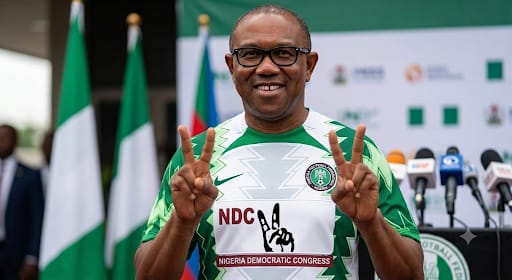
In a statement titled “A New Dimension of Toxic Politics in Nigeria,” Obi said he arrived at the airport at about 7 a.m. on Monday to board a flight to Enugu when he encountered the young footballers, who had just arrived and were preparing to leave the airport.
According to him, he was delighted to see the team and immediately asked his Protocol Officer, Jackie Wayas, to find out whether he could approach the players to congratulate and welcome them.
However, he alleged that NFF officials declined his request and warned against allowing him to interact with the team, claiming that those who permitted the encounter could lose their jobs.
Obi expressed disappointment over the incident, describing it as another example of how political differences were increasingly being allowed to interfere with ordinary social interactions and national activities.
He recalled a similar experience on March 25, 2025, when he travelled to Uyo, Akwa Ibom State, to watch a World Cup qualifying match.
According to him, the state governor warmly received him and welcomed him at the VIP stand. However, after the match, when government officials went to greet the players, he was again prevented from approaching them.
Obi said officials had given the same reason, warning that they could lose their jobs if he was allowed to interact with the players.
The former Anambra State governor described the repeated incidents as troubling, arguing that they reflected the extent to which political intolerance had permeated different aspects of Nigerian society since 2025.
He lamented that the situation appeared to be worsening rather than improving, warning that the country was increasingly being divided by unnecessary hostility and discrimination based on political affiliation.
Obi maintained that sporting activities and national institutions should serve as platforms for unity, friendship and shared national pride rather than becoming instruments of political exclusion.
He said the Nigeria the country should aspire to build must be one where citizens can relate freely, irrespective of their political beliefs or affiliations.
“The new Nigeria we aspire to build must have no room for hostility, intimidation, or discrimination, regardless of political affiliation,” he stated.
He further emphasised the need for mutual respect, tolerance and recognition of shared humanity, insisting that political disagreements should never become reasons to deny people opportunities for ordinary human interaction.
Obi concluded with his familiar message of hope, declaring that a new Nigeria is possible.
His remarks have renewed attention on concerns about political intolerance and the growing tendency to allow partisan considerations to influence interactions within public institutions and national organisations.