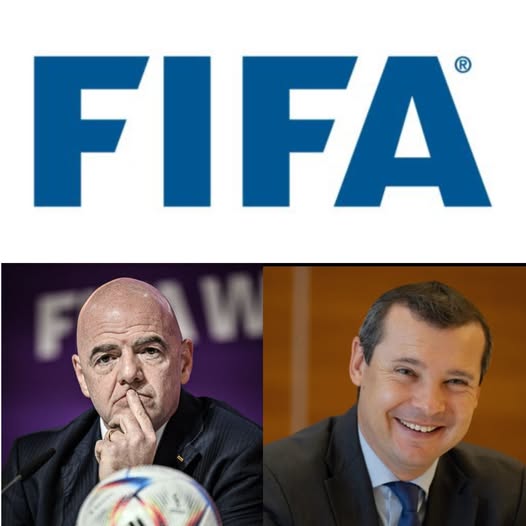
FIFA has confirmed the departure of its Chief Operating Officer, Kevin Lamour, bringing to an abrupt end the tenure of a senior executive who had been closely associated with President Gianni Infantino and the organisation’s top leadership.
FIFA announced on Monday that Lamour’s working relationship with the global football governing body ended on August 17, 2026, without providing details about the circumstances surrounding his departure.
“FIFA can confirm that the working relationship between FIFA and Kevin Lamour as FIFA’s chief operating officer has ended on 17 August 2026,” a FIFA spokesperson said.
The organisation thanked Lamour for his two years of service and wished him well in his future endeavours, but indicated that it would not provide further information about the decision.
Lamour joined FIFA’s senior leadership team in November 2024 after previously working with Infantino during his successful campaign for the FIFA presidency in 2016. His close association with the FIFA president had placed him among the organisation’s influential senior officials.
His departure, however, comes at a sensitive time for FIFA, particularly amid growing internal and external opposition to Infantino’s controversial proposal to establish a new commercial entity designed to generate additional revenue from some of the organisation’s most valuable assets.
The proposed commercial subsidiary, reportedly valued by FIFA at approximately $20 billion, was expected to offer as much as a 20 per cent stake to private equity investors. The plan could potentially raise around $4.2 billion, providing FIFA with substantial additional financial resources.
However, the proposal has faced criticism from within FIFA, with opponents raising concerns about its implications for the organisation’s governance, financial structure and the control of football’s most valuable commercial properties.
Lamour emerged as one of the most outspoken internal critics of the proposal last month. In comments that attracted considerable attention, he accused FIFA employees of being misled over the initiative and questioned the extent to which the project reflected the collective interests of the organisation.
He reportedly described the proposal as the work of “one person”, an apparent reference to Infantino.
“Our mission … is to serve football, not to serve the personal interests of a person who, unfortunately, believes he embodies FIFA when he is supposed to be at its service,” Lamour said.
His criticism represented a significant challenge from within FIFA’s senior management, particularly given his previous relationship with Infantino.
The controversy surrounding the commercial proposal intensified following the resignation of Carlos Cordeiro, another senior adviser to Infantino. Cordeiro had also expressed opposition to the plan, describing it as “a bad deal for football”.
Infantino subsequently withdrew the proposal, although the debate over FIFA’s commercial strategy and governance has continued.
Lamour’s departure therefore comes against the backdrop of disagreements over the direction of FIFA and the management of its increasingly valuable commercial interests.
The proposed commercial structure had been presented as a potential mechanism for unlocking significant value from FIFA’s global football portfolio. The organisation controls some of the most lucrative broadcasting, sponsorship and commercial rights in world sport, particularly those associated with the FIFA World Cup and other major international tournaments.
Supporters of such initiatives could argue that additional investment would enable FIFA to expand its programmes and increase funding for football development around the world. Critics, however, have raised questions about transparency, accountability and whether private investors should be given access to assets tied to the global football community.
Lamour’s departure could consequently add to scrutiny of the proposal and FIFA’s internal decision-making processes.
Despite the controversy, FIFA has provided no indication that Lamour’s exit was directly linked to his criticism of the commercial plan. The organisation’s official statement simply confirmed the termination of his working relationship and thanked him for his service.
The development is nonetheless significant because Lamour occupied a senior operational position within FIFA and had been part of Infantino’s leadership circle.
For now, FIFA has offered no details about who will succeed Lamour as chief operating officer or whether his responsibilities will be redistributed among existing senior officials.
His exit also leaves questions about the extent of internal disagreement over FIFA’s commercial ambitions and the future direction of the organisation under Infantino.
As FIFA continues to oversee the rapid commercial expansion of global football, the organisation is likely to face further scrutiny over how it balances revenue generation with governance, transparency and its stated responsibility to serve the wider interests of the sport.
Lamour’s departure marks another significant development in that debate, particularly given his previous proximity to the FIFA president and his recent criticism of one of the organisation’s most ambitious commercial proposals.