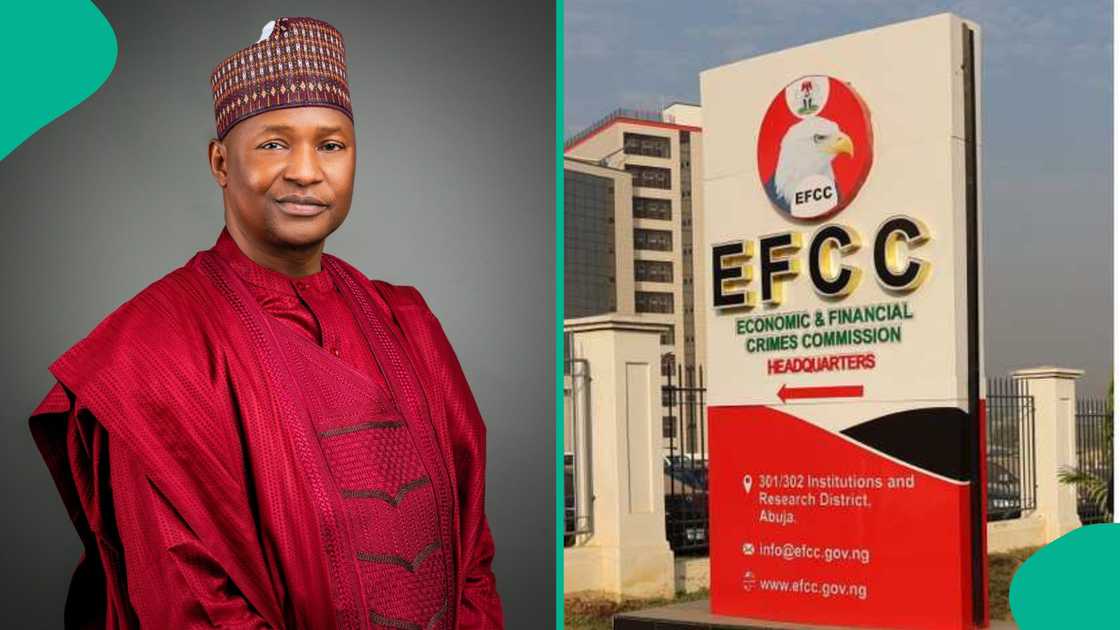
The Federal High Court in Abuja has ordered the final forfeiture of 48 properties linked to former Attorney-General of the Federation and Minister of Justice, Abubakar Malami (SAN), to the Federal Government after ruling that the assets were reasonably suspected to have been acquired through proceeds of unlawful activities.
The judgment, delivered on Wednesday by Justice Joyce Abdulmalik, marked the conclusion of a high-profile non-conviction-based asset forfeiture case instituted by the Economic and Financial Crimes Commission (EFCC). The anti-graft agency had sought the permanent forfeiture of the assets after obtaining an interim forfeiture order earlier this year.
In her ruling, Justice Abdulmalik held that the EFCC successfully established a prima facie case that the properties were proceeds of unlawful activities and that the respondents failed to demonstrate that the assets were acquired with legitimate sources of income.
The court ruled that the respondents merely asserted ownership of the properties without presenting sufficient documentary evidence to prove that the funds used to acquire them came from lawful earnings. According to the judge, ownership alone is not enough in non-conviction-based forfeiture proceedings; the law requires persons challenging such applications to establish the legitimate origin of the funds used in acquiring the assets.
Among the assets permanently forfeited are several high-value educational, hospitality, commercial and residential properties spread across Abuja, Kebbi and Kano states.
A major component of the forfeited assets is Rayhaan University in Kebbi State. The order covers the university’s permanent campus, temporary campus, third campus, the Vice Chancellor’s official residence and Rayhaan Radio located along the Sani Abacha Bypass in Birnin Kebbi.
The court also ordered the forfeiture of several luxury hotels, including Meethaq Hotels in Jabi and Maitama, Abuja. The Jabi facility comprises a five-storey building with 53 rooms and suites, while the Maitama property contains 15 guest rooms. Another notable property forfeited is the former Harmonia Hotels Limited located at No. 3 Onitsha Crescent, Area 11, Garki, Abuja.
Also included in the forfeiture order is a luxury duplex situated on Amazon Street in Maitama District, Abuja, as well as multiple residential developments in Asokoro, Gwarimpa, Wuse II, Karsana District and Apo Legislative Quarters within the Federal Capital Territory.
Other residential assets affected by the judgment include houses in Kaduna and Kano States, commercial properties in Wuse II, Abuja, and several warehouse facilities located in Wuse Market.
The court further ordered the forfeiture of extensive landed properties, including two separate 100-hectare parcels of land located along the Birnin Kebbi–Jega Road, as well as a commercial plaza near Birnin Kebbi Market equipped with warehouse facilities, public conveniences and laundry services.
Justice Abdulmalik also approved the permanent forfeiture of assets belonging to Rayhaan Agro Allied Factory in Kebbi State. These include the factory buildings, industrial machines, processing plants, staff quarters, factory mosque and the Rayhaan Bustan Building.
Similarly, the court ordered the forfeiture of properties associated with Azbir Arena in Kebbi State. The assets include Azbir Hotel, a printing press, event gallery, gardens, mosque, clothing business and pharmacy/supermarket.
Other forfeited assets include the Al-Afiya Energy tanker garage located opposite the Rayhaan University Health Centre along the Sani Abacha Bypass, a security facility identified as Rayhaan Security House, an uncompleted two-storey shopping plaza opposite the Central Motor Park in Birnin Kebbi, and an Amasdul Oil and Gas filling station situated near Jambali Automobile Workshop.
In Kano State, the forfeiture order extends to the assets of Zeennoor Hotel, a 131-room hospitality facility located in Kabuga Satellite Town along Gwarzo Road. The order also covers the Zeennoor Mosque and the old Zeennoor Hotel building within the same vicinity.
Additional assets forfeited include several properties acquired through Khadimiyya for Justice and Development Initiative within the Academic Garden City in Birnin Kebbi. These comprise nine units of three-bedroom bungalows, three units of two-bedroom bungalows and approximately 5.4 hectares of land purchased through the Federal Housing Authority Mortgage Scheme.
Commercial outlets also affected include shops at Citiscape-Shariff Plaza, Vegas Mall, Wuse Market, and numerous residential and commercial buildings spread across Abuja, Kano and Kebbi States.
The EFCC had initially secured an interim forfeiture order on January 6, 2026, when Justice Emeka Nwite granted the agency’s ex parte application filed by senior counsel Ekele Iheanacho (SAN).
Following the interim order, the Commission published notices in national newspapers inviting anyone with an interest in the properties to appear before the court and show cause why the assets should not be permanently forfeited to the Federal Government.
In response, Malami and 14 other individuals, including members of his family and associates, challenged both the interim forfeiture order and the jurisdiction of the court. They urged the court to dismiss the EFCC’s application and set aside the interim order, arguing that the assets were lawfully acquired.
The matter was argued before Justice Abdulmalik on May 27, 2026, after which judgment was reserved.
Delivering the final verdict, the judge dismissed the objections raised by the respondents, holding that they failed to discharge the evidential burden imposed by law.
Justice Abdulmalik explained that in non-conviction-based asset forfeiture proceedings, the responsibility shifts to those claiming ownership of the affected assets to demonstrate, with credible evidence, that the properties were acquired through legitimate income.
According to the court, the respondents failed to produce satisfactory evidence establishing lawful sources of the funds used in acquiring the 48 properties.
The court therefore granted the EFCC’s application and ordered that all the listed assets be finally forfeited to the Federal Government of Nigeria.
The judgment represents one of the most extensive non-conviction-based asset forfeiture orders secured by the EFCC in recent years, involving educational institutions, hotels, commercial enterprises, industrial facilities, residential developments and vast landed properties across multiple states. The ruling also reinforces the legal principle that claimants seeking to recover assets under forfeiture proceedings must provide verifiable evidence of legitimate acquisition rather than rely solely on claims of ownership.