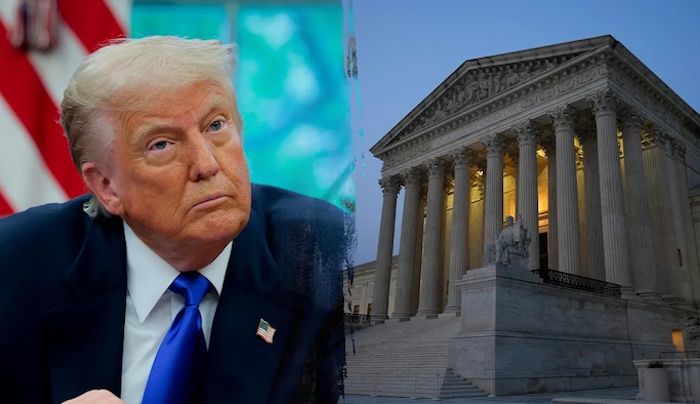
The United States Supreme Court has dealt a significant legal and political blow to President Donald Trump, striking down his executive order seeking to end birthright citizenship for children born in the United States to parents who are either undocumented immigrants or temporarily residing in the country.
In a landmark 6-3 ruling delivered on Tuesday, June 30, the nation’s highest court held that the executive order is inconsistent with the U.S. Constitution, reaffirming that children born on American soil are entitled to citizenship regardless of the immigration status of their parents.
The decision marks one of the most consequential constitutional rulings in recent years and represents a major defeat for President Trump, who has long made immigration reform and the abolition of birthright citizenship central pillars of his political agenda.
Delivering the opinion of the court in Trump v. Barbara, Chief Justice John Roberts concluded that the president’s executive order could not be reconciled with the Citizenship Clause of the Fourteenth Amendment to the Constitution, which guarantees citizenship to nearly everyone born within the territorial boundaries of the United States.
The constitutional provision states that “all persons born or naturalized in the United States, and subject to the jurisdiction thereof, are citizens of the United States.”
According to Chief Justice Roberts, children born in the United States to parents who are either unlawfully present or temporarily residing in the country satisfy both constitutional requirements contained in the Citizenship Clause.
Writing for the majority, Roberts emphasized that such children are born within the United States and are subject to its laws and jurisdiction from birth.
“The children born of parents unlawfully or temporarily present in the United States satisfy both elements of the Citizenship Clause,” Roberts wrote.
“Under the Constitution, they are citizens at birth.”
The ruling effectively prevents the federal government from implementing Trump’s executive order and preserves the long-established constitutional principle of birthright citizenship that has existed in the United States for more than 150 years.
The legal challenge arose after President Trump signed the executive order on January 20, 2025, only hours after taking the oath of office for his second presidential term.
The order directed federal agencies to deny automatic citizenship to children born in the United States if neither parent was an American citizen or lawful permanent resident.
Specifically, the administration sought to exclude children born to undocumented immigrants as well as those whose parents were temporarily in the country on visas or other short-term immigration status.
The executive order immediately attracted widespread legal challenges from civil rights organizations, immigrant advocacy groups, constitutional scholars, state governments and affected families.
Opponents argued that the policy directly violated the Fourteenth Amendment, which has consistently been interpreted by courts to guarantee citizenship to nearly every child born on American soil.
Federal district courts across the country quickly blocked implementation of the executive order, concluding that it was inconsistent with the Constitution.
Those rulings were later upheld by appellate courts, setting the stage for the Supreme Court to resolve the dispute.
In Tuesday’s decision, the Supreme Court agreed with the conclusions reached by the lower courts, affirming that the president cannot alter constitutional guarantees through executive action.
Chief Justice Roberts devoted a significant portion of the majority opinion to the historical origins of the Fourteenth Amendment.
He explained that the amendment was adopted in the aftermath of the American Civil War to settle longstanding questions surrounding citizenship, particularly for formerly enslaved African Americans born in the United States.
According to Roberts, the framers of the amendment intended to establish a broad and enduring guarantee of citizenship that would not depend on race, ancestry or the legal status of one’s parents.
“Citizenship, then and now, was the right to have rights—to freely participate in our political community,” Roberts wrote.
“The Framers of the Fourteenth Amendment extended that promise to ‘every free-born person in this land.'”
“We keep that promise today.”
The majority ruling was welcomed by immigration advocates and constitutional experts, many of whom argued that the decision preserves one of the most fundamental protections contained in the U.S. Constitution.
Legal scholars noted that birthright citizenship has been recognized for generations and has served as a cornerstone of American constitutional law.
However, the ruling drew strong opposition from the court’s conservative minority.
Justice Samuel Alito, writing in dissent, described the decision as both historically significant and legally flawed.
He characterized the ruling as “one of the most important decisions in the history of the Court,” while simultaneously calling it “a serious mistake.”
According to Alito, a careful reading of the Fourteenth Amendment suggests that citizenship should be limited to children who owe complete allegiance to the United States at birth.
“Careful analysis of the text of the Fourteenth Amendment and the process that led to its adoption shows that it does not degrade the concept of United States citizenship in this way,” Alito wrote.
“Instead, the Fourteenth Amendment confers citizenship on only those children who, at birth, owe allegiance solely to this country.”
The dissent reflects a long-standing conservative argument that the phrase “subject to the jurisdiction thereof” should be interpreted more narrowly than it has been under existing constitutional precedent.
President Trump has repeatedly argued that birthright citizenship encourages illegal immigration and creates incentives for individuals to enter the United States unlawfully in order to secure citizenship for their children.
Throughout both his presidential campaigns and his time in office, Trump pledged to eliminate what he described as an abuse of America’s immigration system.
His January 2025 executive order represented the most significant attempt by any modern American president to alter the country’s citizenship policy without seeking a constitutional amendment.
Tuesday’s judgment effectively ends that effort, at least for the foreseeable future.
Legal analysts say the ruling reinforces the principle that constitutional rights cannot be modified through executive orders and that any fundamental change to birthright citizenship would require either a constitutional amendment or a reversal of long-standing constitutional interpretation by the Supreme Court.
The decision is expected to have far-reaching implications for immigration policy, constitutional law and future presidential authority.
By reaffirming the protections of the Fourteenth Amendment, the Supreme Court has preserved automatic citizenship for children born in the United States irrespective of their parents’ immigration status, maintaining a constitutional principle that has defined American citizenship since the Reconstruction era.
The ruling also serves as a powerful reminder of the judiciary’s role in interpreting the Constitution and acting as a check on executive authority, ensuring that constitutional guarantees remain protected regardless of changing political priorities or administrations.