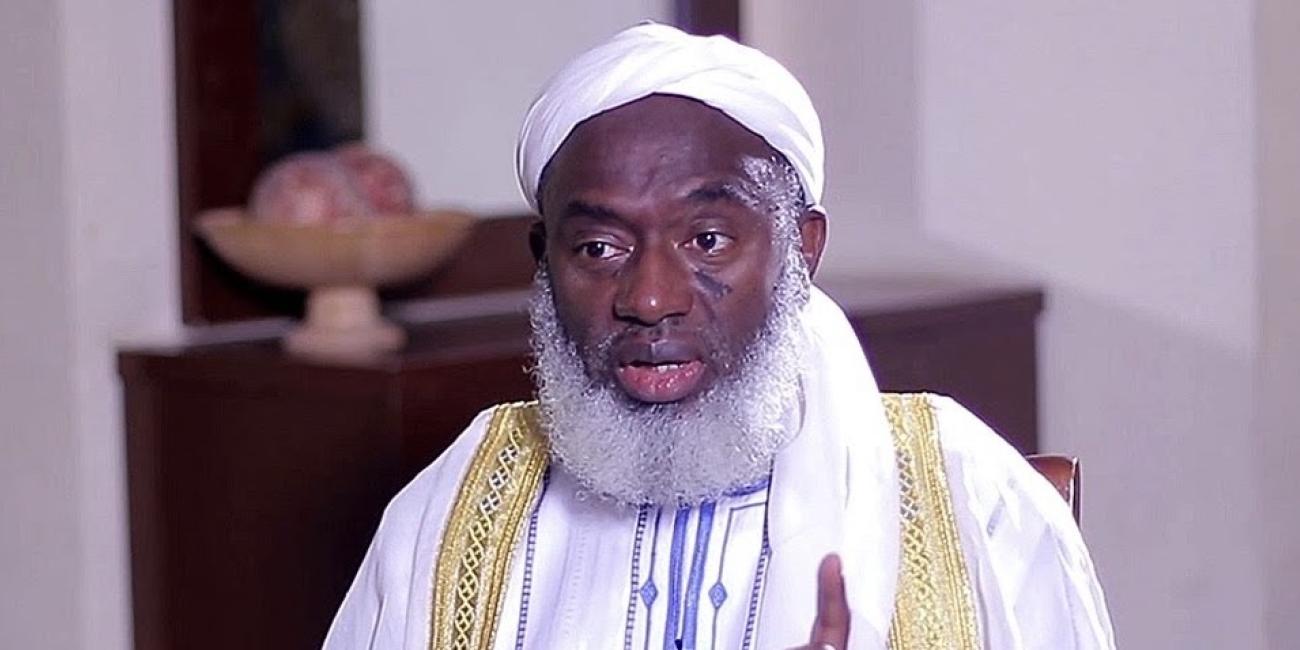
Islamic cleric, Sheikh Abubakar Gumi, has cautioned against any form of foreign military involvement in Nigeria’s fight against terrorism, warning that such intervention could worsen insecurity and expose the country to greater threats from international extremist groups.
Gumi, in a statement posted on his Facebook page on Monday, insisted that Nigeria must protect its sovereignty and avoid relying on external forces to address its security challenges.
According to the cleric, allowing foreign military powers to play a direct role in Nigeria’s counterterrorism efforts could transform the country into a new operational base for global terrorist organisations.
“Nigeria’s sovereignty is a red line,” Gumi declared, warning against what he described as growing calls by some individuals for foreign intervention in the country’s security affairs.
The controversial cleric, who has often advocated dialogue and non-kinetic approaches in addressing insecurity, dismissed claims that the Nigerian military had at any point suspended operations against terrorists under the guise of amnesty arrangements.
“As a peace advocate, I am stunned by some remarks from ignorance that the military was or is prevented from engaging bandits or Boko Haram. This claim is false and malicious,” he said.
Gumi explained that the only significant amnesty programme officially implemented in Nigeria was the Niger Delta Amnesty Programme introduced during the administration of late President Umaru Musa Yar’Adua for militants operating in the oil-rich Niger Delta region.
“Never for one second has the military halted hostilities in the name of Amnesty against unrepentant terrorists except the Niger Delta militants who got a blanket Amnesty from Yar’Adua of blessed memory,” he stated.
Reflecting on the prolonged insurgency in Nigeria, Gumi lamented that Boko Haram has remained active nearly 17 years after the extrajudicial killing of its founder, Mohammed Yusuf, in 2009.
According to him, despite years of military operations, the insurgent group continues to inflict heavy casualties on both civilians and security personnel across parts of the country.
“Today, almost 17 years since 2009 when Muhammad Yusuf was summarily executed extra-judicially, Boko Haram has remained a thorn in the throat of Nigerians, killing high-ranking officers,” he said.
The cleric argued that the continued insecurity was partly caused by what he described as shortcomings in the implementation of military operations and alleged abuses against innocent civilians.
He maintained that excessive use of force and violations against non-combatants had undermined public trust and weakened the effectiveness of the counterterrorism campaign.
“The gross failure of the kinetic approach is chiefly attributed to the morality of our fighting force. Until innocent people are safe from our excesses in the application of the kinetic approach and our hands are not stained with the blood of innocent people, the war is going to erode our sovereignty, which it has already,” Gumi stated.
He, however, expressed confidence that the Nigerian military possesses the capacity to overcome the country’s security challenges if operations are conducted professionally and transparently.
According to him, success in the fight against insurgency depends on fairness, discipline and accountability in both military operations and the management of resources allocated for the war effort.
“The military can handle the situation if the rules of engagement are free from prejudices and deception, both in the application of force and finances,” he added.
Gumi also strongly opposed suggestions that the United States or other foreign countries should become directly involved in military operations against terrorists in Nigeria.
He warned that such involvement could attract international terror networks seeking to confront Western powers on Nigerian soil.
“The involvement of the USA will only attract the international terror groups to the ‘new arena,’ exposing Nigeria to an unnecessary increase in violence, in which these same foreign forces are complicit,” he warned.
The cleric referenced allegations involving former American diplomat Russell Hanks, questioning why the diplomat allegedly declined to comment on accusations surrounding the 1995 bombing of a bookshop at Durbar Hotel in Kaduna.
He also cited comments reportedly made by United States Congressman Scott Perry, who alleged in February 2025 that the United States Agency for International Development had inadvertently funded terrorist organisations, including Boko Haram, ISIS and Al-Qaeda.
“U.S. Congressman Scott Perry, a Republican representing Pennsylvania, alleged in February 2025 that the United States Agency for International Development (USAID) had inadvertently provided funding to terrorist organizations, including Boko Haram, ISIS, and Al-Qaeda,” Gumi said.
The Islamic cleric further criticised Nigerians advocating foreign intervention, accusing some citizens of displaying what he termed a “slave mentality” by being willing to surrender the country’s sovereignty to outside powers.
“Nigerians, especially a section of them, are not just gullible but have a slave mentality ever ready to hand over the sovereignty of our dear nation to foreign interests. We have to resist foreign subjugation and disgrace,” he stated.
Gumi concluded by urging Nigerians to remain united and support the country’s armed forces in tackling insecurity without external domination.
His comments come amid recent reports of increased collaboration between Nigerian and United States security forces in counterterrorism operations.
Over the weekend, the Defence Headquarters confirmed the killing of Abu-Bilal al-Minuki, described as a senior ISIS commander and one of the world’s most wanted terrorists, during a joint operation involving Nigerian and American forces.
According to the military, al-Minuki was linked to several deadly terrorist activities, including the infamous abduction of more than 100 schoolgirls from Dapchi in Yobe State, among them Leah Sharibu, who remains in captivity.
United States President Donald Trump had also announced that American and Nigerian troops jointly carried out the operation that eliminated the ISIS commander, whom he described as the terrorist group’s second-in-command globally.
The development has sparked renewed debate over the role of foreign military cooperation in Nigeria’s counterterrorism operations, with opinions sharply divided between those advocating international support and others, like Gumi, warning against external interference.