The National Publicity Secretary of the faction of the Peoples Democratic Party (PDP) aligned with Kabiru Turaki, Ini Ememobong, has defended recent remarks by Oyo State Governor, Seyi Makinde, which referenced the historical “Operation Wetie,” insisting that the statement was intended as a warning drawn from history rather than an incitement to violence.
Ememobong made the clarification while appearing on The Morning Brief, a current affairs programme on Channels Television, where he addressed the controversy that has followed the governor’s comments. According to him, the reactions from critics—particularly members of the ruling All Progressives Congress (APC)—reflect a misreading of Makinde’s intent and a broader tendency to politicise historical references.
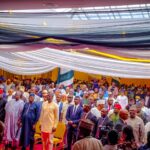
The controversy stems from remarks made by Makinde during a high-profile gathering of opposition political leaders in Ibadan, the Oyo State capital. At the event, the governor cautioned against what he described as emerging threats to Nigeria’s multiparty democracy. In doing so, he invoked the memory of “Operation Wetie,” a period of intense political violence in Nigeria’s Western Region during the mid-1960s.
Makinde had stated, “For those who are carrying on as if there is no tomorrow, they should remember that ‘Operation Wetie’ started from here. This is the same Wild Wild West.” The statement quickly drew criticism from the APC, whose National Publicity Secretary, Felix Morka, described the comment as reckless and potentially dangerous in a fragile political climate.
However, Ememobong rejected that interpretation, arguing that the governor’s remarks were grounded in historical consciousness and meant to serve as a cautionary signal to political actors. He stressed that referencing past crises should not automatically be equated with endorsing or promoting conflict.
“Everyone should commend Governor Seyi Makinde for reminding us of the circumstances and the consequences,” Ememobong said during the interview. “What is the essence of history if it does not teach? Those who neglect history are often doomed to repeat it.”
“Operation Wetie” refers to a notorious episode of political unrest that engulfed Nigeria’s Western Region, particularly Ibadan, following the disputed 1965 elections. The crisis was marked by widespread violence, arson, and breakdown of law and order, eventually contributing to the collapse of Nigeria’s First Republic and paving the way for military intervention in 1966. By invoking this historical moment, Ememobong argued, Makinde was highlighting the dangers of escalating political tensions and urging restraint among contemporary actors.
According to the PDP spokesman, the governor’s intention was to draw parallels between past and present political developments, not to suggest a repeat of violent confrontations. He likened the remark to a warning sign—something designed to alert rather than provoke.
“It is not a call to re-enact ‘Operation Wetie,’” he explained. “It is a reminder, a cautionary sign. Just like you have guardrails and signs warning you of danger ahead, that is what the governor was doing—alerting the nation to the risks of political excesses.”
Ememobong also addressed concerns that Makinde’s statement might reflect a “do-or-die” approach to politics, a phrase often associated with electoral desperation in Nigeria. He firmly dismissed such suggestions, maintaining that the opposition’s focus extends beyond electoral victory to the broader goal of preserving democratic norms and institutions.
He accused the ruling APC of contributing to an environment of political tension through actions that, in his view, undermine opposition parties and weaken democratic competition. While he did not provide specific examples during the interview, he suggested that recent developments in the political landscape point to a pattern that should concern all stakeholders.
“The responsibility of preserving democracy does not lie with one party alone,” Ememobong said. “When opposition voices are weakened or marginalised, it creates an imbalance that can ultimately harm the democratic system as a whole.”
The PDP chieftain further revealed that recent engagements among opposition leaders, including the Ibadan summit where Makinde spoke, are part of ongoing efforts to strengthen collaboration and prevent the emergence of a one-party state. According to him, these discussions are still evolving but could result in a more coordinated strategy ahead of the 2027 general elections.
He hinted at the possibility of a united opposition front, including the potential adoption of a single presidential candidate to challenge the ruling party. Such a move, he noted, would be driven by the need to consolidate votes and present a viable alternative to Nigerians.
“These conversations are ongoing,” he said. “The ultimate objective is to ensure that democracy remains vibrant and competitive. If that requires greater cooperation among opposition parties, then it is something worth considering.”
Despite the controversy, Ememobong insisted that public discourse should focus on the substance of the issues raised rather than the rhetoric surrounding them. He urged political actors and commentators to engage more thoughtfully with historical references, recognising their value in shaping national consciousness.
The debate over Makinde’s remarks underscores the sensitivity of political language in Nigeria, where historical memories of conflict remain vivid. While some view such references as necessary reminders of the consequences of political instability, others see them as potentially inflammatory in a tense environment.
For Ememobong and his allies, however, the priority is clear: to ensure that lessons from the past are not forgotten, and that Nigeria’s democratic journey is guided by both reflection and responsibility.