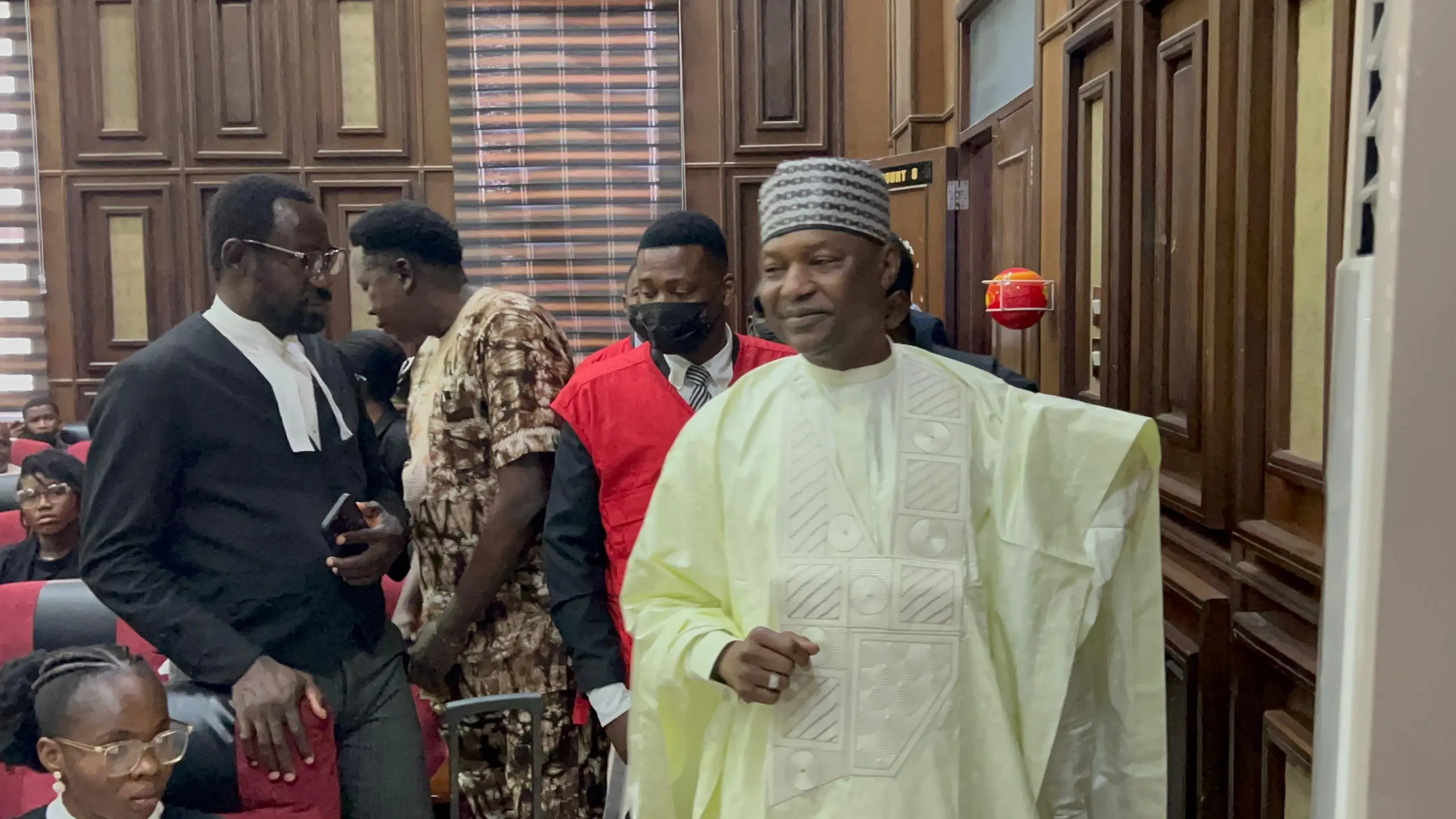
The Economic and Financial Crimes Commission (EFCC) has approached the Federal High Court in Abuja, urging it to grant a final order for the forfeiture of 57 properties allegedly linked to former Attorney General of the Federation and Minister of Justice, Abubakar Malami.
In a motion filed before the court, the anti-graft agency argued that the properties in question are reasonably suspected to have been acquired through unlawful means and should therefore be permanently forfeited to the Federal Government. The case, marked FHC/ABJ/CS/20/2026, is being heard by Justice Joyce Abdulmalik.
The EFCC’s legal team, led by Senior Advocates of Nigeria, Jibrin Okutepa and Ekele Iheanacho, told the court that the respondents—including Malami, his associate Hajia Bashir Asabe, and Abiru’ Rahman Abubakar Malami, alongside several companies—had failed to provide sufficient justification to overturn an earlier interim forfeiture order.
According to the commission, the application is based on provisions of the Advance Fee Fraud and Other Fraud-Related Offences Act, 2006, which empowers the court to order the forfeiture of assets suspected to be proceeds of crime, even in the absence of a criminal conviction. This type of legal action, known as non-conviction-based forfeiture, allows authorities to recover assets believed to have been unlawfully acquired without waiting for the conclusion of a criminal trial.
Presenting the EFCC’s argument, Okutepa noted that the court had already granted an interim forfeiture order and that the directive was duly published in a national newspaper, giving interested parties the opportunity to contest it. However, he maintained that no convincing evidence had been presented to justify setting aside that order.
“This honourable court made an interim order forfeiting the properties to the Federal Government of Nigeria, and the order was published as required. No sufficient cause has been shown why the properties should not now be finally forfeited,” he argued.
The EFCC’s case is supported by an affidavit sworn by one of its investigators, Daniel Adebayo, who detailed the findings of a wide-ranging investigation into the former minister’s financial activities.
According to Adebayo, the commission received multiple petitions alleging corruption, abuse of office, and fraud involving Malami. These allegations prompted a comprehensive probe that included the review of financial records from commercial banks and the Central Bank of Nigeria, as well as data from key government agencies such as the Corporate Affairs Commission, the Federal Inland Revenue Service, the Code of Conduct Bureau, and the Abuja Geographical Information System.
Investigators also extended their inquiries to land registries in Kebbi, Sokoto, and Kano states, while conducting physical verification and valuation of the properties. Individuals connected to the transactions were invited for questioning as part of the process.
A key element of the EFCC’s argument is the claim that the value of the assets is grossly disproportionate to Malami’s known and declared sources of income while in public office. According to the affidavit, Malami served as Attorney General from 2015 to 2023, earning a total salary of about N89.6 million during that period, with an average monthly income of roughly N962,000.
In addition to his salary, he reportedly received a severance package of over N12 million at the end of his tenure, as well as estacode allowances for official foreign trips. The total amount declared for such travel allowances between 2015 and 2023 stood at approximately N253.6 million, as indicated in documents submitted to the Code of Conduct Bureau.
Despite these earnings, the EFCC contends that they do not justify the scale and value of the properties under investigation. The assets, estimated at about N213.2 billion, are spread across Abuja, Kebbi, Kano, and Kaduna states, and include properties allegedly linked to Rayhaan University in Kebbi.
The commission further alleged that some of the properties were acquired through proxies and corporate entities connected to the former minister, a method it claims was used to conceal the true ownership and origin of the funds.
Additionally, Adebayo stated that several of the structures—particularly those located in Kano and Kebbi—were built without obtaining the necessary approvals or building permits from relevant authorities. This, he suggested, was part of a broader scheme to disguise the unlawful origin of the funds used in acquiring and developing the properties.
The current legal proceedings follow an earlier ruling delivered on January 8, 2026, by Justice Emeka Nwite of the Federal High Court in Abuja. In that ruling, the court granted an interim forfeiture order after considering an ex parte application filed by the EFCC.
The order directed that the 57 properties be temporarily forfeited to the Federal Government and instructed the commission to publish the decision in a national newspaper. This was to allow any interested parties a 14-day window to come forward and show cause why the assets should not be permanently seized.
Following that development, Malami and other respondents challenged the interim forfeiture, asking the court to set it aside. Their legal challenge forms part of the ongoing proceedings, which will determine the final status of the assets.
Justice Abdulmalik has now fixed April 21 for the hearing of the EFCC’s motion seeking final forfeiture.
The case has drawn significant public attention, given Malami’s former role as the nation’s chief law officer and the scale of the assets involved. It also highlights the increasing use of non-conviction-based asset recovery mechanisms by anti-corruption agencies in Nigeria.
As the matter proceeds, the court’s decision will likely have far-reaching implications—not only for the parties involved but also for broader efforts to strengthen accountability and transparency in public office.