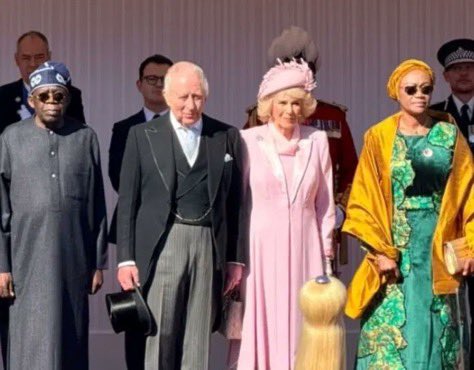
In a moment rich with diplomatic symbolism and historic resonance, King Charles III and Queen Camilla formally welcomed President Bola Ahmed Tinubu and Nigeria’s First Lady, Senator Oluremi Tinubu, to Windsor Castle as part of the Nigerian leader’s state visit to the United Kingdom.
The ceremonial reception, held within the majestic grounds of Windsor Castle in Berkshire, underscored the enduring ties between Nigeria and the United Kingdom—two nations bound by history, shared democratic traditions, and expanding economic and cultural partnerships.
Related posts:
- Kio Amachree Urges King Charles III to Cancel Proposed State Visit of President Tinubu
- Nigerian Defence Intelligence detains Brigadier-General, 15 others over alleged coup plot against President Bola Tinubu
- Backlash Over Interaction With Adeleke at Ooni’s Event ‘Needless Controversy’ – First Lady Oluremi Tinubu
- US Airstrikes a ‘Blessing’ for Nigeria, Says First Lady Oluremi Tinubu as Abuja Signals Deeper Security Cooperation with Washington
Windsor Castle, the oldest and largest occupied castle in the world, has long served as a venue for high-level state engagements. Hosting President Tinubu at this iconic royal residence marked a significant diplomatic gesture, reflecting the importance Britain attaches to its relationship with Nigeria, Africa’s most populous nation and one of its largest economies.
The arrival ceremony was conducted with traditional royal protocol. President Tinubu and First Lady Oluremi Tinubu were received with full honours, including a guard of honour and the formal exchange of courtesies between the two heads of state. The atmosphere combined regal pageantry with the warmth of Commonwealth camaraderie.
This marks a notable milestone in Nigeria-UK relations, as it is one of the rare occasions a Nigerian leader has been hosted at Windsor Castle for a state visit of this magnitude.
The state visit is expected to deepen cooperation across several key sectors, including trade and investment, security collaboration, climate change, education, and technological innovation.
Nigeria and the United Kingdom share extensive economic ties, with the UK being one of Nigeria’s leading trading partners and home to a vibrant Nigerian diaspora community. The discussions during the visit are anticipated to focus on expanding British investment in Nigeria’s infrastructure, energy transition initiatives, and digital economy.
Security cooperation is also high on the agenda, particularly in areas relating to counterterrorism, regional stability in West Africa, and maritime security in the Gulf of Guinea.
Climate action and sustainable development are additional areas of mutual interest. Both countries have committed to global climate goals, and the visit provides an opportunity to align strategies on renewable energy development, environmental sustainability, and green financing.
Beyond politics and economics, the reception at Windsor Castle symbolised the cultural and historical connections between the two nations. Nigeria, as a prominent member of the Commonwealth, continues to play an influential role within the association of nations.
King Charles III, who has consistently emphasised unity within the Commonwealth, has often spoken about strengthening partnerships with African countries. Nigeria’s strategic importance within the Commonwealth framework makes this engagement particularly significant.
The presence of First Lady Senator Oluremi Tinubu added a further dimension to the visit. Known for her advocacy in education, women’s empowerment, and social development, her participation reflects Nigeria’s broader diplomatic outreach beyond government-to-government relations.
State visits carry immense symbolic weight. They serve not only as diplomatic engagements but also as platforms for soft power projection. For Nigeria, the invitation to Windsor Castle signals international recognition of its pivotal role in Africa and the global South.
For the United Kingdom, the reception reinforces its post-Brexit strategy of strengthening ties with key global partners, especially within the Commonwealth and emerging markets.
The carefully choreographed ceremony—replete with royal traditions—was also a reminder of the longstanding institutional relationship between the Nigerian presidency and the British monarchy, a relationship that has evolved from colonial history into one defined by sovereign equality and mutual respect.
Observers have described the reception as a reaffirmation of the “special relationship” between Nigeria and the United Kingdom. Diplomats note that such high-level engagements often pave the way for concrete agreements, memoranda of understanding, and expanded bilateral frameworks.
The visit has also generated interest among Nigerians both at home and in the diaspora, many of whom see it as an opportunity to enhance Nigeria’s global standing and attract greater foreign direct investment.
As President Tinubu’s state visit continues, further meetings with British government officials, business leaders, and members of the Nigerian community in the UK are expected. These engagements aim to translate ceremonial diplomacy into tangible outcomes that benefit citizens of both nations.
The official reception by King Charles III and Queen Camilla at Windsor Castle stands as a powerful symbol of continuity, cooperation, and shared aspirations between Nigeria and the United Kingdom.
In a world marked by geopolitical uncertainty and shifting alliances, such diplomatic engagements reaffirm the value of dialogue, partnership, and mutual respect among nations.