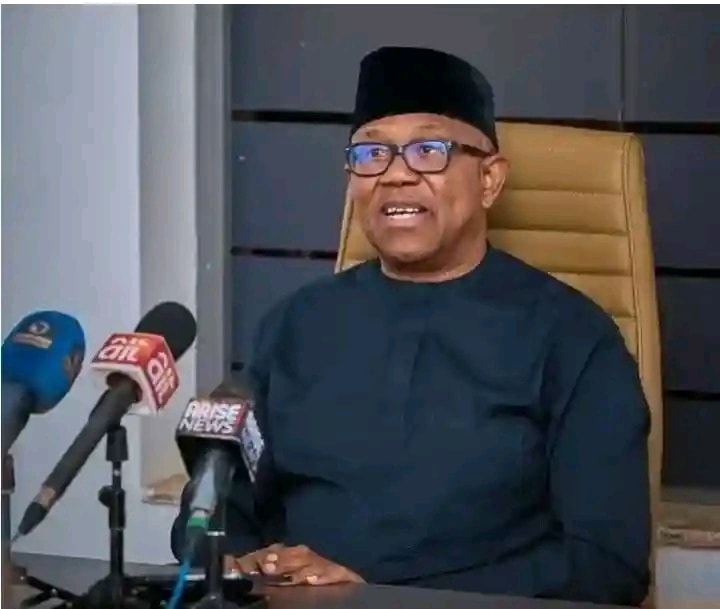
Former Governor of Anambra State and presidential candidate in the 2023 general election, Peter Obi, has explained the circumstances that led to his departure from the Labour Party, alleging that the Independent National Electoral Commission repeatedly refused to recognise court rulings concerning the party’s leadership dispute.
Obi, who recently joined the African Democratic Congress, made the disclosure on Friday during a community empowerment programme held in Nimo, a town in Njikoka Local Government Area.
The programme was organised by George Ozodinobi, who represents the Dunukofia/Njikoka/Anaocha Federal Constituency in the House of Representatives.
Addressing participants at the event, Obi said his decision to leave the Labour Party was influenced by persistent legal disputes within the party over its leadership structure and the electoral commission’s alleged refusal to acknowledge favourable court judgments obtained by his faction.
According to him, the party had secured several legal victories in court concerning the internal leadership crisis, but the electoral commission allegedly declined to recognise the rulings despite the judgments being in their favour.
“You all know that I am now in the African Democratic Congress,” Obi told the audience. “People have been asking me why I left the Labour Party. The truth is that we were involved in several court cases regarding leadership issues within the party, and in many instances we obtained favourable judgments.”
However, he claimed that despite these rulings, the electoral body did not recognise the decisions of the courts.
Obi further alleged that the situation changed only after he exited the party toward the end of 2025.
“Yet, INEC refused to recognise us,” he said. “But when I left on December 31, 2025, they suddenly recognised the same court orders that they had earlier rejected.”
His remarks drew reactions from supporters at the event, many of whom have continued to follow his political activities since the last general election.
Obi’s exit from the Labour Party had generated widespread debate within Nigeria’s political landscape, particularly among supporters who had rallied behind his presidential campaign under the party’s platform during the 2023 election.
During his address, the former governor also expressed concern about what he described as attempts to alter constitutional provisions in ways that could potentially affect his political ambitions.
He alleged that some of the constitutional amendments currently being proposed were specifically designed to prevent him from contesting future elections.
“You see all the things they have been tinkering with in the Constitution,” he said. “Some of them are simply because they do not want me to contest.”
Despite these alleged obstacles, Obi maintained that he remained determined to participate in the next presidential election and would not be discouraged by political manoeuvres.
He challenged political leaders and institutions to ensure that future elections in the country are conducted in a transparent and fair manner.
“But I want to tell them that with their 30 governors, they should simply make the election free and fair and see who wins,” Obi stated.
The former presidential candidate insisted that his political ambition was not driven by personal desperation for power but by a desire to address Nigeria’s numerous socio-economic challenges.
“I want to announce to you all that no matter what they do, I must contest the election,” he said.
According to him, the most important requirement for Nigeria’s democracy is to create a level playing field where all candidates can compete fairly.
“Let them declare a free and fair contest. Bring the ball to the middle of the field, declare the game started, and let us see what happens,” he added.
Obi also used the occasion to express concern about what he described as the deteriorating condition of Nigeria’s economy and governance system.
He argued that the country was facing severe structural challenges that require urgent reforms and responsible leadership.
“Nigeria has collapsed totally, and there is a need to redeem it,” he said.
The former governor emphasised that his political mission was driven by the need to rebuild institutions and create opportunities for citizens, rather than simply occupying the office of president.
“I have never been desperate to become President,” he explained. “Rather, I am desperate to see a Nigeria that works.”
According to him, widespread inequality and economic hardship have deepened frustration among citizens and worsened the nation’s socio-economic problems.
He argued that greed and excessive concentration of wealth among a few individuals have contributed significantly to the country’s current challenges.
“Nigeria has collapsed and is already lying on the ground,” Obi said.
He added that the country’s economic system has become increasingly unfair to ordinary citizens, making it difficult for people from disadvantaged backgrounds to succeed.
“Nigeria is not working because many rich Nigerians are hungry and greedy,” he said.
The former governor stressed that one of his key objectives is to create a society where merit, opportunity and fairness replace patronage and privilege.
“This country is skewed against the poor,” he said. “That is why we are working to become president.”
According to him, a properly functioning society should allow every citizen to pursue success regardless of their social background.
“We want a country where the son of a nobody can become somebody without knowing anybody,” Obi added.
Beyond discussing national politics, the former governor also commended the organiser of the empowerment programme, Ozodinobi, for initiating projects aimed at supporting constituents and improving livelihoods.
Obi noted that community-based initiatives such as empowerment programmes play an important role in addressing poverty and promoting development at the grassroots level.
He encouraged political leaders to focus more on initiatives that directly improve the lives of citizens rather than merely engaging in political rhetoric.
According to him, the quality of leadership elected into public office has a direct impact on the level of development experienced by communities and the nation as a whole.
He therefore urged Nigerians to pay closer attention to the character and competence of individuals seeking political office.
Obi stressed that responsible leadership remains essential for rebuilding Nigeria and restoring confidence in the country’s democratic institutions.
The empowerment programme in Nimo attracted residents, community leaders, youth groups and supporters from various parts of the constituency.
Participants received different forms of support aimed at improving economic activities and encouraging self-reliance within the community.
Obi’s remarks at the event highlighted the growing political discussions surrounding the next electoral cycle, particularly as political actors reposition themselves ahead of future elections.
As Nigeria continues to grapple with economic and governance challenges, his comments also reflect broader debates about political reform, leadership accountability and the direction of the country’s democracy.
For Obi and his supporters, the focus remains on building a political movement capable of challenging existing structures while advocating for a system that promotes transparency, fairness and equal opportunity for all citizens.