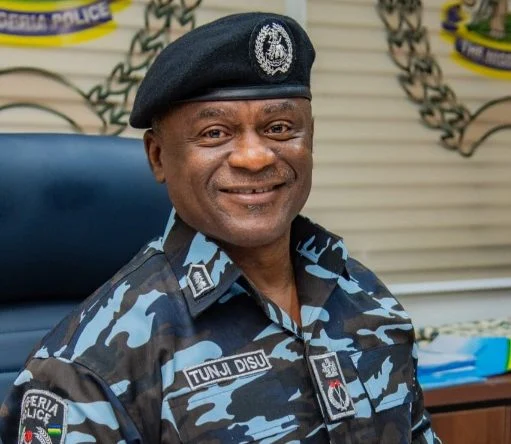
President Bola Ahmed Tinubu has accepted the resignation of the Inspector-General of Police, Mr. Kayode Egbetokun, and appointed Assistant Inspector-General of Police Tunji Disu as Acting Inspector-General with immediate effect.
The development was announced in a State House press release issued on February 24, 2026, by the President’s Special Adviser on Information and Strategy, Bayo Onanuga.
According to the statement, Mr. Egbetokun tendered his resignation letter earlier in the day, citing pressing family considerations as the reason for his decision to step down from office. President Tinubu received the letter and conveyed his appreciation for the outgoing police chief’s years of dedicated service to the Nigeria Police Force and the country at large.
The President commended Egbetokun’s professionalism and commitment to strengthening Nigeria’s internal security framework during his tenure. He acknowledged the former IGP’s efforts in reinforcing law enforcement operations and institutional reforms within the Force.
Egbetokun was appointed Inspector-General of Police in June 2023 for a four-year term, in line with the amended provisions of the Police Act. His tenure was originally scheduled to run until June 2027.
In appointing AIG Tunji Disu in an acting capacity, the President cited the prevailing security challenges across the country and the need for continuity and steady leadership within the Nigeria Police Force. The appointment, the statement said, was made in accordance with extant laws and relevant legal guidance.
President Tinubu expressed confidence in Disu’s capacity to lead the Force at a critical time. He described the acting IGP as an officer with extensive operational experience, depth of expertise, and demonstrated leadership competence. According to the President, these qualities will ensure focused and stable direction for the police as it continues to address complex security threats nationwide.
Disu, who currently holds the rank of Assistant Inspector-General of Police, is expected to assume duties immediately and oversee the administration and operations of the Force pending further constitutional processes.
The statement further indicated that, in compliance with the provisions of the Police Act 2020, the President will shortly convene a meeting of the Nigeria Police Council. The Council is expected to formally consider Disu’s appointment as substantive Inspector-General of Police.
Following the Council’s deliberation, the President will transmit Disu’s name to the Senate for confirmation, as required by law. The process underscores the administration’s commitment to adherence to constitutional and statutory procedures in matters relating to top security appointments.
The State House emphasized that the transition reflects the President’s determination to maintain stability within the country’s security institutions while ensuring that leadership changes are handled in a lawful and orderly manner.
President Tinubu reiterated his administration’s unwavering commitment to strengthening national security architecture. He stressed the importance of building institutional capacity within the Nigeria Police Force to enable it to effectively discharge its constitutional responsibilities.
The President also reaffirmed the government’s focus on promoting professionalism, accountability, and operational efficiency within the Force. He stated that ongoing reforms aimed at improving policing standards, enhancing intelligence capabilities, and equipping officers with modern tools will continue under the new leadership.
Security analysts note that the appointment of an acting IGP at this time places significant responsibility on Disu to sustain operational momentum and reassure both officers and the public of continuity in policing strategy.
With Nigeria confronting diverse security concerns ranging from insurgency and banditry to kidnapping and urban crime, the leadership of the Police Force remains central to the broader national security framework.
As the formal confirmation process begins, attention will now turn to the Nigeria Police Council and the Senate, whose actions will determine whether Disu assumes the role in a substantive capacity.
For now, the Presidency has signaled a clear transition plan — one that seeks to balance continuity, legality, and renewed focus within the nation’s foremost law enforcement institution.