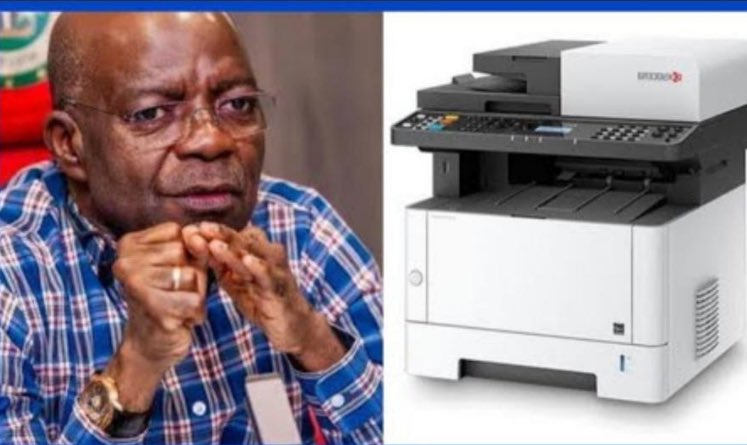
The Abia State Government has firmly denied reports alleging that it earmarked more than ₦210 million for the purchase of a single photocopying machine for its Lagos Liaison Office, describing the claim as a gross misrepresentation arising from a clerical and formatting error in the 2026 Appropriation Law.
The clarification followed an investigative report by SaharaReporters, which cited figures contained in the published 2026 budget document to allege that the state government planned to spend over ₦210 million on a photocopier for its Lagos office. The report quickly sparked public outrage and renewed debate over fiscal prudence, budget transparency, and the cost of governance.
In a statement issued on February 7, 2026, the Abia State Ministry of Budget and Planning said the controversy was the result of a “technical formatting error” that occurred during the final compilation and layout of the budget document, leading to the misalignment of project descriptions and their corresponding financial figures in one section of the published material.
According to the Ministry, the 2026 Appropriation Law was published on the state government’s official website on January 31, 2026, in line with the administration’s transparency policy and commitment to making fiscal information accessible to the public. It stressed that the publication was done in good faith and without any intention to mislead citizens.
The Ministry explained that the correct budgetary provisions relating to the Lagos Liaison Office are clearly and accurately stated on Page 60 of the budget document. It clarified that the sum of ₦210,831,142 was appropriated for the “rehabilitation and repair of residential buildings and staff quarters” at the Lagos Liaison Office, a capital-intensive project unrelated to office equipment procurement.
In contrast, the Ministry stated that only ₦12 million was allocated for the “procurement of one Sharp photocopier and other sundry office equipment” for the same office. This figure, it noted, reflects the realistic cost of the item and related equipment and is consistent with prevailing market prices and standard government procurement estimates.
However, the Ministry admitted that a serious formatting error occurred on Page 289 of the budget document, where a much larger figure was mistakenly placed beside the photocopier item. This misalignment, it said, erroneously gave the impression that ₦250 million—or, in some interpretations, over ₦210 million—was intended for the purchase of a single office machine.
“The ₦250,000,000 figure that appeared beside the copier item on Page 289 is not the provision for a copier,” the Ministry stated. It explained that the amount actually belongs to “a different, larger capital project elsewhere in the budget” and was inadvertently displaced during the document’s final formatting and pagination process.
The Ministry emphasised that there was no inflation or manipulation of the cost of procuring a photocopier, insisting that the approved estimate for the item remains ₦12 million, as correctly reflected in the appropriate section of the budget. It added that the error was purely clerical and did not reflect any attempt to conceal or exaggerate expenditure.
Beyond addressing the immediate controversy, the Ministry used the opportunity to provide broader clarification on Abia State’s budgeting and procurement framework. It explained that budgetary allocations are authorisations to spend and do not amount to automatic release or utilisation of funds.
According to the statement, every procurement process in Abia State is subject to multiple layers of statutory review and approval designed to safeguard public funds. These include evaluation by the Departmental Tenders Board, scrutiny and approval by the Ministerial Tenders Board, and final clearance by both the Finance and General Purpose Committee (F&GPC) and the State Executive Council.
“These layers of scrutiny are designed specifically to ensure fiscal responsibility, value for money, and transparency in the use of public funds,” the Ministry said. It added that even where a project appears in the budget, it would not be executed if it fails due process requirements or cannot be justified on cost, necessity, and public interest grounds.
The Ministry stressed that the procurement of office equipment, including photocopiers, would undergo strict market price verification and technical evaluation before approval, making it impossible for an inflated or unjustifiable cost to pass through the system unnoticed.
While expressing regret over the confusion generated by the formatting error, the Ministry maintained that the incident should not be misconstrued as evidence of financial recklessness or lack of transparency on the part of the state government. It reiterated the administration’s commitment to prudent fiscal management, accountability, and openness in public finance.
“The error was purely clerical and presentational,” the statement said, assuring Abia residents and Nigerians at large that the state’s financial control mechanisms remain firmly in place and fully operational.
The Ministry also reaffirmed its openness to public scrutiny, noting that the very fact that the budget was published online reflects the government’s willingness to subject its fiscal plans to citizen review, media analysis, and constructive criticism.
The clarification was later shared publicly by Ferdinand Ekeoma, Special Adviser on Media and Publicity to the Governor of Abia State, who posted the full statement on his official Facebook page on Saturday evening. The post was aimed at correcting public perception and providing context to citizens who may have been alarmed by the initial report.
Political observers note that the controversy underscores both the value and the risks of open budgeting, where technical errors can quickly become viral narratives if not promptly explained. They argue that while transparency invites scrutiny, it also demands meticulous attention to detail in documentation to avoid misinterpretation.
For the Abia State Government, the incident has become a test of its communication and accountability mechanisms. Officials say lessons have been learned and that additional checks will be introduced in future budget publications to prevent similar formatting issues.
As public debate continues around government spending and accountability, the state government insists that the facts of the matter are clear: no ₦210 million photocopier exists in the Abia 2026 budget, and claims suggesting otherwise are the product of a clerical error rather than fiscal misconduct.