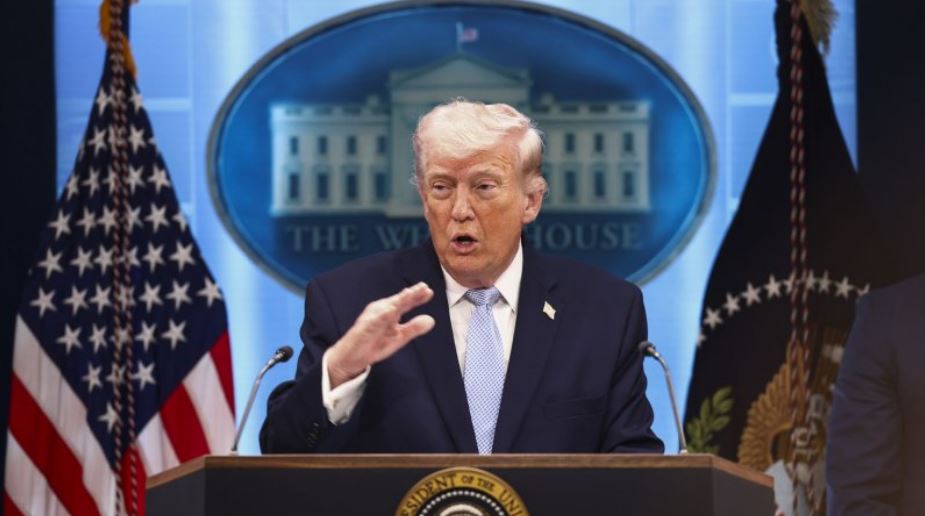
Donald Trump has announced plans to dispatch a new United States delegation to Islamabad for renewed negotiations with Iran, even as he issued strong warnings of possible military escalation if diplomatic efforts fail.
In a statement posted on the social media platform Truth Social, the US president indicated that Washington is preparing to re-engage Tehran in talks aimed at resolving key disputes that have fueled weeks of confrontation in the region. However, his message combined diplomatic outreach with explicit threats, underscoring the fragile and high-stakes nature of the situation.
“NO MORE MR. NICE GUY!” Trump wrote, warning that failure to reach an agreement could prompt the United States to take sweeping military action. He suggested that critical Iranian infrastructure—including power plants and bridges—could become targets if negotiations collapse.
The announcement comes at a critical moment, as a temporary ceasefire involving the United States, Iran, and Israel approaches its expiration. The truce, which followed an intense period of hostilities, has so far held, but remains precarious. Only one round of negotiations has been conducted, also in Islamabad earlier this month, and it ended without a breakthrough.
Despite ongoing diplomatic engagement, officials on both sides have acknowledged that significant gaps remain. Mohammad Bagher Ghalibaf stated that discussions are still far from reaching a conclusive stage, signalling that core disagreements have yet to be resolved.
At the centre of the dispute is Iran’s nuclear programme, a longstanding point of contention between Tehran and Washington. The United States maintains that Iran must significantly scale back its nuclear activities to prevent the potential development of weapons capability. Iran, however, insists that its programme is strictly for peaceful purposes, including energy production and scientific research.
Masoud Pezeshkian has publicly questioned the rationale behind US demands, arguing that Iran should not be compelled to relinquish what it considers a legitimate sovereign right.
“Why should we give up our legal right to nuclear development?” he asked in recent remarks, reflecting Tehran’s firm stance on the issue.
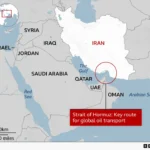
Another major flashpoint is the Strait of Hormuz, a narrow but vital corridor through which a significant share of the world’s oil and natural gas supplies pass. Control and access to the strait have become central to the broader geopolitical standoff.
Throughout the conflict, Iran has intermittently closed and reopened the waterway, using it as a lever in its confrontation with the United States and its allies. In response, Washington has imposed a naval blockade on Iranian ports, aiming to restrict Tehran’s ability to export oil and exert economic pressure.
Iranian authorities have issued stern warnings regarding maritime activity in the region, stating that any vessel attempting to pass through the strait without authorisation could be treated as hostile. This has heightened concerns among global shipping operators and contributed to volatility in energy markets.
Commenting on the situation, Esmaeil Baqaei described the US naval blockade as a violation of the ceasefire agreement, further complicating efforts to sustain the fragile truce.
As preparations for the next round of talks intensify, security has been significantly ramped up in Islamabad. Reports indicate widespread deployment of security personnel, establishment of checkpoints, and road closures across key areas of the city in anticipation of the arrival of the US delegation.
The previous US negotiating team was led by Vice President JD Vance and included senior officials such as Steve Witkoff, reflecting the high-level attention the talks have received from Washington.
However, the diplomatic process has been marked by conflicting narratives. While Trump has claimed that Iran had agreed in principle to relinquish its stockpile of enriched uranium, Iranian officials have categorically denied that any such agreement has been reached. This divergence highlights the lack of consensus even on fundamental aspects of the negotiations.
With the ceasefire deadline rapidly approaching, the situation remains highly fluid. Diplomatic efforts are continuing, but the simultaneous escalation in rhetoric and military posturing has created an atmosphere of uncertainty.
Analysts note that the combination of hardline messaging and ongoing negotiations suggests a dual-track strategy by Washington—seeking to pressure Iran into concessions while keeping channels for dialogue open. For Tehran, the challenge lies in balancing resistance to external demands with the need to avoid further economic and military strain.
The coming days are likely to prove decisive. If negotiations in Islamabad yield progress, they could pave the way for a more durable agreement and a reduction in tensions. However, failure to bridge the existing gaps may trigger a renewed phase of confrontation, with potentially severe consequences for regional stability and global energy markets.
As both sides prepare for another round of high-stakes diplomacy, the international community is closely watching developments, aware that the outcome could reshape the geopolitical landscape of the Middle East.