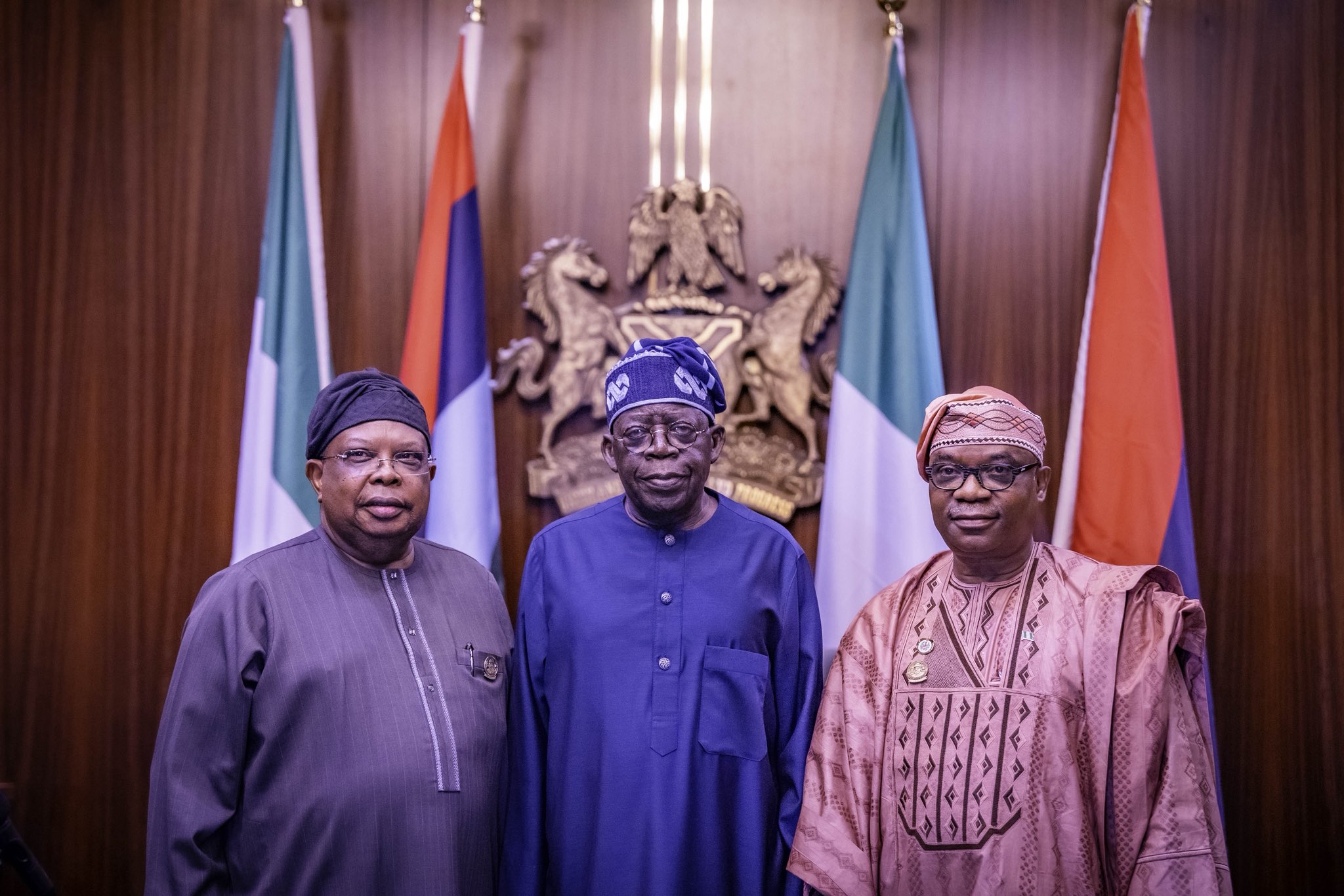
President Bola Ahmed Tinubu on Monday officially swore in Mr. Joseph Tegbe as the new Minister of Power and Ambassador Sola Enikanolaiye as the Minister of State for Foreign Affairs during a ceremony held at the Presidential Villa in Abuja.
The inauguration followed the resignation of two cabinet members who stepped down from the Federal Executive Council to pursue elective political positions ahead of the All Progressives Congress (APC) primary elections scheduled for May 2026.
The brief but significant ceremony took place at the Council Chamber of the Presidential Villa and was attended by family members of the newly appointed ministers, senior government officials, members of the Federal Executive Council, and top presidential aides.
A statement issued by the Special Adviser to the President on Information and Strategy, Bayo Onanuga, confirmed the appointments and highlighted the professional credentials and extensive public service records of both appointees.
President Tinubu had nominated Tegbe and Enikanolaiye on May 5, 2026, following the resignation of former Minister of Power, Chief Adebayo Adelabu, and former Minister of Foreign Affairs, Ambassador Yusuf Tuggar. Both former ministers left the cabinet to participate in the political process leading to the 2027 general elections.
The appointments form part of an ongoing restructuring of President Tinubu’s cabinet as several political office holders seek elective positions and new faces are brought into government to sustain the administration’s policy agenda.
The swearing-in of Tegbe and Enikanolaiye represents the second major ministerial induction into the Federal Executive Council since the Secretary to the Government of the Federation, Dr. Muttaqha Darma, issued a directive in March 2026 requiring ministers and other political appointees with electoral ambitions to resign before participating in party primaries.
The directive was designed to ensure compliance with constitutional provisions and promote transparency in the political process.
Earlier, on April 30, 2026, Dr. Darma himself was sworn in as Minister of Housing and Urban Development after a cabinet reshuffle that saw the departure of Dr. Ahmed Dangiwa from the ministry.
That reshuffle also resulted in changes within the economic management team, including the replacement of former Finance Minister Wale Edun by tax and fiscal policy expert Taiwo Oyedele.
With the latest appointments, President Tinubu continues to reshape his cabinet while maintaining continuity in key sectors considered vital to his administration’s development agenda.
For the Ministry of Foreign Affairs, Ambassador Sola Enikanolaiye steps into office after previously serving as Senior Special Assistant to the President on Foreign Affairs and International Relations.
His appointment fills the vacancy created when Ambassador Bianca Odumegwu-Ojukwu was elevated from Minister of State for Foreign Affairs to substantive Minister of Foreign Affairs following the resignation of Yusuf Tuggar.
A respected career diplomat, Enikanolaiye brings decades of experience in international relations, diplomacy, and public administration to his new role.
Born in Igbagun, Kogi State, he spent more than 35 years in Nigeria’s foreign service and rose through the ranks to become one of the country’s most accomplished diplomats.
His academic achievements are equally remarkable. He graduated with a First Class degree in Political Science from Ahmadu Bello University, Zaria, where he won the Dean’s Prize as the best graduating student in his faculty. He later obtained a Master’s degree in International Law and Diplomacy from the University of Lagos with distinction.
Enikanolaiye joined the Federal Ministry of Foreign Affairs in August 1982 and built an impressive diplomatic career spanning multiple continents.
During his years in service, he represented Nigeria in key diplomatic missions and postings, including Addis Ababa in Ethiopia, Belgrade in Serbia, Ottawa in Canada, London in the United Kingdom, and New Delhi in India.
His final diplomatic assignment was as Nigeria’s Head of Mission in India, a position in which he played a significant role in strengthening bilateral relations between Nigeria and one of the world’s fastest-growing economies.
In 2016, he was appointed Permanent Secretary of the Ministry of Foreign Affairs, a role he held until his retirement from the civil service on August 4, 2017.
Throughout his distinguished career, he received numerous honours, including the Presidential Civil Service Merit Award, the Presidential Distinguished Public Service Career Award, and recognition as a Distinguished Fellow of the National Defence College.
Observers believe his vast diplomatic experience will strengthen Nigeria’s foreign policy engagements at a time when the country is seeking greater international investment, enhanced regional cooperation, and stronger diplomatic partnerships.
Meanwhile, Joseph Tegbe assumes leadership of the Ministry of Power, one of the most critical ministries in the Federal Executive Council due to its direct impact on economic growth, industrial development, and citizens’ welfare.
Born in Ibadan, Oyo State, Tegbe is widely regarded as a seasoned technocrat with more than three decades of experience spanning both the public and private sectors.
He graduated with a First Class degree in Civil Engineering from Obafemi Awolowo University before obtaining a Master of Business Administration from Switzerland and a Master of Public Administration from the University of Birmingham in the United Kingdom.
Over the years, Tegbe has built a reputation as a respected management consultant, policy strategist, and reform expert.
Before his appointment, he served as Senior Partner and Head of Advisory Services at KPMG Africa, where he played a leading role in designing and implementing major public-sector reforms.
His professional portfolio includes extensive work in fiscal policy restructuring, institutional reform, governance improvement, and infrastructure development across federal and state governments.
He has also worked with several major public institutions and multinational corporations, including the Nigerian Communications Commission (NCC), Nigerian Bulk Electricity Trading Company (NBET), Nigerian Electricity Regulatory Commission (NERC), Federal Inland Revenue Service (FIRS), Shell, Huawei, General Electric, and MTN.
In addition, he served as Director-General and Global Liaison of the Nigeria-China Strategic Partnership, a role that positioned him at the center of efforts to deepen economic and investment relations between Nigeria and China.
His appointment to the Power Ministry comes at a time when Nigeria’s electricity sector continues to face significant challenges, including inadequate generation capacity, transmission constraints, distribution inefficiencies, and persistent power outages.
Many industry stakeholders have expressed optimism that Tegbe’s extensive background in reform management and infrastructure development could help accelerate efforts to improve electricity supply and strengthen investor confidence in the sector.
President Tinubu originally constituted his Federal Executive Council on August 21, 2023, when he inaugurated 45 ministers in what became the largest single-day cabinet swearing-in ceremony since Nigeria’s return to democratic rule in 1999.
Since then, the administration has undertaken several cabinet adjustments aimed at improving performance, responding to emerging national priorities, and replacing officials who left government service.
The first major cabinet reshuffle occurred in October 2024, after which a series of individual appointments, portfolio changes, and ministerial replacements followed.
With the latest inauguration of Tegbe and Enikanolaiye, the Tinubu administration has now carried out at least a dozen cabinet adjustments since assuming office in 2023.
Political analysts view the latest appointments as part of a broader effort to maintain stability within government while ensuring that strategic ministries remain led by experienced professionals capable of driving the administration’s reform agenda.
As both ministers assume office, expectations are high that they will bring their considerable experience to bear in addressing the challenges within their respective sectors and advancing the policy objectives of the Tinubu administration.