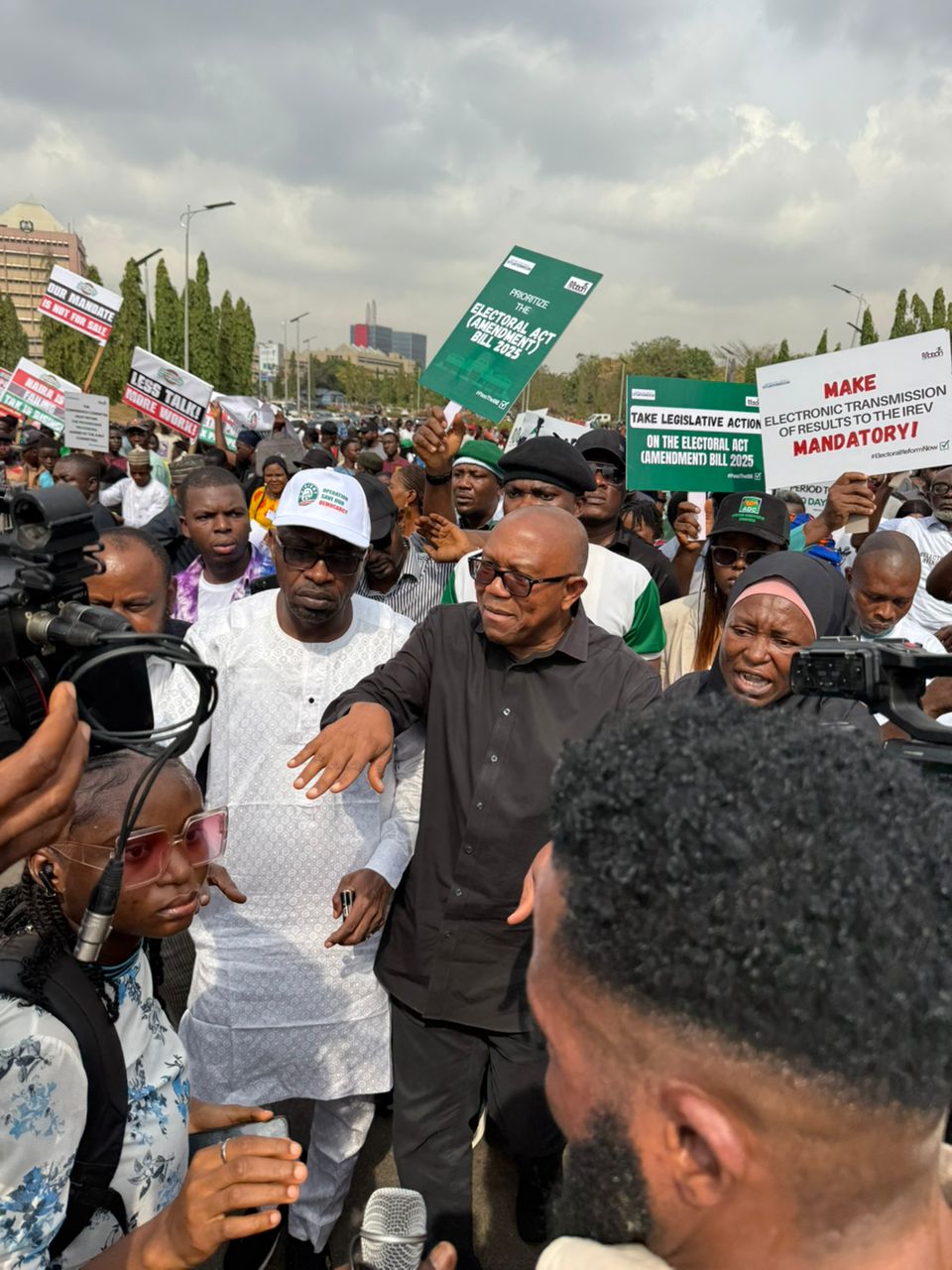
Former Anambra State Governor and Labour Party presidential candidate, Mr. Peter Obi, has renewed his call for comprehensive electoral reforms in Nigeria, insisting that credible elections remain the foundation of democratic governance and national renewal. Obi made the call on Monday, February 9, after participating in a peaceful protest at the National Assembly in Abuja, aimed at pressing lawmakers to urgently address perceived weaknesses in the country’s electoral framework.
In a statement titled “Identifying with the People Peacefully for Electoral Integrity,” Obi said the protest was driven by the collective desire of Nigerians to protect the sanctity of their votes and ensure that public office holders truly emerge through transparent and honourable processes.
According to him, the demands presented to the National Assembly were clear, focused, and non-negotiable, centring on integrity, transparency, and accountability in the electoral process.
“Yesterday, February 9th, I participated in a peaceful protest at the National Assembly to demand urgent electoral reforms that truly reflect the will of the Nigerian people,” Obi stated.
He stressed that anyone aspiring to occupy public office and bear titles such as Honourable, Distinguished, or Excellency must emerge through a process that is credible, transparent, and in full compliance with the law.
Obi argued that leadership should not be treated as an entitlement but as a responsibility earned through due process. He maintained that aspirants for elective positions must meet all constitutional and legal requirements without exception.
“Our demands were clear and non-negotiable: anyone seeking to hold titles such as Honourable, Distinguished, or Excellency must emerge through a transparent and honourable process,” he said.
The former governor emphasised the need for strict verification of candidates’ credentials, noting that public office seekers should be required to present verifiable records of their primary, secondary, and tertiary education, alongside other statutory qualifications such as age and eligibility.
“No one should aspire to lead without having gone through due process,” Obi asserted.
Beyond eligibility requirements, Obi also underscored the importance of open political engagement, insisting that candidates must subject themselves to public scrutiny through campaigns, debates, and other platforms provided by law.
He lamented what he described as a growing culture of political opacity, where some aspirants avoid debates and public engagement, thereby denying voters the opportunity to assess their competence, ideas, and character.
“Candidates must engage in open campaigns, public scrutiny, and debates as mandated by law,” he said, adding that democracy thrives when voters are properly informed and empowered to make choices based on merit.
Central to Obi’s demands was the issue of electronic transmission of election results, which he described as critical to safeguarding the people’s mandate and restoring confidence in Nigeria’s electoral system.
He insisted that results must be transmitted electronically and in real time from polling units to prevent manipulation, tampering, and post-election disputes.
“Most importantly, election results must be transmitted electronically and in real time to protect the people’s mandate and eliminate manipulation,” Obi said.
Addressing arguments often raised against electronic transmission, particularly claims of inadequate network coverage in some parts of the country, Obi dismissed such excuses as outdated and unconvincing.
He pointed out that Nigeria’s financial sector already operates nationwide through secure digital networks, facilitating daily transactions, tax collection, and other sensitive operations without disruption.
“Claims that certain states lack network coverage are no longer acceptable,” he declared.
“If financial institutions can operate nationwide through secure digital networks to conduct transactions and collect taxes on a daily basis, our electoral system can and should do the same.”
Obi argued that the persistence of weak electoral practices continues to undermine Nigeria’s global image and democratic credentials, despite its status as Africa’s most populous nation.
“Nigeria must stop being a so-called Giant of Africa that disgraces the continent and instead become a beacon of exemplary governance, beginning with credible elections,” he said.
He warned that without urgent reforms, the country risks deepening public distrust in democratic institutions and worsening political apathy, especially among young people.
The former presidential candidate also used the occasion to commend Nigerian youths who turned out in large numbers to participate in the peaceful protest, describing their presence as a powerful signal of generational resolve to reclaim the country’s future.
“We owe the younger generation a nation built on order, justice, and trust—not one mired in chaos and impunity,” Obi said.
He urged young Nigerians to remain peaceful, focused, and resolute in their advocacy, stressing that sustained civic engagement is necessary to compel meaningful change.
“As the agitation continues, I urge our youth, who turned out in large numbers, to remain steadfast and not relent until the necessary reforms are achieved,” he added.
Obi reaffirmed his long-standing commitment to democratic principles and the rule of law, insisting that electoral reform is not about partisan advantage but about national survival and progress.
According to him, a flawed electoral system produces flawed leadership, which in turn perpetuates poor governance, insecurity, economic hardship, and social injustice.
He stressed that only a credible electoral process can produce leaders who are accountable to the people and committed to national development.
“I remain firmly committed to the vision of a New Nigeria—one that is not only possible, but inevitable if we stand and act together,” Obi declared.
The peaceful protest at the National Assembly comes amid heightened national debate over proposed amendments to the Electoral Act, particularly provisions relating to electronic transmission of results, candidate eligibility, and sanctions for electoral malpractice.
Civil society organisations, professional bodies, and youth groups have increasingly joined calls for lawmakers to prioritise electoral integrity, warning that Nigeria’s democracy cannot survive repeated cycles of disputed elections and declining public trust.
For many observers, Obi’s participation in the protest symbolises a broader push by political leaders and citizens alike to shift Nigeria’s politics away from elite consensus and towards people-centred democracy anchored on transparency, accountability, and the rule of law.
As discussions around electoral reform continue, the pressure on the National Assembly is expected to intensify, with protesters insisting that credible elections are the first and most important step toward building the Nigeria that citizens desire and deserve.