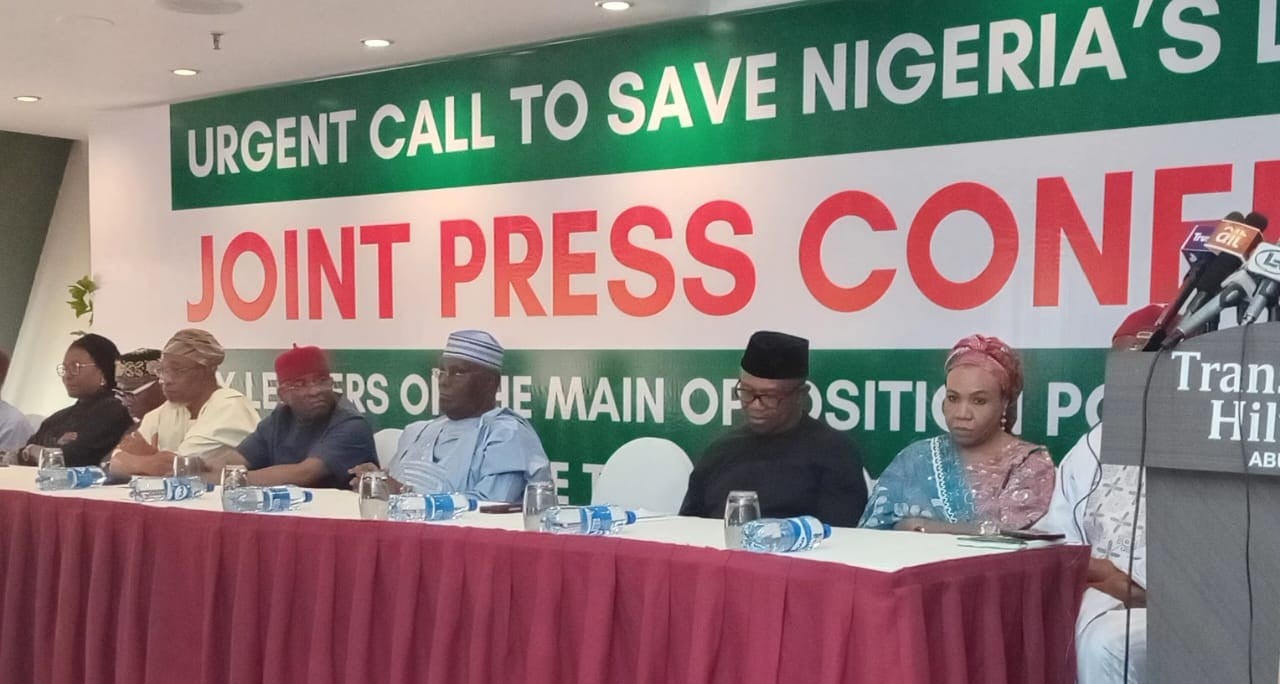
The African Democratic Congress (ADC) and the New Nigeria Peoples Party (NNPP) have firmly rejected the recently signed Electoral Act Amendment Bill 2026, describing it as a direct threat to Nigeria’s democratic framework and alleging that it is designed to entrench a one-party system.
The position of the opposition bloc was made public on Thursday in Abuja by the National Chairman of the NNPP, Ajuji Ahmed, who addressed journalists on behalf of the affected parties. He declared that the new amendments to the Electoral Act undermine the principles of transparency, competitiveness and fairness that are fundamental to credible elections in Nigeria.
Ahmed stated that the opposition would mobilise all constitutional and legal mechanisms available within the Nigerian system to resist the implementation of what he described as “obnoxious provisions” embedded in the amended law. According to him, the legislation, as presently constituted, fails to reflect the collective will and aspirations of Nigerians for a genuinely free and fair electoral process.
“We demand that the National Assembly immediately commence a fresh amendment to the Electoral Act 2026 to remove all obnoxious provisions and ensure that the Act reflects only the will and aspiration of Nigerians for free, fair, transparent and credible electoral process in our country. Nothing short of this will be acceptable to Nigerians,” Ahmed declared.
The opposition parties argue that the amendment contains clauses capable of weakening institutional checks and reducing the competitiveness of Nigeria’s multi-party system. While specific sections of the law were not exhaustively detailed at the briefing, party leaders insisted that certain provisions could restrict political participation, consolidate excessive powers in the hands of dominant actors, and create structural disadvantages for smaller parties.
The ADC and NNPP maintain that electoral legislation must strengthen democratic institutions rather than diminish them. They contend that any reform to the Electoral Act should emerge from broad-based consultation, incorporating input from political parties, civil society organisations, electoral experts, and the general public.
Analysts note that Nigeria’s Electoral Act has historically been subject to amendments aimed at improving electoral integrity, including provisions relating to voter accreditation, result transmission, and dispute resolution. However, the current controversy underscores the deep mistrust between the ruling establishment and opposition parties over the management of electoral reforms.
Ahmed emphasised that democracy thrives on pluralism and competitive political participation. He warned that any legal framework perceived to narrow the political space or tilt the playing field in favour of a dominant party risks eroding public confidence in the electoral process.
The opposition coalition signalled its readiness to pursue judicial review, legislative engagement, and civic mobilisation to press for a reconsideration of the amendments. According to Ahmed, the integrity of Nigeria’s democracy must not be compromised for partisan advantage.
As debate over the Electoral Act Amendment 2026 intensifies, attention now shifts to the National Assembly and other key stakeholders to determine whether further legislative review will be undertaken or whether the controversy will escalate into a broader constitutional confrontation.