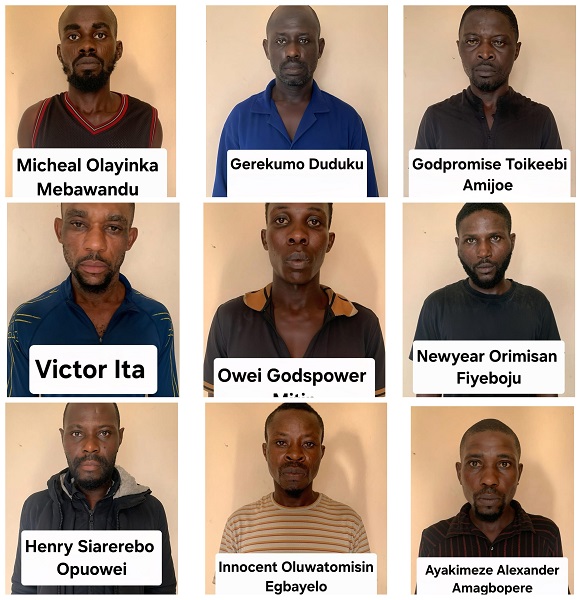
The Federal High Court sitting in Uyo, Akwa Ibom State, has convicted and sentenced nine persons to 10 years in prison for their involvement in crude oil theft and pipeline tampering.
The nine convicts were among 19 suspects arrested by security agencies during an intelligence-led operation targeting illegal activities around oil-producing communities in the state.
Delivering judgment, the presiding judge, Justice Joy Ikpeme, found the nine defendants guilty of a two-count charge bordering on conspiracy and tampering with an oil pipeline.
The offences were said to be contrary to Section 1(7) of the Miscellaneous Offences Act.
Justice Ikpeme sentenced each of the convicts to five years imprisonment on the first count and 10 years on the second count.
The court further ruled that the sentences should run concurrently and that the convicts would have no option of a fine.
Consequently, the effective prison term for each of the nine convicts is 10 years.
The conviction followed their arrest earlier in the year during an intelligence-driven operation jointly conducted by the Nigerian Navy and the Department of State Services (DSS).
The suspects were reportedly apprehended while allegedly stealing crude oil from the ASABO-D oil well head in Ibeno Local Government Area of Akwa Ibom State.
Their arrest formed part of broader security operations aimed at disrupting crude oil theft, illegal bunkering and other forms of criminal activity associated with Nigeria’s oil-producing areas.
Crude oil theft remains a major challenge to Nigeria’s petroleum industry, with significant implications for government revenue, oil production, environmental protection and the livelihoods of communities located in oil-producing regions.
Illegal tapping of pipelines and other forms of unauthorised access to petroleum infrastructure can also result in oil spills, destruction of vegetation and contamination of waterways used by local residents for fishing and other economic activities.
Security agencies have consequently intensified operations in the Niger Delta and other oil-producing areas in an effort to prevent criminals from gaining access to oil infrastructure.
A security source described the latest conviction as an important development in the ongoing efforts of the Nigerian Navy and other security agencies to combat crude oil theft and illegal bunkering.
The source said the prosecution of suspects arrested during such operations was essential to ensuring that arrests resulted in meaningful legal consequences.
According to the source, crude oil theft has continued to pose a threat to Nigeria’s economic interests, particularly because illegal activities along oil pipelines and wellheads can reduce legitimate production and deprive the country of substantial revenue.
The environmental consequences are equally significant.
Illegal bunkering activities frequently involve the unauthorised diversion of crude oil and the destruction or alteration of petroleum infrastructure. Such activities can lead to spills and other forms of environmental degradation, placing additional pressure on communities that depend on surrounding land and waterways.
The latest judgment therefore represents both a criminal justice outcome and part of the wider campaign against petroleum-related crimes in the Niger Delta.
The conviction of nine of the 19 persons arrested also demonstrates the role of the courts in determining criminal responsibility following investigations and prosecution by law enforcement agencies.
While the remaining suspects were not covered by the judgment, the conviction provides another example of the legal action being taken against individuals accused of involvement in the theft and illegal diversion of Nigeria’s crude oil.
The Nigerian government and security agencies have repeatedly stressed the need to reduce oil theft as part of efforts to increase legitimate crude oil production and strengthen national revenues.
Nigeria relies heavily on petroleum revenues, making the protection of oil infrastructure and the prevention of illegal diversion of crude oil an important national security and economic priority.
For communities in the Niger Delta, however, the fight against crude oil theft also has an environmental dimension. Residents have long raised concerns about pollution, damaged ecosystems and the impact of oil-related activities on farming and fishing.
The sentencing of the nine convicts is therefore expected to reinforce the message that interference with oil infrastructure and illegal crude oil operations can attract significant criminal penalties.
With the court imposing a 10-year effective prison term without an option of fine, the judgment sends a strong signal about the seriousness with which the authorities and judiciary are treating offences connected with crude oil theft and pipeline tampering.
Security agencies are expected to continue intelligence-led operations in oil-producing communities, while prosecutions will remain critical to ensuring that suspects who are found guilty are held accountable under the law.
The latest conviction in Uyo adds to the continuing efforts to protect Nigeria’s petroleum resources, safeguard oil-producing communities and reduce the economic and environmental consequences of crude oil theft and illegal bunkering.