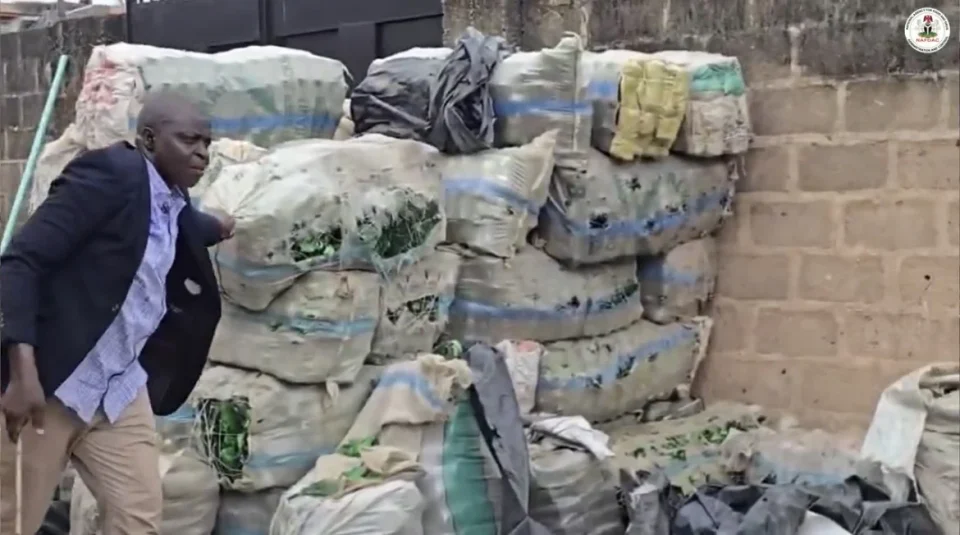
The agency said its Investigation and Enforcement Directorate discovered the bottles at a building located at 322B Meiran Road, Agbado Oke-Odo, Lagos, following what it described as credible intelligence about activities at the premises.
According to NAFDAC, the empty bottles were destroyed during the operation to prevent them from being reused in the production and distribution of counterfeit alcoholic beverages.
An Assistant Director in the agency’s Investigation and Enforcement Directorate, Kunle Ojo, disclosed details of the operation in a video released by NAFDAC on Friday.
Ojo said the team was led to the location after receiving information about suspicious activities in the area. He explained that the property was situated in a secluded residential neighbourhood where different materials had been stored.
Upon arrival, the enforcement team discovered numerous empty bottles of alcoholic beverages stacked at the premises and covered with tarpaulins.
“On arriving, we saw different kinds of bottles stacked in this place. These are bottles covered with tarpaulins,” Ojo said.
He explained that the bottles came in different sizes and bore labels associated with various alcoholic beverage brands. Among the containers recovered were bottles measuring 750 millilitres, alongside other sizes.
The brands identified included Action Bitter and Royal Circle Premium Whiskey, among others.
According to the official, the quantity and variety of the bottles raised suspicions that they might have been stockpiled for supply to individuals involved in the production of counterfeit alcoholic drinks.
Ojo alleged that the bottles were being stored for possible distribution to suspected counterfeiters who could reuse them to package illegally produced beverages.
“What these people are planning to do, or what they do here, is to watch the bottle supply to different suspected counterfeiters to be used for another production,” he said.
However, the agency’s statement did not identify any individual responsible for the storage of the bottles or disclose whether arrests had been made in connection with the discovery.
The operation forms part of NAFDAC’s enforcement efforts against the production, packaging and distribution of counterfeit and unregistered products, which the agency considers a threat to public health.
Counterfeit alcoholic beverages can expose consumers to serious health risks, particularly where the ingredients, production processes and storage conditions are unknown. The reuse of branded bottles to package unauthorised products may also make it difficult for consumers to distinguish genuine beverages from fake ones.
NAFDAC has repeatedly urged Nigerians to exercise caution when purchasing regulated products and to report suspicious commercial activities that could endanger public health.
Speaking during the operation, Ojo condemned the alleged use of a residential property for storing bottles suspected to be destined for counterfeit production. He stressed that the agency’s intervention was aimed at protecting consumers and preventing potentially dangerous products from reaching the market.
“This is a residential area, and this is not acceptable to government. We are here to safeguard the health of the nation,” he said.
The agency destroyed the recovered bottles to prevent their possible reuse. It did not, however, provide further details about the method of destruction or whether additional investigations would lead to enforcement action against those connected with the premises.
Ojo also called on members of the public to support NAFDAC’s efforts by providing information about suspicious activities in their communities.
He urged residents who observe unusual storage or handling of products suspected to be counterfeit to report such incidents to the nearest NAFDAC office.
The agency believes public cooperation can help enforcement officers identify locations used for storing materials linked to illegal manufacturing and distribution networks.
The Lagos discovery underscores the importance of monitoring not only facilities where counterfeit products may be manufactured but also locations where packaging materials are stored and potentially supplied to illegal producers.
While the presence of empty branded bottles does not, on its own, establish that counterfeit drinks were manufactured at the property, NAFDAC’s stated concern is that the containers could be reused to package fake alcoholic beverages.
The agency’s investigation and any subsequent enforcement action will be important in determining who owned or controlled the bottles, their intended destination and whether they were connected to an established counterfeiting operation.
NAFDAC has urged Nigerians to remain vigilant and report suspected violations as part of broader efforts to protect consumers and prevent counterfeit products from entering the market.