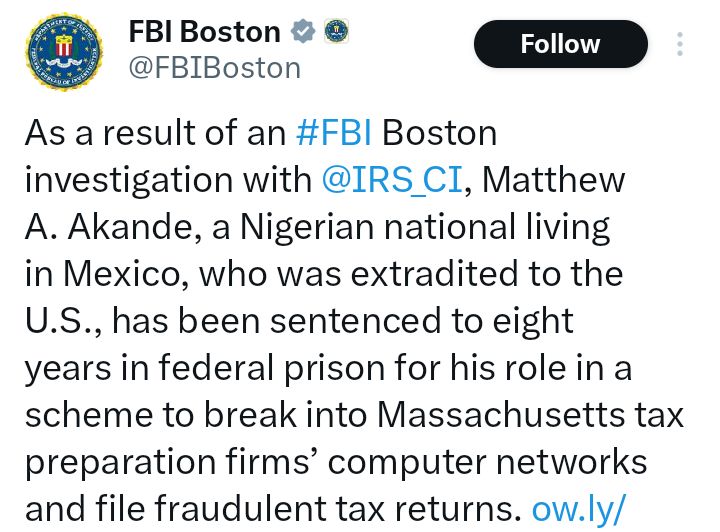
A Nigerian national residing in Mexico, Mathew A. Akande, has been sentenced in a federal court in Boston, United States, for orchestrating a sophisticated cyber-enabled tax fraud scheme that targeted Massachusetts tax preparation firms and defrauded the U.S. government of more than $1.3 million.
The United States Department of Justice disclosed the sentencing in a press statement issued on Wednesday, February 18, 2026. According to the statement, Akande, 37, was sentenced on Tuesday, February 17, 2026, by U.S. District Court Judge Indira Talwani to eight years in federal prison. He will also serve three years of supervised release following the completion of his prison term.
In addition to the custodial sentence, the court ordered Akande to pay $1,393,230 in restitution, representing the amount successfully obtained through the fraudulent scheme.
Akande’s prosecution followed an international manhunt that culminated in his arrest in October 2024 at Heathrow Airport in the United Kingdom. Acting at the request of U.S. authorities, British law enforcement detained him while he was in transit.
After several months of legal proceedings, Akande was extradited to the United States on March 5, 2025, to face charges stemming from a federal indictment issued in July 2022.
The Justice Department’s Office of International Affairs coordinated closely with authorities in the United Kingdom to secure his extradition, underscoring the cross-border nature of the investigation and the growing international cooperation in combating cybercrime.
A federal grand jury indicted Akande on multiple charges, reflecting the scale and complexity of the operation. The counts included:
- One count of conspiracy to obtain unauthorized access to protected computers in furtherance of fraud and to commit theft of government money and money laundering;
- One count of wire fraud;
- Four counts of unauthorized access to protected computers in furtherance of fraud;
- Thirteen counts of theft of government money; and
- Fourteen counts of aggravated identity theft.
The indictment alleged that between June 2016 and June 2021, Akande and his co-conspirators executed a coordinated plan to exploit stolen taxpayer information to file fraudulent tax returns and divert refund payments.
According to court documents, the scheme relied heavily on phishing attacks and malicious software to infiltrate the computer networks of Massachusetts-based tax preparation firms.
Akande allegedly caused fraudulent emails to be sent to at least five tax preparation firms. The emails were crafted to appear as legitimate inquiries from prospective clients seeking tax preparation services. In reality, they were designed to trick employees into opening attachments or clicking links that installed remote access trojan (RAT) malware on the firms’ systems.
Among the malware used was a program known as Warzone RAT. Once installed, the software allowed Akande and his associates to remotely access the firms’ computer systems without authorization.
Through this unauthorized access, the conspirators obtained taxpayers’ personally identifiable information (PII), including Social Security numbers, prior-year tax returns, and other sensitive financial data.
With the stolen information, Akande and his accomplices filed fraudulent federal tax returns in the names of unsuspecting taxpayers. The false filings sought refunds that were then directed to bank accounts opened by co-conspirators within the United States.
Once the Internal Revenue Service (IRS) issued the refunds, co-conspirators withdrew the funds in cash. A portion of the stolen money was then transferred to third parties in Mexico, allegedly at Akande’s direction, while the remainder was retained by the individuals who facilitated the withdrawals.
Over the course of approximately five years, Akande and his associates filed more than 1,000 fraudulent tax returns seeking over $8.1 million in refunds. Although they did not obtain the full amount requested, they successfully secured more than $1.3 million before the scheme was disrupted by federal investigators.
The sentencing announcement was made by United States Attorney Leah B. Foley; Ted E. Docks, Special Agent in Charge of the Federal Bureau of Investigation’s Boston Division; and Thomas Demeo, Acting Special Agent in Charge of the Internal Revenue Service’s Criminal Investigation division in Boston.
Federal authorities highlighted the collaborative efforts of multiple agencies in uncovering and dismantling the fraud scheme. The case involved digital forensics, financial tracing, and international coordination.
Assistant U.S. Attorney David M. Holcomb of the Criminal Division prosecuted the case.
Officials emphasized that cyber-enabled tax fraud poses a serious threat to both taxpayers and government institutions. They reiterated that individuals who engage in such crimes, regardless of where they reside, will be pursued and held accountable under U.S. law.
The case reflects a growing trend in transnational cybercrime, where perpetrators operate across multiple jurisdictions, leveraging technology to exploit vulnerabilities in financial and governmental systems.
Authorities noted that phishing attacks and malware-based intrusions remain common tactics used by cybercriminals to obtain sensitive information. Tax preparation firms, which store large volumes of personal and financial data, are often attractive targets.
The Justice Department urged businesses and individuals to adopt robust cybersecurity measures, including employee training to detect phishing attempts, multi-factor authentication, and regular system monitoring to prevent unauthorized access.
With Akande’s sentencing, U.S. authorities have closed a significant chapter in a multi-year investigation into a complex tax fraud conspiracy that spanned continents. The eight-year prison sentence and restitution order underscore the seriousness with which federal courts treat identity theft, cyber intrusions, and theft of government funds.
Officials stated that the outcome sends a clear message: those who exploit digital tools to defraud institutions and individuals will face substantial legal consequences, regardless of international borders.