The Israel Defense Forces (IDF) has confirmed disciplinary action against two of its soldiers involved in the destruction of a religious statue in southern Lebanon, announcing that both have been removed from combat duties and sentenced to 30 days in military detention.
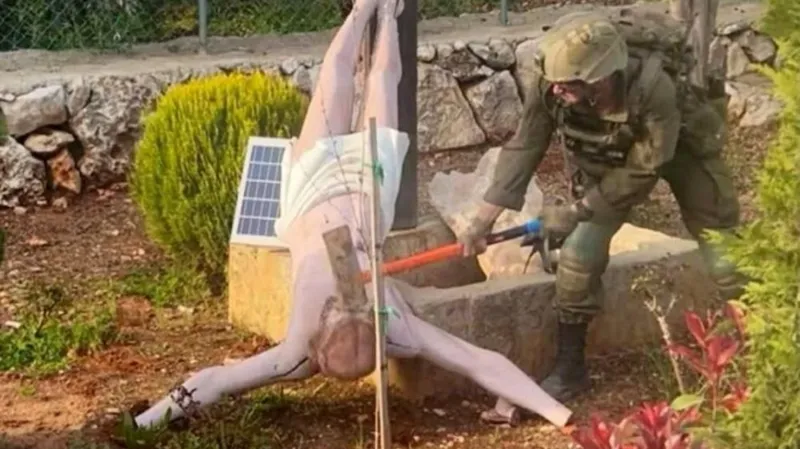
The incident, which occurred in the predominantly Christian village of Debel, drew widespread attention after one soldier was seen smashing a statue of Jesus with a sledgehammer while another documented the act by taking photographs. The images circulated rapidly, sparking outrage and raising concerns about the conduct of troops operating in sensitive religious environments.
In an official statement, the IDF acknowledged the incident and disclosed that an internal investigation had been conducted to determine the circumstances surrounding the destruction of the statue. According to the military, the findings revealed that the actions of the soldiers involved were in clear violation of operational directives and ethical standards.
The soldier who physically destroyed the statue, along with the one who recorded the act, were identified as the primary offenders. Both have now been dismissed from active combat roles and ordered to serve 30 days in military prison as punishment for their conduct.
Beyond the two directly involved, the investigation also uncovered that six additional soldiers were present at the scene during the incident. These individuals neither intervened to stop the act nor reported it through proper channels, a failure the military described as a serious lapse in responsibility.
“The inquiry determined that the soldiers’ conduct completely deviated from IDF orders and values,” the military stated, emphasising that the behaviour observed did not reflect the standards expected of its personnel.
The case was reviewed by the commander of the 162nd Division, Brigadier General Sagiv Dahan, who oversees operations in the area where the incident took place. After examining the findings and recommendations from the investigative team, Dahan approved the disciplinary measures imposed on the two soldiers.
The IDF further indicated that the remaining six troops who were present but failed to act have been summoned for formal clarification sessions. These proceedings will determine whether additional sanctions or corrective actions are necessary at the command level.
In an effort to address the damage caused and restore relations with the affected community, the military confirmed that the destroyed statue has since been replaced. According to the IDF, the replacement was carried out “in full coordination with the local community,” signalling an attempt to repair trust with residents of Debel.
“The Northern Command worked to coordinate the replacement of the statue from the moment it received the report of the incident,” the statement noted. “We express deep regret over the incident and are working to ensure that it does not happen again in the future.”
The destruction of the statue, which held religious significance for the Christian population in the area, was widely viewed as a deeply offensive act. The prompt replacement of the monument appears to be part of broader efforts by the military to mitigate the fallout and reaffirm its commitment to respecting religious sites and cultural sensitivities.
Senior military leadership also weighed in on the matter. The findings of the investigation were presented to the IDF Chief of Staff, Lieutenant General Eyal Zamir, and the head of the Northern Command, Major General Rafi Milo.
According to the IDF, Zamir strongly condemned the actions of the soldiers, describing the incident as both unacceptable and indicative of a serious moral failure.
“He stated that it constitutes unacceptable conduct and a moral failure, far exceeding any acceptable standard and contradicting IDF values and the expected conduct of its troops,” the military said.
The IDF also disclosed that prior to deployment, troops had received guidance on proper conduct regarding religious institutions and symbols. However, in light of the incident, the military has pledged to reinforce these protocols more rigorously across all units operating in the region.
“Procedures regarding conduct with religious institutions and symbols were reinforced to the troops prior to their entry into the relevant areas, and will be reinforced again for all troops in the area following the incident,” the statement added.
The episode underscores the challenges faced by military forces operating in culturally and religiously sensitive environments, where individual actions can have broader diplomatic and social repercussions. For the IDF, the incident represents not only a breach of discipline but also a test of its commitment to upholding professional and ethical standards.
While the swift disciplinary measures and replacement of the statue may help ease immediate tensions, the broader implications of the incident—particularly in a region marked by complex religious and political dynamics—are likely to linger.
For residents of Debel and observers alike, the response from the Israeli military will be closely scrutinised as a measure of accountability and respect for local communities. The IDF, for its part, has signalled that it intends to treat the matter as a serious internal failure and a lesson for future operations.