The Chairman of the Independent National Electoral Commission (INEC), Prof. Joash Amupitan, has ordered an investigation into reported operational shortfalls during the recent Federal Capital Territory (FCT) council elections, warning that any staff found culpable will face disciplinary action.
Speaking on Wednesday at a post-election review meeting with Resident Electoral Commissioners (RECs) at INEC headquarters in Abuja, Amupitan said the commission would not tolerate lapses that undermine the credibility and efficiency of the electoral process.
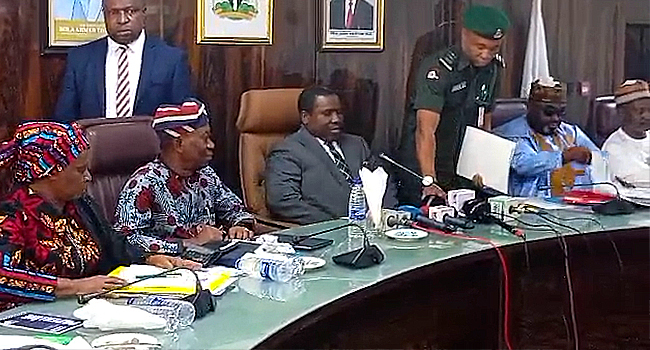
The meeting was convened four days after the conduct of the FCT area council elections and by-elections in Rivers and Kano states held last Saturday. It brought together all Resident Electoral Commissioners from the 36 states of the federation and the FCT to assess the conduct of the polls, identify operational challenges, and begin strategic planning for the 2027 general election.
Addressing the commissioners, the INEC chairman specifically referenced logistical and administrative shortcomings recorded in Kuje and Kabusa during the FCT elections. While he did not provide exhaustive details of the irregularities, he confirmed that internal reviews had identified areas of concern requiring immediate scrutiny.
“We will investigate the staff responsible for the shortfalls recorded in Kuje and Kabusa,” Amupitan stated. “If found guilty of negligence or misconduct, appropriate sanctions will be applied in accordance with the commission’s regulations.”
The chairman also disclosed that transporters responsible for delays in the distribution of electoral materials to Kwali Area Council would be blacklisted. He described timely logistics deployment as a non-negotiable component of electoral integrity, noting that any disruption in the movement of materials can erode public confidence in the process.
“The transporters involved in the delay to Kwali will be blacklisted. We cannot afford avoidable disruptions in critical logistics operations,” he said.
INEC conducted elections across the six area councils of the FCT to fill chairmanship and councillorship positions. In addition, the commission organised by-elections in Ahoada East II and Khana II constituencies of Rivers State, as well as legislative elections in Kano Municipal and Ungogo constituencies in Kano State.
The Abuja meeting, beyond reviewing the immediate outcomes of the elections, is expected to provide a platform for Resident Electoral Commissioners to present field reports, highlight systemic vulnerabilities, and propose reforms to strengthen future electoral operations.
Amupitan emphasised that the review process forms part of INEC’s continuous improvement framework. According to him, post-election audits are essential to identifying operational inefficiencies and preventing recurrence in subsequent polls.
“All elections present lessons. Our responsibility is to draw from those lessons, correct deficiencies, and reinforce best practices ahead of larger national exercises,” he said, in apparent reference to preparations for the 2027 general election.
Also present at the meeting was a delegation from the Forum of State Independent Electoral Commissions (SIECs), who were on a courtesy visit to the INEC chairman. The leader of the delegation, Mamman Eri, said the visit aimed to strengthen institutional collaboration between INEC and state-level electoral bodies responsible for local government elections.
Eri stressed the need for capacity-building, knowledge sharing, and harmonisation of standards to enhance the credibility of grassroots elections nationwide.
“We are here to explore areas of collaboration that will strengthen local government elections across the states,” he said.
The outcomes of the FCT council elections revealed a mixed performance across political parties. In Kuje Area Council, the candidate of the All Progressives Congress (APC), Danjuma Shekwolo, was declared winner of the chairmanship election with 17,269 votes.
In Abuja Municipal Area Council (AMAC), the APC’s Christopher Maikalangu was returned elected after securing 40,295 votes out of 62,861 valid votes cast, consolidating the party’s foothold in the nation’s capital.
Similarly, in Kwali Area Council, APC candidate Daniel Nuhu polled 17,032 votes to defeat the Peoples Democratic Party (PDP) candidate, Haruna Pai, who secured 8,575 votes.
However, the PDP recorded a notable victory in Gwagwalada Area Council, where its candidate, Mohammed Kasim, won the chairmanship seat with 22,165 votes, defeating APC’s Yahaya Shehu, who garnered 17,788 votes.
Political analysts note that the results reflect competitive party dynamics within the FCT, with both the APC and PDP maintaining strong support bases in different area councils.
The by-elections in Rivers and Kano states were also part of INEC’s broader electoral calendar aimed at filling vacant legislative seats. While the chairman did not dwell extensively on those contests during the briefing, he reiterated the commission’s commitment to transparency, neutrality, and adherence to statutory guidelines.
Observers have welcomed the chairman’s decision to investigate internal lapses, describing it as a signal that the commission is willing to hold its personnel accountable. Electoral credibility, they argue, depends not only on political neutrality but also on administrative competence and strict enforcement of operational standards.
As Nigeria gradually shifts focus toward the 2027 general election, the Abuja review meeting underscores the scale of preparations required. With national polls involving millions of voters, thousands of polling units, and complex logistics networks, even minor procedural lapses at local levels can offer critical insights for reform.
Amupitan assured the commissioners that INEC would continue to refine its processes, invest in staff training, and strengthen oversight mechanisms to enhance efficiency and public trust.
“We must remain proactive, transparent, and accountable,” he said. “Our mandate is to deliver elections that reflect the will of the people and withstand scrutiny at all levels.”
With investigations now set to commence and logistical partners facing possible sanctions, the commission’s internal review process signals a determination to address weaknesses ahead of future electoral cycles.
For INEC, the FCT polls represent not just a routine exercise in local democracy but a testing ground for operational resilience as Nigeria prepares for another round of nationwide elections in 2027.