An Igbo community leader based in South Africa, Solomon Ezekiel, has publicly apologised and distanced himself from claims that he was crowned a traditional ruler, following widespread backlash over a controversial coronation event that sparked tensions in the Eastern Cape.
In a statement shared on social media platform X on Saturday, Ezekiel clarified that he was never installed as a king, insisting that the ceremony in question merely recognised him as a senior elder within the Igbo community in the region. He expressed deep regret over the confusion surrounding the event and the unrest that followed, appealing for forgiveness from South African authorities and affected communities.
“I want to make it clear that I was not crowned as a king,” Ezekiel stated. “I am not a king, and I do not claim to be one. What happened on that day was simply my recognition as a senior elder within the Igbo community in the Eastern Cape. It does not confer any authority as a traditional ruler.”
Ezekiel’s apology comes in the wake of intense criticism and violent protests triggered by the March 14, 2026 event in East London, where he was reportedly presented as “Eze Ndigbo na East London.” The development drew condemnation from South African traditional leaders, government institutions, and sections of the public, who viewed the installation as a violation of local customs and governance structures.
In his statement, Ezekiel acknowledged the authority of South Africa’s traditional leadership and extended respect to key figures, including His Majesty Kunkane Jobgolo Sandile. He emphasised that he had no intention of undermining the country’s cultural or legal systems.
“I respect His Majesty Kunkane Jobgolo Sandile and recognise his authority, as well as that of all traditional leaders in South Africa,” he said. “It was never my intention to disrespect the people, the leadership, or the laws of this country. I take full responsibility for the misunderstanding and sincerely apologise.”
The controversy surrounding the event escalated rapidly in the days that followed, culminating in protests that began on March 30 and later turned violent. Reports indicated that at least 13 vehicles were destroyed, properties were looted, and a stabbing incident occurred, prompting security forces to intervene using crowd control measures such as stun grenades and tear gas.
South African authorities were swift in condemning the coronation. The Eastern Cape House of Traditional and Khoi-San Leaders described the event as a “flagrant violation” of established cultural protocols, while the Department of Cooperative Governance and Traditional Affairs declared the installation illegal.
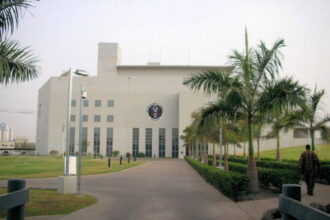
Nigeria’s diplomatic missions in South Africa also moved to distance themselves from the development, describing it as a cultural misunderstanding rather than a recognised traditional institution. The Nigerian Embassy in Pretoria subsequently issued an apology and called on Nigerians residing in the country to remain calm and avoid actions that could further inflame tensions.
Back home, the Federal Government of Nigeria expressed strong disapproval of the practice of installing “Eze Ndigbo” titles in foreign countries. Speaking through a statement signed by her media aide, Bianca Odumegwu-Ojukwu described the trend as an embarrassment not only to the Nigerian government but also to the Igbo people and the country’s international image.
She made the remarks during a meeting of Ohanaeze Ndigbo Worldwide in Enugu, where concerns were raised about the increasing frequency of such installations abroad and their potential to create diplomatic and cultural conflicts.
According to her, while Igbo communities in the diaspora are encouraged to preserve and promote their cultural heritage, the establishment of parallel traditional institutions in foreign countries often leads to misunderstandings with host communities.
“People can still express their cultural identity without creating tension or appearing to impose structures that conflict with the traditions of their host countries,” she noted.
In response to the growing controversy, Ohanaeze Ndigbo Worldwide, in collaboration with the South East Council of Traditional Rulers, has taken decisive steps to outlaw the conferment of “Eze Ndigbo” titles outside Igboland.
The President-General of the organisation, Azuta Mbata, stated unequivocally that any such titles conferred abroad would not be recognised by the Igbo people.
“Anybody who is awarded that type of title outside Igbo land is on his own,” Mbata declared. “It is unknown to the Igbo people and has no legitimacy. We will formally communicate this position to state governments and Nigerian embassies around the world.”
He further indicated that consultations would be held with traditional rulers across Igboland to determine appropriate sanctions for individuals who violate the directive. According to him, any penalties imposed would be enforced at the community level, including through hometown associations.
The fallout from the South African incident has reignited broader debates about cultural representation, identity, and the limits of traditional authority in diaspora settings. Analysts note that while diaspora communities often seek to maintain strong ties to their heritage, the replication of traditional institutions in foreign environments can lead to unintended consequences, particularly when they intersect with the legal and cultural frameworks of host nations.
For Ezekiel, the priority now appears to be reconciliation. In his apology, he expressed support for ongoing efforts to restore peace and rebuild trust between the Igbo community and South African stakeholders.
“I fully support all efforts to restore peace, understanding, and unity,” he said. “I humbly ask for forgiveness from everyone affected by this incident.”
The Ministry of Foreign Affairs has also indicated that it is engaging diplomatic channels to address the situation and prevent similar occurrences in the future. Officials say these efforts are aimed at strengthening cooperation between Nigeria and South Africa while ensuring that Nigerians abroad conduct themselves in ways that respect the laws and traditions of their host countries.
As tensions gradually subside, the incident serves as a cautionary tale about the complexities of cultural expression in a globalised world. It underscores the need for sensitivity, dialogue, and adherence to established norms, particularly when cultural practices intersect with governance and public order in multicultural societies.