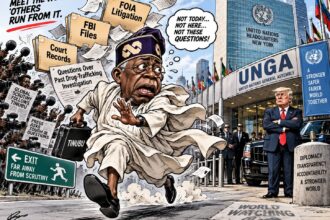
Former Vice President Atiku Abubakar has demanded an explanation from President Bola Ahmed Tinubu over his decision not to attend the 81st Session of the United Nations General Assembly in New York, questioning whether the President’s past legal controversies in the United States have affected Nigeria’s diplomatic engagement.
Atiku’s position was contained in a statement issued on Sunday by his Senior Special Assistant on Public Communication, Phrank Shaibu. The statement followed the Presidency’s decision to send Vice President Kashim Shettima to lead Nigeria’s delegation to the 2026 UNGA.
The 81st UN General Assembly high-level week is scheduled for September 22 to 28, with the General Debate taking place from September 22 to 26 and continuing on September 28. The United Nations describes the General Assembly as its main deliberative and policymaking body, with all 193 member states represented.
Atiku said Tinubu’s absence had become a recurring issue, alleging that the President did not personally attend the 79th UNGA in 2024, the 80th in 2025, and would again be absent from the 81st session in 2026.
He argued that while the Vice President could represent the country, repeated delegation of presidential responsibilities at one of the world’s major diplomatic gatherings deserved public explanation.
According to Atiku, the UNGA provides an important platform for national leaders to present their countries’ positions, engage foreign governments and participate in discussions on international security, economic development, trade, climate change and multilateral cooperation.
“Vice President Shettima may represent Nigeria capably, but representation by delegation cannot permanently substitute for the personal authority, visibility and responsibility of the President,” Atiku said.
He further argued that the sidelines of the General Assembly offer opportunities for bilateral meetings and discussions with governments, international institutions and potential investors.
Atiku specifically questioned reports that Nigeria’s Permanent Representative to the United Nations, Jimoh Ibrahim, had previously indicated that arrangements had been made for Tinubu to occupy a seat relatively close to United States President Donald Trump.
“The seat was secured, but the President disappeared,” Atiku said, questioning why such an arrangement would have been highlighted if Tinubu ultimately had no plans to attend.
The former Vice President also linked Tinubu’s absence to reported spending on American lobbying efforts. He questioned reports that Nigeria’s government had committed as much as $9 million to lobbyists in the United States, asking what Nigerians had received in return for the expenditure.
Atiku argued that the reported expenditure and Tinubu’s continued absence from New York raised questions about the government’s broader strategy for managing Nigeria’s relationship with Washington.
He also raised questions concerning a 1993 case before the United States District Court for the Northern District of Illinois involving funds associated with Tinubu and companies linked to him.
According to Atiku, the case involved US government forfeiture proceedings concerning funds allegedly connected to narcotics trafficking and money laundering. He referred to the eventual forfeiture of approximately $460,000 to the US government.
Those matters are historical legal proceedings, and Atiku presented them as the basis for questions about whether Tinubu’s history in the United States could be affecting his willingness or ability to participate in diplomatic engagements there. His statement did not establish that Tinubu is legally barred from entering the United States.
“We are not asserting that Tinubu is legally prohibited from entering the United States. The Presidency has announced no such restriction,” Atiku said.
He nevertheless asked the Federal Government to clarify whether there was any legal, diplomatic, medical or personal reason for the President’s repeated absence from the UNGA.
The former Vice President also questioned whether the President’s absence could affect Nigeria’s international profile and opportunities for economic diplomacy.
Atiku said direct presidential participation in high-level international meetings could provide opportunities for Nigeria to discuss investment, trade, development financing, security cooperation and other issues with foreign leaders.
However, the Nigerian delegation led by Shettima is expected to participate in the General Assembly’s high-level engagements. The United Nations schedule confirms that the 81st session will feature discussions involving heads of state, government and other high-level representatives.
The UN’s official programme includes high-level meetings on the Right to Development, climate action, sea-level rise, pandemic prevention and preparedness, and the 25th anniversary of the Durban Declaration and Programme of Action.
Atiku also criticised what he described as a contrast between the President’s domestic political posture and his absence from major international forums.
He questioned why Nigeria would deploy substantial resources to strengthen its diplomatic image abroad while the President repeatedly declined to attend the UNGA in person.
“After committing up to $9 million to American lobbyists, Nigerians deserve more than silence, evasions and another empty presidential seat at the United Nations,” he said.
Atiku further demanded that the Presidency state clearly whether Tinubu was free to travel to the United States and explain the circumstances surrounding his decision not to attend the 81st UNGA.
“If there is no impediment, the Presidency must explain this serial absenteeism. If an impediment exists, Nigerians have a right to know,” he said.
The statement comes as the 81st UNGA prepares to open its General Debate in New York on September 22. The United Nations says the annual General Debate provides a forum for heads of state and government and other senior representatives to present their positions on global challenges.
Atiku concluded by arguing that Nigeria’s foreign policy and international interests should remain separate from the personal circumstances of any individual occupying the presidency.
The Presidency has not, in the material provided, announced any legal restriction preventing Tinubu from travelling to the United States. It has instead confirmed that Vice President Shettima will lead the Nigerian delegation to the 81st UNGA.
The controversy is therefore centred on the political and diplomatic implications of Tinubu’s absence, Atiku’s questions about the reasons for it, and the government’s decision to have the Vice President represent Nigeria at the 2026 gathering.
I have kept the allegations about the U.S. case and lobbying expenditure attributed to Atiku rather than presenting them as independently established conclusions.