As Nigeria gradually inches toward the 2027 general elections, political realignments and strategic consultations are intensifying across party lines, with the African Democratic Congress (ADC) making a bold move to court Bauchi State Governor, Bala Mohammed, into its fold.
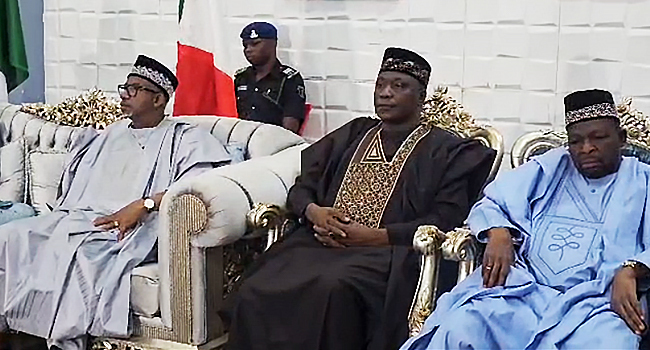
The high-level political outreach unfolded on Tuesday when a delegation of ADC stakeholders, led by former Secretary to the Government of the Federation, Babachir Lawal, visited the governor at the Bauchi State Government House. The meeting, described by insiders as strategic and forward-looking, centred on exploring possible alliances and charting a new political direction ahead of what is already shaping up to be a fiercely contested election cycle.
Speaking after the closed-door meeting, Lawal disclosed that the visit was undertaken at the behest of the party’s National Chairman, David Mark. He emphasised that the ADC leadership recognises the urgency of building a broad-based coalition capable of challenging the current political order in 2027.
“We are here in Bauchi State today at the instance of our National Chairman, Senator David Mark,” Lawal stated. “He is deeply concerned about the future of Nigeria and believes that the coming political contest in 2027 will be decisive. It is a battle that can only be won if all patriotic and well-meaning Nigerians unite under a common platform.”
Lawal did not mince words in expressing his concerns about the country’s trajectory, warning of dire consequences should the current administration remain in power beyond 2027. According to him, the stakes are extraordinarily high, and failure to achieve political change could worsen existing socio-economic challenges.
“We are fully aware that if we make a mistake and allow this government to continue post-2027, Nigeria may face unprecedented hardship,” he said. “The situation could deteriorate to the point where basic necessities like healthcare become unaffordable for the majority, forcing people into extreme conditions.”
The visit to Governor Mohammed is widely seen as part of ADC’s broader strategy to attract influential political figures, particularly those disenchanted with internal crises within their current parties. As Chairman of the Peoples Democratic Party Governors’ Forum, Mohammed occupies a critical position within the opposition landscape, making him a valuable ally for any coalition seeking to mount a credible challenge in 2027.
Sources familiar with the meeting indicated that discussions revolved around potential pathways for political collaboration, including the possibility of Mohammed and his supporters aligning with the ADC or forming a broader coalition platform. While no formal commitment has been announced, the engagement signals growing momentum toward political realignment.
The ADC’s move comes against the backdrop of a deepening crisis within the Peoples Democratic Party (PDP), Nigeria’s main opposition party. The party has been embroiled in a prolonged leadership tussle that has fractured its internal structure and weakened its cohesion.
At the centre of the crisis is a power struggle involving the Minister of the Federal Capital Territory, Nyesom Wike, whose loyalists are said to have taken control of key party structures. Governor Mohammed has been one of the prominent figures opposing this development, leading to a prolonged standoff that has split the party into rival factions.
One faction of the PDP is aligned with Tanimu Turaki and is backed by Governor Mohammed alongside Oyo State Governor Seyi Makinde. The opposing faction, however, is led by Abdulrahman Mohammed and enjoys the support of Wike.
The divisions reached a critical point last Sunday when the Wike-backed faction held a national convention at the Moshood Abiola National Stadium in Abuja. The convention produced Abdulrahman Mohammed as the substantive National Chairman and Samuel Anyanwu as National Secretary, a move that has further complicated the party’s internal dynamics.
However, the roots of the crisis date back to November of the previous year, when the Turaki-led faction organised a separate convention in Ibadan, Oyo State. That gathering, dismissed by Wike as a mere “social event,” escalated tensions within the party and triggered a series of legal battles over its legitimacy.
The judicial dimension of the crisis has added another layer of complexity. On March 9, the Court of Appeal Nigeria sitting in Abuja upheld a ruling of the Federal High Court that restrained the PDP from conducting the Ibadan convention. In its judgment delivered on March 23, a three-member panel led by Justice Uchechukwu Onyemenam dismissed the PDP’s appeal, affirming that the lower court had jurisdiction over the matter.
The appellate court further held that the party had violated its own constitutional provisions in organising the Ibadan convention, thereby rendering its outcomes legally questionable. Despite this setback, the Turaki faction has proceeded to the Supreme Court of Nigeria, seeking to overturn the judgment and assert its position.
The ongoing legal battles and factional disputes have significantly undermined the PDP’s ability to function as a cohesive opposition force. Analysts warn that if the crisis remains unresolved, it could weaken the party’s prospects in the 2027 elections and create openings for alternative platforms like the ADC.
It is within this context that the ADC’s outreach to Governor Mohammed takes on added significance. By engaging a key figure in the PDP’s power structure, the party appears to be positioning itself as a viable alternative for politicians seeking stability and a fresh political platform.
Political observers note that the next few months will be critical in determining whether the opposition can consolidate its forces or remain fragmented. The possibility of defections, alliances, and the emergence of new coalitions is likely to shape the political landscape in the lead-up to 2027.
For Governor Mohammed, the decision ahead is both strategic and consequential. Aligning with a new political platform could redefine his political trajectory and influence the balance of power within the opposition. At the same time, remaining within the PDP would require navigating an increasingly complex and uncertain internal environment.
As consultations continue behind closed doors, one thing is clear: the battle lines for the 2027 general elections are already being drawn. The ADC’s move to court Bala Mohammed underscores the intensity of the political manoeuvring underway and highlights the growing importance of coalition-building in Nigeria’s evolving democratic landscape.
Whether this outreach will translate into a formal alliance remains to be seen, but it signals a broader trend of political recalibration that could ultimately reshape the contours of Nigeria’s opposition politics in the years ahead.