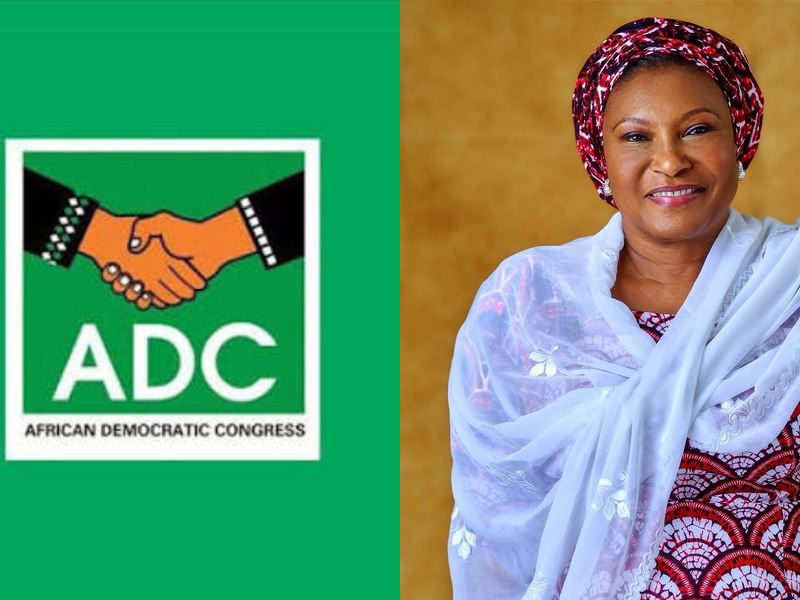
The African Democratic Congress (ADC) in the Federal Capital Territory has filed a suit at the Federal High Court in Abuja seeking an order restraining Senator Ireti Kingibe from presenting herself as a member of the party.
The legal action comes barely 48 hours after the senator was reportedly placed on an indefinite suspension by the party’s executive committee in Wuse Ward, a decision that has triggered fresh controversy within the ADC’s ranks in the Federal Capital Territory.
In the suit filed before the Abuja division of the Federal High Court, the party asked the court to affirm that the Wuse Ward Executive Committee acted within its constitutional powers when it suspended the lawmaker.
The originating summons, which was filed through the ADC’s counsel, Maxwell Opara, seeks a judicial declaration that the ward leadership of the party possesses the authority to discipline members within its jurisdiction, including the power to suspend individuals who violate the party’s rules.
The party further urged the court to declare that the suspension of Senator Kingibe, who currently represents the Federal Capital Territory in the National Assembly of Nigeria, remains valid and binding until it is formally lifted by the appropriate party organ.
According to court documents, the suit was filed by two officials of the ADC in Wuse Ward. The plaintiffs are Okezuo Godfrey Kanayo, who serves as the chairman of the party in the ward, and Isaiah Ojonugwa Samuel, the ward secretary.
Both men instituted the legal action on behalf of themselves and other members of the Wuse Ward Executive Committee.
The case, which has been assigned the suit number FHC/ABJ/CS/539/2026, outlines several reliefs that the plaintiffs are seeking from the court in relation to the ongoing internal dispute within the party.
Among the key prayers before the court is a request for a declaration that Senator Kingibe cannot legally present herself as a member or card-carrying member of the African Democratic Congress while the suspension imposed by the Wuse Ward Executive Committee remains in force.
The plaintiffs also asked the court to affirm that the party’s National Working Committee of the African Democratic Congress should not recognise Senator Kingibe as a member of the party in any official capacity during the period of her suspension.
According to the plaintiffs, recognising the senator as a member of the party while the suspension remains active would undermine the authority of the ward leadership and weaken the party’s internal disciplinary structure.
The suit also seeks a declaration validating the decision taken by the Wuse Ward Executive Committee to suspend the senator indefinitely.
The plaintiffs argued that the ward leadership acted in accordance with the constitution of the African Democratic Congress and therefore has the legal authority to enforce disciplinary measures against members within its jurisdiction.
The legal action was brought pursuant to Sections 6(6)(b) and 251 of the 1999 Constitution of the Federal Republic of Nigeria (as amended), which define the powers of the courts and the jurisdiction of the Federal High Court.
In addition, the plaintiffs cited Article 16 of the constitution of the African Democratic Congress, which outlines the disciplinary procedures and internal governance mechanisms of the party.
They also relied on Order 3 Rules 6 and 7 of the Federal High Court (Civil Procedure) Rules 2019 to support their application before the court.
The plaintiffs further invoked the inherent jurisdiction of the Federal High Court, requesting that the court interpret the relevant provisions of the party’s constitution and enforce them accordingly.
Legal observers note that the case highlights a broader issue involving the internal management of political parties in Nigeria, where disputes over membership status, disciplinary actions, and leadership authority frequently end up before the courts.
The decision to seek judicial intervention in the matter underscores the seriousness of the dispute within the ADC in the Federal Capital Territory.
Although details of the allegations that led to Senator Kingibe’s suspension were not extensively outlined in the court filings available to the public, party insiders say the development reflects deepening tensions between the senator and some elements within the party’s local leadership structure.
The dispute has already generated considerable attention within political circles in Abuja, particularly because Senator Kingibe is one of the most prominent political figures representing the Federal Capital Territory at the national level.
Her representation of the FCT in the National Assembly places her at the centre of legislative discussions affecting the administration and development of the nation’s capital.
As a result, the legal challenge filed by the ward executive committee is being closely monitored by political observers, party members, and constitutional lawyers.
The outcome of the case could potentially clarify the scope of authority that ward-level party executives possess when it comes to disciplining elected officials within the party.
It could also determine whether a sitting senator can continue to identify with a political party while a suspension imposed by a lower party organ remains unresolved.
As of the time this report was filed, the case had not yet been assigned to a judge at the Federal High Court in Abuja.
Court officials confirmed that the matter is still undergoing administrative processing before it can be formally listed for hearing.
Once assigned, the court is expected to examine the legal arguments presented by the plaintiffs and determine whether the ward executive committee acted within the limits of the ADC constitution.
The development represents the latest twist in the internal political tensions within the African Democratic Congress in the Federal Capital Territory.
Observers say the dispute could have broader implications for party unity and internal discipline as Nigeria’s political parties continue to reposition themselves ahead of future electoral contests.
For now, the matter remains before the court, and the final determination will depend on the judicial interpretation of the party’s constitution and the applicable provisions of Nigerian law.