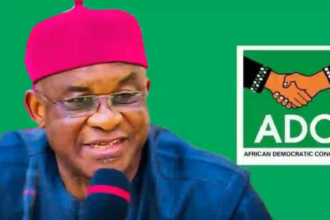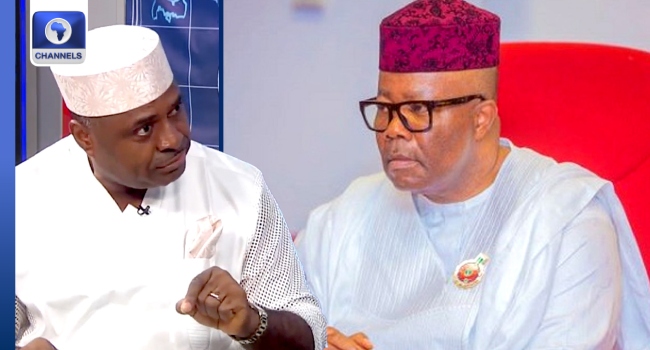
A chieftain of the African Democratic Congress (ADC), Kenneth Okonkwo, has strongly criticised Senate President Godswill Akpabio over the ongoing controversy surrounding the Electoral Act Amendment Bill, describing him as an “enemy of democracy” and calling for his removal from office.
Okonkwo made the remarks on Sunday while speaking on Inside Sources with Laolu Akande, a political programme aired on Channels Television, where he reacted to the Senate’s recent decision on key provisions of the proposed amendments to Nigeria’s electoral law.
The former Nollywood actor and lawyer accused Akpabio of deliberately frustrating efforts to strengthen Nigeria’s electoral system, particularly with regard to electronic transmission of election results. According to Okonkwo, the Senate President’s position reflects a continued commitment to electoral malpractice and undermines the credibility of democratic processes in the country.
“What it means is that Senator Godswill Akpabio has become an enemy of democracy and is sticking to the vicious cycle of election rigging, manipulation, falsification, and subterfuge,” Okonkwo said. “By trying to maintain the same provision that the Supreme Court has already warned against, he has placed himself against the will of the people and the spirit of democracy.”
He further argued that maintaining discretionary provisions on the transmission of election results contradicts judicial guidance and public demand for transparency in elections.
“That man is an enemy of democracy and should be removed if he doesn’t resign,” Okonkwo added, intensifying his call for accountability at the highest level of the National Assembly.
The controversy stems from the Senate’s consideration of the Electoral Act Amendment Bill, which passed its third reading last week. A key point of contention is Clause 60(3) of the bill, which deals with the transmission of election results from polling units.
During plenary last Wednesday, the Senate rejected proposals seeking to mandate the real-time electronic transmission of results directly from polling units. Instead, lawmakers voted to retain the existing provision in the 2022 Electoral Act, which allows the Independent National Electoral Commission (INEC) to transmit results “in a manner as prescribed by the Commission.”
Critics argue that this discretionary wording weakens the legal framework for transparent elections and leaves room for manipulation, especially during collation stages. Advocacy groups, opposition figures, and civil society organisations have consistently pushed for a clear statutory mandate that would compel INEC to upload results electronically in real time, immediately after votes are counted at polling units.
In addition to rejecting mandatory real-time electronic transmission, the Senate also threw out a proposal to impose a 10-year ban on individuals convicted of vote-buying. Lawmakers opted instead to retain existing sanctions, which include jail terms and monetary fines, as provided under the current electoral law.
Okonkwo faulted the Senate’s decisions, describing them as retrogressive and inconsistent with the lessons from previous elections, particularly the 2023 general polls, which were marred by disputes over result transmission and allegations of manipulation.
He maintained that refusing to strengthen the law sends a dangerous signal ahead of the 2027 general elections, suggesting that political elites are unwilling to close loopholes that enable electoral fraud.
“The refusal to make electronic transmission mandatory is a deliberate attempt to keep the system opaque,” Okonkwo argued. “If you truly believe in democracy, you should have nothing to fear from transparency.”
The ADC chieftain also warned that public confidence in the electoral process would continue to erode if lawmakers fail to align electoral reforms with global best practices and citizens’ expectations.
The Senate leadership has yet to formally respond to Okonkwo’s comments. However, supporters of the Senate’s position have argued that INEC should retain operational flexibility, claiming that challenges such as connectivity and infrastructure still require discretion in how results are transmitted.
As debate over the Electoral Act Amendment Bill continues, the issue of electronic transmission remains a flashpoint in Nigeria’s democratic discourse, with growing pressure on the National Assembly to revisit its decision and enact reforms that reinforce transparency, credibility, and public trust in elections.