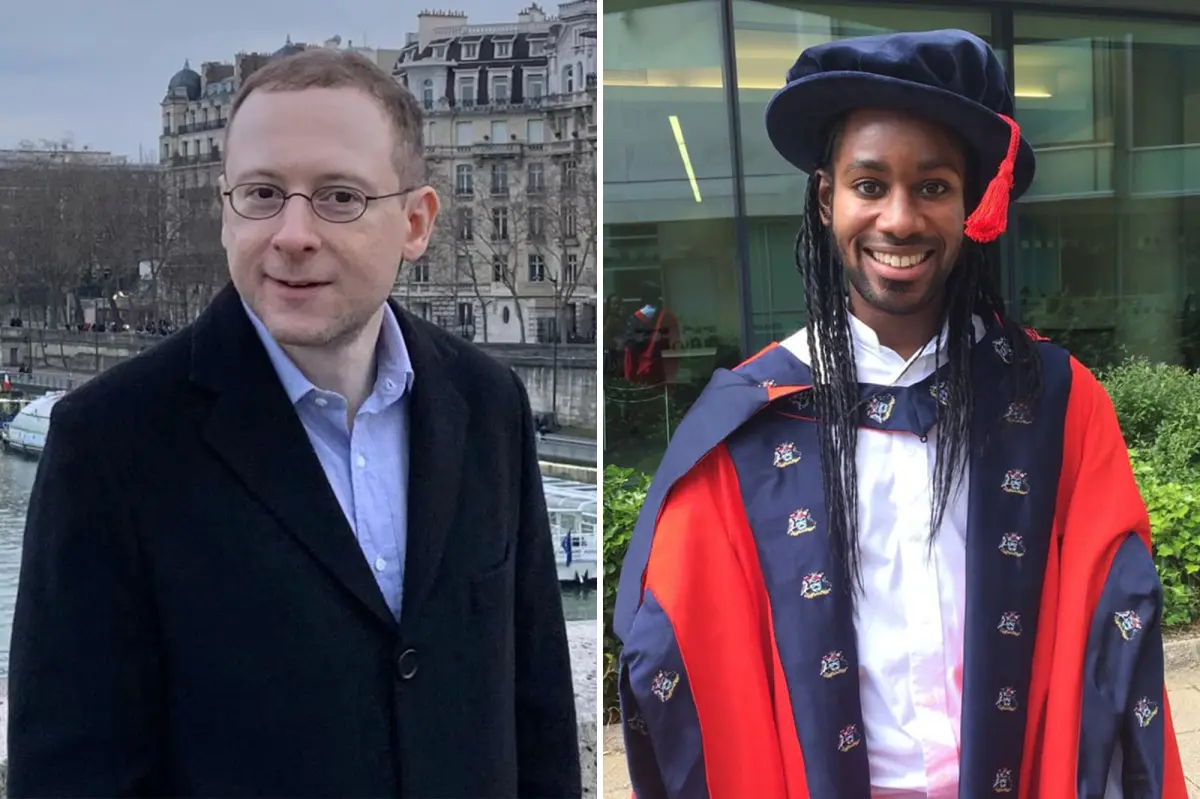
An American academic who publicly accused the late former Cambridge University professor Jason Arday of plagiarism has been suspended from his position at Ghent University in Belgium, just days after Arday was found dead at his home in London.
Nathan Cofnas, a postdoctoral researcher in the Department of Philosophy and Moral Sciences at Ghent University, disclosed that he had been suspended from his position following public statements he made concerning Arday and his academic career.
Cofnas, a Chicago-born academic and former Cambridge researcher, said he expected that the university could ultimately terminate his appointment as a result of the controversy.
“They will almost certainly fire me,” Cofnas reportedly said after learning of his suspension.
Ghent University, however, described the action as a precautionary measure and said it was part of an internal investigation into recent public statements made by one of its postdoctoral researchers. Although the university did not name Cofnas, the timing and circumstances surrounding the announcement made clear that the disciplinary process concerned the academic.
A university spokesperson said the institution was assessing whether there were sufficient grounds to refer the matter to its competent disciplinary body for further consideration.
The university declined to provide additional details, citing the confidentiality of personnel files and disciplinary proceedings.
Cofnas had recently attracted considerable attention after publishing allegations concerning Arday, who became the youngest Black professor at Cambridge University when he was appointed as a professor of sociology in 2023.
Arday was found unresponsive at his home in south London less than a week before Cofnas announced that he had been suspended. He was later pronounced dead at the age of 41.
Following news of Arday’s death, Ghent University Rector Petra De Sutter issued a statement saying the circumstances should encourage reflection within the academic community.
De Sutter said the university hoped lessons would be learned about how people treat one another both inside and outside academic institutions, particularly when individuals become the subject of intense public controversy.
The statement came amid a wider debate over the treatment of academics facing public allegations, criticism and scrutiny.
Cofnas had outlined his allegations against Arday in a Substack article titled “DEI fraud and cover-up at Cambridge.” In the publication, he claimed to have examined Arday’s doctoral thesis using Copyleaks, a plagiarism-detection platform.
According to Cofnas, the software identified substantial similarities between sections of Arday’s thesis and an earlier thesis by Paula Zwozdiak-Myers, who was studying at Brunel University in 2009.
Cofnas claimed that subsequent analysis identified more than 100 passages in Arday’s thesis that appeared similar to, or had allegedly been lifted from, Zwozdiak-Myers’ work.
The allegations became part of a wider controversy surrounding Arday’s academic credentials and professional history. Cofnas also questioned the circumstances surrounding Arday’s appointment at Cambridge, alleging that the university had recruited him with a specific objective of promoting racial diversity.
Arday joined Cambridge as a professor of sociology in February 2023. In an article published by the university at the time, he spoke about his ambition to widen access to higher education and create opportunities for people from disadvantaged backgrounds.
Arday said his academic work focused largely on opening doors for people from disadvantaged communities and helping to democratise higher education. He also expressed the hope that his position at Cambridge would give him the influence necessary to advance that agenda nationally and internationally.
Cofnas, who himself had previously been employed by Cambridge, was dismissed by the university in 2024 following controversy over blog posts he had written.
The scrutiny surrounding Arday also extended to claims concerning his professional affiliations with other universities.
One allegation concerned his claim to have been a visiting professor at Ohio State University’s Office of Diversity and Inclusion. According to reports cited by Cofnas, the university’s diversity office was later closed, while staff members reportedly said they had no record of Arday being employed there.
Another claim concerned the University of Glasgow. Arday had reportedly described himself as a visiting professor at the Scottish institution, but the university strongly disputed that description.
Questions were also raised over his association with Durham University, where he had listed himself as an honorary professor in the Department of Sociology.
Durham University subsequently clarified that, after Arday left the institution for another university, he maintained an unpaid academic association with Durham in connection with ongoing project work. The university explained that such arrangements were standard practice within academia.
Cambridge University had indicated that it would investigate the allegations concerning Arday’s academic record. However, before the process could apparently reach a conclusion, Arday resigned from his position.
In a resignation letter published by the Good Law Project, Arday said the years following his appointment to Cambridge had been characterised by what he described as an unrelenting level of public scrutiny and personal attacks.
He acknowledged that criticism was an unavoidable aspect of academic life but argued that the allegations and public commentary directed at him had gone well beyond legitimate scholarly disagreement.
Arday said the accusations, speculation and continuing public attention had taken a serious toll on him and on people close to him.
His death has now added another dimension to the controversy, with academic institutions and commentators confronting questions about the consequences of prolonged public disputes involving academics.
The circumstances surrounding Arday’s death and the allegations made against him remain separate issues, and the claims concerning his academic work should not be treated as established facts merely because they were publicly alleged.
Meanwhile, Ghent University has indicated that its investigation into Cofnas is ongoing. The university’s description of the suspension as a precautionary measure suggests that no final disciplinary decision has yet been announced.
The institution is expected to determine whether Cofnas’s public statements breached university rules or professional standards and whether the matter should proceed to a formal disciplinary hearing.
The controversy has generated renewed discussion about academic freedom, professional accountability and the boundaries of public criticism. Universities routinely face the difficult task of balancing freedom of expression with obligations to protect staff members, maintain professional standards and ensure that allegations are handled through appropriate procedures.
Cofnas’s case is particularly sensitive because his allegations concerned another academic institution and were made publicly, while his own employer has now launched an investigation into his conduct.
As the Ghent University process continues, the academic community is likely to remain focused on how institutions respond when serious allegations about scholarly integrity become public.
For now, the university has not disclosed what disciplinary action, if any, could ultimately be taken against Cofnas. It has also declined to comment on the specific allegations or evidence involved in the case.
The suspension therefore remains an interim measure while the investigation proceeds. Any final determination will depend on the outcome of the university’s internal process and whether its disciplinary authorities conclude that further action is warranted.
The episode has nevertheless become a striking chapter in the controversy surrounding Arday’s short but prominent academic career, raising difficult questions about plagiarism allegations, academic credentials, freedom of expression and the treatment of individuals caught in highly publicised disputes.
With investigations and questions still unresolved, the case is likely to continue attracting attention within academic circles in Britain, Belgium and the United States.