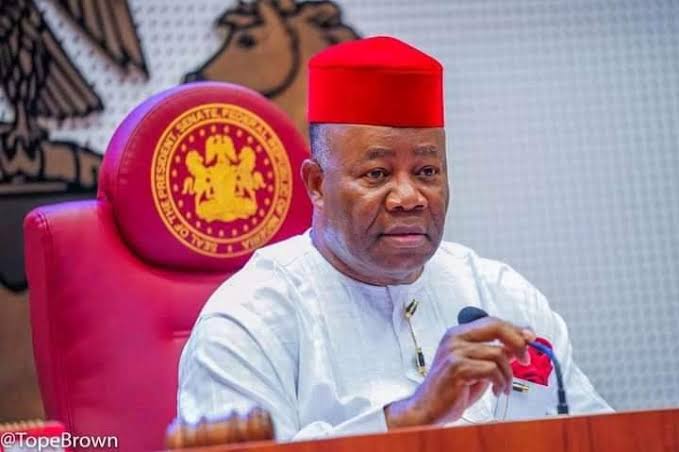
Senate President Godswill Akpabio has warned Nigerian politicians against recruiting young people to attack political opponents, candidates and campaign teams ahead of the 2027 general elections.
Akpabio condemned the growing practice of using youths as instruments of political violence, urging political leaders to stop exposing other people’s children to dangers they would never allow their own children to face.
He gave the warning during Tuesday’s plenary session of the Senate, where he called for greater public enlightenment on the criminal consequences of electoral violence under the Electoral Act 2026.
The Senate President argued that politicians who would not permit their children to participate in violent political activities should not encourage or recruit young people from other families to do so.
“I don’t think there’s any politician that will allow his child to carry sticks and carry stones to go and stone candidates, other candidates,” he said.
He continued: “So if they cannot use their children, they should not use other people’s children. So that orientation and then enlightenment program should involve drawing attention to the provisions embedded in the Electoral Act 2026 as to the criminal nature of the act.”
Akpabio’s remarks come amid growing concerns over reported attacks on political candidates, supporters and campaign officials in different parts of the country as political activities intensify ahead of the January 16, 2027 elections.
Several incidents involving political parties and their supporters have raised questions about the safety of candidates and the ability of security agencies to guarantee peaceful campaigns.
Among the incidents cited was the November 4 attack on the convoy of the Nigeria Democratic Congress (NDC) presidential candidate, Peter Obi, in Cross River State.
There was also a reported attack on the African Action Congress (AAC) presidential candidate, Omoyele Sowore, and members of his entourage in Ado-Ekiti, Ekiti State.
In Sokoto State, the ADC governorship candidate, Manir Dan’iya, was reportedly attacked near the state airport, adding to concerns over the safety of opposition candidates during political engagements.
Violence was also reported during an NDC and Obidient procession in Asaba, Delta State, where one person was reportedly killed and five others injured.
In Lagos, suspected armed assailants reportedly disrupted an NDC town hall meeting in Oregun ahead of Obi’s scheduled appearance.
The incidents have contributed to concerns that political disagreements could increasingly spill into physical confrontations if political parties and security agencies fail to take preventive measures.
The violence has not been limited to opposition parties. Supporters of the ruling All Progressives Congress (APC) have also reportedly experienced attacks during political activities.
On October 28, supporters travelling to attend an APC rally in Katsina State were reportedly attacked. Another incident involving violence at an APC rally in Lafia, Nasarawa State, was reported on November 4.
Akpabio’s intervention highlights the need for political parties to discourage the recruitment of young people for intimidation, attacks and other unlawful activities during election campaigns.
His call for public enlightenment also draws attention to the importance of making politicians, party supporters and the wider electorate aware of the legal consequences of electoral offences.
Beyond the immediate danger to those recruited, political violence can undermine public confidence in the electoral process, discourage participation and create an atmosphere of fear around political campaigns.
The Senate President’s message was that political leaders must take responsibility for the conduct of their supporters and avoid using vulnerable young people as instruments of political confrontation.
With the 2027 elections approaching, the challenge for political parties, security agencies and electoral authorities will be to ensure that campaigns remain peaceful and that candidates and voters can exercise their democratic rights without intimidation or violence.