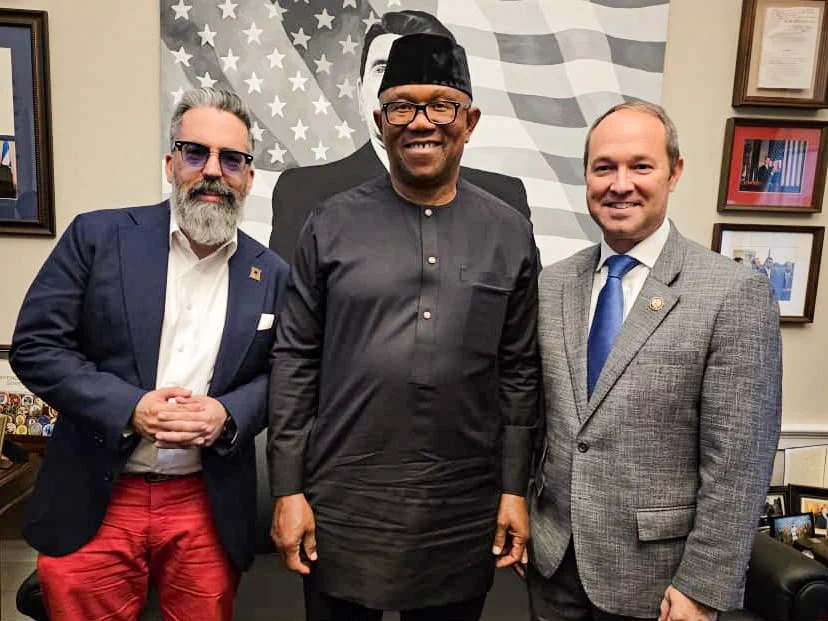
Obi said reports suggesting that his engagements with American lawmakers amounted to endorsements of his political aspirations were inaccurate and misrepresented the purpose of his visit.
In a clarification issued on Wednesday, the former Anambra State governor explained that his trip to the United States was primarily aimed at discussing Nigeria’s development, the welfare of its citizens and the country’s democratic future with congressional leaders and other influential American stakeholders.
He stressed that he neither sought nor described the meetings as endorsements by the US Congress or any of its members.
According to him, the engagements provided an opportunity to exchange ideas, share perspectives and discuss issues of mutual concern, particularly the need to strengthen Nigeria’s democratic institutions and improve the credibility of its electoral process.
Obi expressed concern over what he described as inaccurate interpretations of his visit, insisting that the central focus of his discussions was Nigeria and the challenges confronting its political and developmental future.
“I wish to address the inaccurate interpretation presented in certain media reports concerning my recent engagements with members of the United States Congress in Washington, DC,” he said.
He added that he had expressly stated during his remarks that the visit was not designed to obtain endorsements for his political ambition.
“As I expressly noted in my remarks, my visit to the United States was not intended to secure an endorsement, and I did not characterise my meetings as endorsements of my political aspirations by the US Congress or any of its members,” Obi stated.
The NDC presidential candidate explained that his discussions with American lawmakers and other stakeholders centred on issues affecting Nigeria, including economic development, citizens’ welfare, accountability and democratic consolidation.
He particularly highlighted the importance of building strong democratic institutions capable of ensuring that elections reflect the genuine choices of voters.
Obi maintained that Nigeria needed an electoral system that guarantees free, fair, transparent and credible elections, arguing that the integrity of the democratic process should be a concern for all citizens who desire a stable and prosperous country.
He said strengthening democratic institutions and promoting accountability were essential to restoring public confidence in governance and ensuring that political leadership remained responsive to the needs of the people.
The former governor also encouraged other Nigerian political leaders, particularly those seeking elective offices, to engage international stakeholders and learn from democratic experiences in other countries.
He argued that constructive international dialogue could provide opportunities for exchanging ideas, understanding best practices and building partnerships that would contribute to the development of Nigeria’s democratic institutions.
According to him, such engagements should not be interpreted merely through the narrow lens of partisan politics or electoral calculations.
“I consider engagements of this kind valuable, and I encourage other Nigerian political leaders, especially those seeking public office, to pursue similar discussions with international stakeholders,” he said.
Obi further noted that Nigeria’s democracy could benefit from the exchange of experiences and a shared commitment to credible elections.
He maintained that discussions with international lawmakers and influential stakeholders could help draw attention to the importance of democratic accountability, institutional independence and respect for the electoral choices of citizens.
The clarification comes after Obi’s recent visit to Washington, DC, where he held engagements with members of the US Congress and other American stakeholders.
The meetings attracted public attention amid growing political activities ahead of Nigeria’s 2027 general elections. Some reports had interpreted the engagements as an attempt to obtain international backing for his presidential ambition.
However, Obi rejected that interpretation, insisting that his mission was focused on Nigeria’s national interests rather than securing support from foreign political figures.
He warned against allowing sensational headlines and inaccurate reporting to distract from the substantive issues raised during the visit.
“Nigeria’s democratic future is far too consequential to be distorted by sensational headlines or inaccurate interpretations,” he said.
Reiterating the purpose of his trip, Obi stressed that his discussions were centred on the Nigerian people, national development and the future of democracy.
“My mission centred on Nigeria, its people and the future of our democracy—not on endorsing any individual,” he added.
His clarification seeks to draw a distinction between diplomatic and policy engagements with international stakeholders and formal political endorsements.
As political consultations intensify ahead of the 2027 elections, Obi’s statement places emphasis on the need for Nigerian political leaders to promote credible elections, institutional accountability and democratic values through constructive engagement at home and abroad.