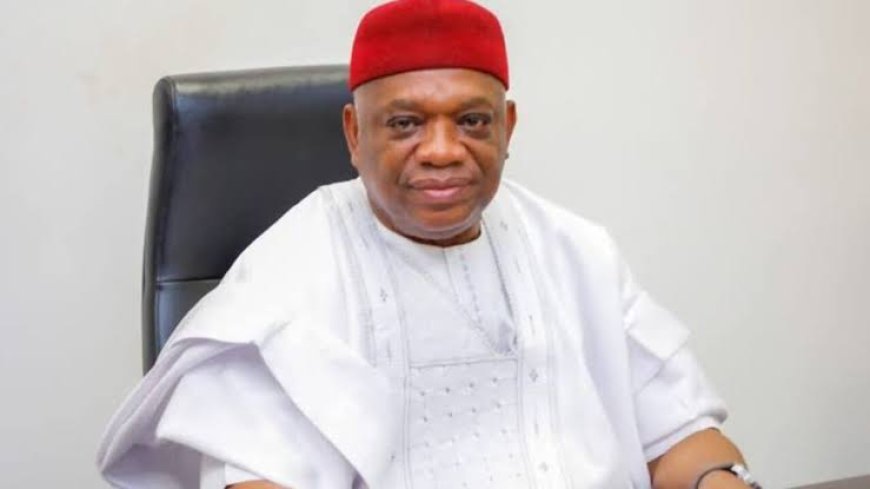
Senator Orji Uzor Kalu, representing Abia North Senatorial District, has admitted that he previously engaged in international arms trading, revealing that he sold heavy weapons to buyers in different countries, regardless of their political affiliations, provided they had the financial capacity to purchase them.
Kalu, a former governor of Abia State, made the disclosure during an interview on Arise Television on Monday while discussing his business activities across Africa and his relationships with former and serving South African leaders.
During the interview, the senator confirmed that he once operated an international arms business, explaining that his transactions involved heavy military equipment traded between countries rather than small firearms.
When the interviewer directly asked whether he had been an arms dealer, Kalu answered in the affirmative but said he eventually abandoned the business following intervention by his parents.
He explained that his parents, particularly his mother and father, insisted that he discontinue the trade.
“But my parents, my mother, my father came and said I must stop, and I stopped,” he said.
Asked whether he sold weapons to people who intended to use them to kill others, Kalu dismissed the suggestion, maintaining that his primary motivation was to make money rather than concern himself with how buyers eventually used the weapons.
“No, no, no, no, no, no. I was selling guns to make money, whether they blow up it’s not my business,” he stated.
The interviewer also asked whether he supplied weapons to the African National Congress (ANC) during its struggle against apartheid in South Africa.
Kalu, however, said his business was not limited to the ANC or any particular political organisation. He maintained that he sold weapons to anyone who could afford them.
“No, I was selling to anybody who wants to buy. If you have the money, you want to buy in D.R.C, I sell to you, you want to buy in Namibia, you want to buy…” he said.
When asked to identify the sources of the weapons, the senator declined to provide details, describing the information as a private business matter.
“It’s only my business,” he responded.
Kalu further clarified that the weapons involved in his former business were heavy military equipment transferred between countries, rather than small arms.
“No, these are heavy arms that were sold country to country,” he explained.
Another significant moment in the interview came when the anchor asked whether he had sold weapons to Libya under its former leader, Muammar Gaddafi.
Kalu reiterated that he was willing to sell to anyone with the financial means to purchase the weapons. However, he did not expressly confirm a specific transaction involving the late Libyan leader.
“May his soul rest in peace. He was a good man. If you have money to buy, when I was selling, I would sell to you,” he said.
The senator did not disclose the period during which he operated the arms business, the companies involved, the volume of weapons traded, the identities of specific buyers or whether the transactions were conducted under licensed international arms-trading arrangements.
His disclosure raises questions about the nature, scale and regulatory framework of the business, particularly given the security implications associated with international transfers of heavy military equipment.
Beyond his account of his former arms dealings, Kalu discussed his longstanding relationships with South African political leaders, tracing the connections to his friendship with the late anti-apartheid icon and former President, Nelson Mandela.
He said Mandela introduced him to several prominent South African politicians, including former President Thabo Mbeki and the country’s incumbent President, Cyril Ramaphosa.
Kalu also recalled a conversation in which Mandela allegedly explained the political considerations behind the emergence of Mbeki over Ramaphosa as his running mate within the ANC.
According to Kalu, Mandela told him that Mbeki’s father had contributed more to the anti-apartheid struggle than Ramaphosa’s father, a factor he said influenced the party’s preference for Mbeki.
The Abia North senator further disclosed that Mbeki later introduced him to former South African President Jacob Zuma, adding that his relationships with the country’s political leadership continued across successive administrations.
The interview has brought renewed attention to Kalu’s account of his former international arms-trading activities, particularly his assertion that he supplied heavy weapons to buyers based primarily on their ability to pay.