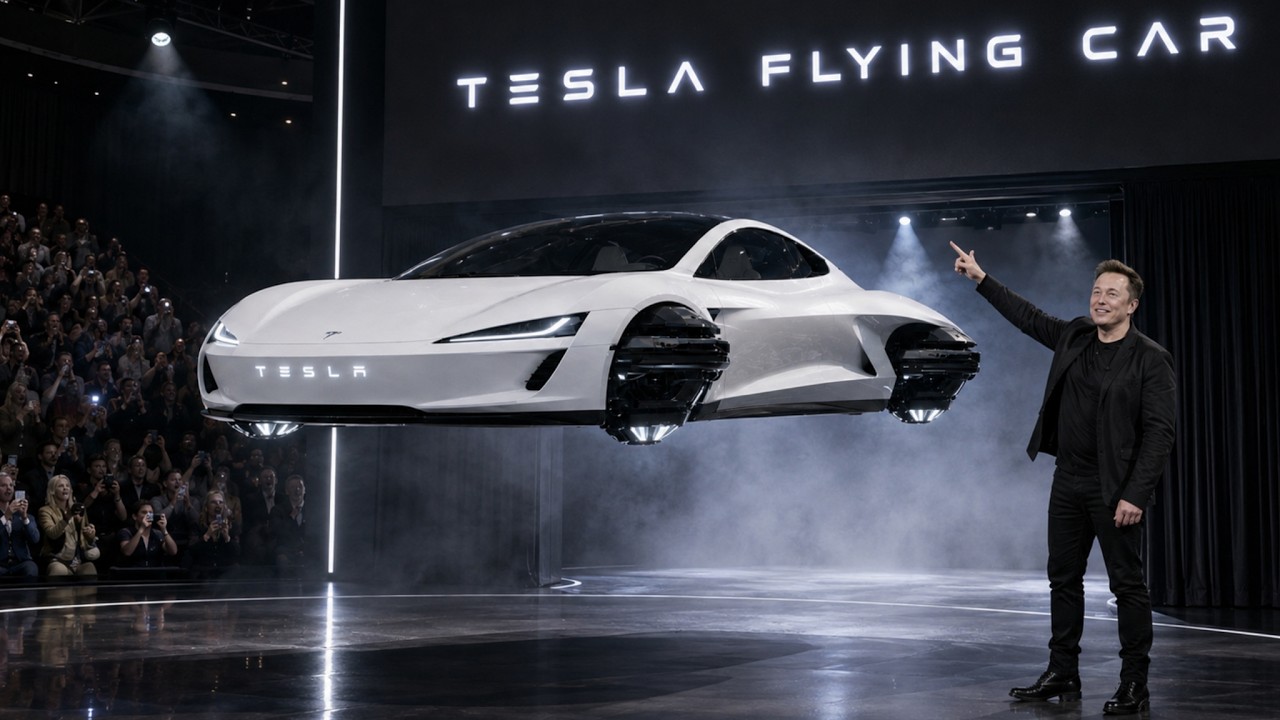
The vehicle was demonstrated on Thursday at a SpaceX test facility in Texas, where it reportedly performed a series of stunts, including climbing a steep ramp, hanging upside down, flipping in the air and landing with the assistance of air jets.
During the demonstration, the two-seater Roadster also leapt over a row of parked Tesla vehicles. Musk claimed that jets mounted at the rear could propel the car from zero to 60 miles per hour in less than a second.
The vehicle operated without a human driver during the demonstration, a precaution Musk said was intended to prevent injuries in the event of a malfunction.
“Success is not guaranteed,” Musk told the audience. “I mean that. It’ll probably work, but if it doesn’t work, we’re at a safe distance.”
According to the report, the Roadster uses 10 nozzles and what Musk described as ultra-high-pressure air tanks to generate thrust, enabling it to lift off the ground and accelerate rapidly.
Musk attributed the technology to a collaboration between Tesla, the electric vehicle manufacturer, and SpaceX, his aerospace company. He also said the vehicle was expected to enter production in 2028.
However, the demonstration has not established whether the Roadster can achieve sustained flight or travel significant distances through the air. While the vehicle reportedly performed aerial manoeuvres, questions remain about its practical capabilities, safety and suitability for everyday use.
Musk said the event was intended to demonstrate that the technology was real and not the product of artificial intelligence or visual effects.
Engineering and Safety Challenges
Experts have raised concerns about the difficulties involved in developing a vehicle that can operate efficiently both on roads and in the air.
Roger Connor, curator for vertical flight at the Smithsonian’s National Air and Space Museum, told CNN that aircraft and road vehicles have fundamentally different engineering requirements.
“Aircraft are extremely sensitive to weight, whereas with ground vehicles you want them to have bumpers and crumple zones and all that,” Connor said.
He explained that incorporating the structural features required for road safety into an aircraft-capable vehicle could increase its weight and compromise its flight performance. Such a hybrid design could also prove expensive while struggling to perform optimally in both environments.
The distinction is particularly important for electric vertical take-off and landing aircraft, commonly known as eVTOLs, which are designed to rise vertically before transitioning to forward flight.
Musk’s demonstration has drawn attention to the possibility of combining road transport with aerial mobility, but experts caution that lifting a vehicle into the air is different from developing a reliable aircraft capable of sustained, controlled flight.
Other Companies Pursuing Flying Cars
Tesla is not the only company exploring the concept of flying vehicles.
California-based startup Alef is developing a vehicle that uses eight propellers to lift off the ground. However, its prototype has significant limitations, including its weight, passenger capacity and restrictions on the weight of its occupant.
Alef Chief Executive Officer Jim Dukhovny told CNN before Tesla’s demonstration that getting a vehicle off the ground would not, by itself, establish that it could function effectively as a flying car.
He identified the transition from vertical lift to forward flight, while maintaining stability, as one of the major technical challenges facing electric aircraft developers.
Connor also questioned whether a road-legal vehicle such as the Roadster could sustain flight over distances comparable to those covered by conventional aircraft.
“We’re not talking about sustained flight,” he said. “We are literally talking about hopping.”
Questions Remain Over Practical Use
The proposed flying capability could represent an ambitious development in personal transportation if the technology can be demonstrated to work safely and reliably beyond controlled demonstrations.
However, several challenges remain, including flight stability, energy consumption, passenger protection, regulatory approval and the ability to operate safely in populated areas.
A vehicle capable of brief aerial jumps would also differ significantly from one able to travel long distances through the air, navigate changing weather conditions and comply with aviation regulations.
Although Musk has announced a 2028 production target, the Roadster’s claimed flying capabilities will require further demonstration and independent verification before it can be regarded as a practical flying car.
For now, the demonstration has highlighted the ambition behind Tesla and SpaceX’s reported collaboration, while leaving important questions about the vehicle’s real-world performance and safety unanswered.