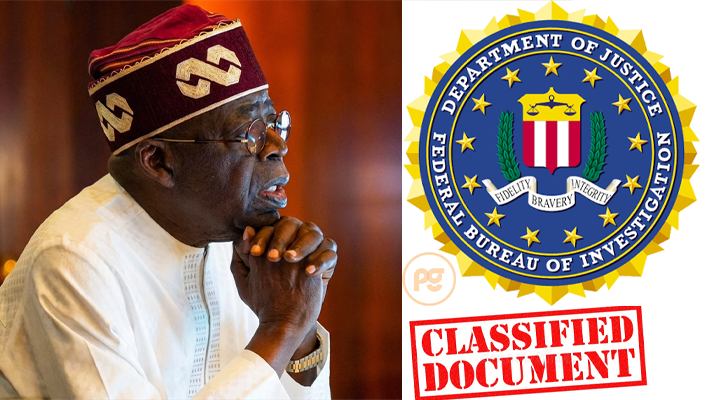
President Bola Tinubu could potentially face criminal charges in the United States after leaving office over allegations connected to a decades-old heroin-trafficking investigation, according to a Washington-based lobbying and investigative firm, Von Batten-Montague-York, L.C.
The firm said its assessment was based on its review of court filings in an ongoing Freedom of Information Act (FOIA) lawsuit involving records held by the United States Federal Bureau of Investigation (FBI) and Drug Enforcement Administration (DEA).
However, the firm did not claim that criminal charges against Tinubu are imminent or that US authorities have decided to prosecute him. Rather, it said the position of the federal agencies in the FOIA proceedings had raised questions about whether any investigation or enforcement proceeding connected to the historical matter could still be active.
The controversy centres on efforts to obtain government records relating to investigations involving Tinubu during the early 1990s.
According to the lobbying firm, the FBI and DEA were asked on two separate occasions to confirm that there was no longer any investigation or enforcement proceeding pending in relation to the underlying cases.
The agencies reportedly declined to provide such confirmation.
Instead, they stated that they were “not obligated to comment on whether law enforcement investigation(s) or proceeding(s) may exist.”
Von Batten-Montague-York said the response was noteworthy because the FBI and DEA had responded directly to other factual claims contained in the relevant court filings.
The firm argued that the agencies’ refusal to affirmatively state that no investigation or enforcement proceeding exists could leave open the possibility that some form of law-enforcement activity remains ongoing.
Nevertheless, the firm acknowledged that the agencies’ responses do not establish that the US government plans to charge Tinubu.
The development is linked to an ongoing legal battle over whether historical records relating to Tinubu should be made public.
Tinubu’s legal team recently asked a US federal court to block the release of unredacted records held by the FBI, DEA and the US Department of Justice.
The documents are being sought by American transparency activist Aaron Greenspan through a FOIA lawsuit against several US government agencies.
Among the records being requested are FBI files concerning Tinubu, including FBI Form 302 interview reports relating to the period between 1992 and 1993.
FBI Form 302 records generally document information obtained by federal agents during interviews conducted as part of investigations. The requested documents are therefore being closely watched because of their potential relevance to questions surrounding the historical allegations.
The case also involves records connected to a 1993 civil forfeiture proceeding concerning approximately $460,000.
Tinubu has consistently denied wrongdoing in relation to the allegations.
The historical controversy has resurfaced because of the continuing legal effort to obtain records that could shed further light on the investigations and proceedings from more than three decades ago.
Recent court filings have reportedly confirmed that the FBI possesses records compiled during investigations into multiple individuals in connection with drug-trafficking offences.
The filings also reportedly referenced an earlier judicial determination concerning the official acknowledgment of an investigation involving Tinubu.
For the transparency campaigners seeking access to the records, the existence and possible contents of the files are considered important to understanding what US law-enforcement agencies knew and investigated during the period in question.
For Tinubu’s legal team, however, the issue involves the protection of records that the president and his representatives have sought to prevent from being released in unredacted form.
The dispute therefore places questions of government transparency, privacy, law-enforcement records and public interest at the centre of the legal proceedings.
The suggestion that Tinubu could face criminal prosecution after leaving office remains, at this stage, an assessment by the lobbying firm rather than an announced decision by US prosecutors.
There is also no indication from the information presented that the FBI or DEA has formally announced an intention to bring criminal charges against the Nigerian president.
The agencies’ refusal to confirm or deny whether an investigation or enforcement proceeding exists is, by itself, not proof that an active criminal case against Tinubu remains open.
The significance of the development therefore lies primarily in the continuing legal struggle over access to historical US government records and what those documents may reveal.
As the FOIA litigation progresses, additional court filings could provide greater clarity on the nature of the records held by the agencies, the status of any historical investigations and the legal basis for withholding or releasing the documents.
The case has attracted considerable attention because of Tinubu’s position as Nigeria’s sitting president and the long-standing questions surrounding the historical US investigations.
For now, however, the available information does not establish that Tinubu will face criminal charges in the United States. Any such prosecution would depend on evidence available to US authorities, applicable law, prosecutorial decisions and the outcome of the continuing legal proceedings over the requested records.