The Presidency has described the recent deterioration and partial failure of sections of the Benin-Agbor-Asaba Expressway as an isolated incident, insisting that the development does not reflect the overall condition of federal road projects across Nigeria.
The Special Adviser to President Bola Tinubu on Media and Public Communications, Sunday Dare, made the clarification while speaking on Channels Television on Wednesday. He was reacting to growing concerns over the state of the highway and the Federal Government’s decision to redesign and completely reconstruct the affected section.
Dare said the government acted promptly after the road deteriorated, with the Minister of Works, David Umahi, National Assembly members and other relevant stakeholders visiting the affected area to assess the situation and demand immediate remedial action from the contractor.
According to him, the incident should not be used as a general measure of the performance of the Federal Government’s road construction programme, noting that several other federal highways across the country had either been completed or were progressing without similar problems.
“I think that first, these are isolated cases. And we all know by the nature of road construction, during rainy season, you encounter problems like this,” Dare said.
He acknowledged that the condition of the road represented a failure that required immediate attention, particularly from the contractor responsible for the project.
“Whatever played out yesterday, we had all the stakeholders there. And it’s important that even the contractor came out, even though he gave excuses, it showed a failure on their part,” he stated.
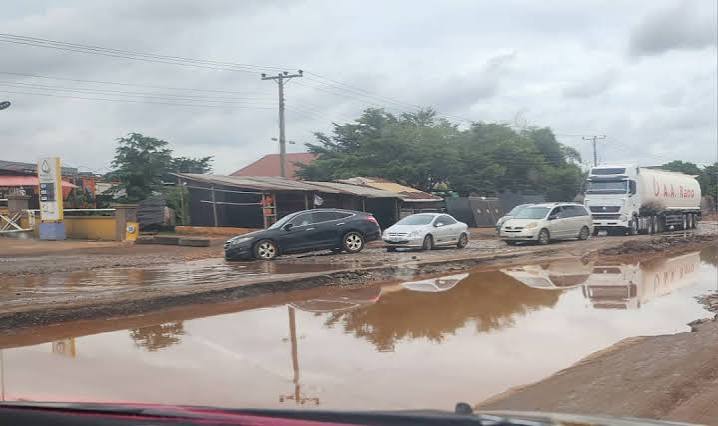
Dare’s comments came shortly after Umahi inspected the troubled section of the Benin-Agbor-Asaba road in Edo State and apologised to motorists and other road users over the hardship caused by the deteriorating highway.
During the inspection, Umahi reportedly took responsibility for the government’s part in addressing the problem while expressing dissatisfaction with the concessionaire handling the reconstruction project.
The minister subsequently directed moves towards the total reconstruction of the road after concluding that temporary palliative measures would not provide a sustainable solution.
The condition of the highway has generated significant public concern, particularly among commuters, commercial transport operators and businesses that depend on the route for the movement of people and goods.
When the road was inspected by journalists on Tuesday, sections around the Benin axis were reportedly in poor condition. However, the severe traffic congestion that had persisted for approximately two weeks had eased considerably.
Dare argued that the Federal Government’s response demonstrated the importance of government institutions reacting quickly when infrastructure problems emerge.
“Government has a responsibility to identify the roads that need to be fixed. Government has a responsibility to provide the funding. And then, the next responsibility goes to the contractors to do what is necessary,” he said.
He added that the rapid deployment of the Works Minister, legislators and other stakeholders to the affected location represented an example of responsive governance.
“What we saw yesterday, the Minister, the National Assembly members, and other key stakeholders going there in record time, right on the spot. And I think that’s what good governance is about, responding as quickly and as swiftly as possible, putting the blame where it is, and requesting for immediate action,” Dare stated.
The presidential aide also defended the administration’s broader infrastructure programme, maintaining that several federal roads had been successfully rehabilitated or constructed without attracting the kind of complaints associated with the Benin-Agbor-Asaba corridor.
“I said these are isolated, but we have quite a number of other roads where there are no complaints, where the roads have been fixed,” he said.
Dare further appealed for patience from Nigerians over the inconveniences associated with major road construction projects, explaining that large-scale infrastructure development is usually undertaken in phases.
He cited the Abuja-Lokoja road as an example, saying he recently travelled along the corridor with about 65 journalists and observed sections that had already been completed, as well as areas where concrete construction was ongoing.
According to him, road construction cannot be completed everywhere simultaneously, and motorists may have to use older sections of a highway while new portions are being constructed.
Using the construction of a building as an analogy, Dare said infrastructure projects are progressive and require time to reach completion.
“It’s like a house construction; a house is not built in a day, it’s progressive. Until the roof comes on, the rain will still pour down on the building,” he said.
He stressed that the Federal Government was implementing a large number of road projects across the country, including five major legacy roads and approximately 320 other roads.
Dare said the scale of the projects demonstrated the Tinubu administration’s commitment to infrastructure development and described the Ministry of Works as central to the implementation of the government’s road construction agenda.
“Is President Bola Ahmed Tinubu on top of what’s happening? Absolutely,” he said. “We’re talking about five legacy roads; we’re talking about 320 roads across the length and breadth of our country.”
The renewed attention to the Benin-Agbor-Asaba Expressway followed mounting complaints over the worsening condition of the road, which has disrupted transportation and increased the difficulty and cost of movement along the corridor.
The route is strategically important because it connects major commercial centres in Edo and Delta states and serves as a critical transportation corridor for passengers, traders and businesses moving between different parts of southern Nigeria.
The Presidency’s position is that while the failure on the road requires urgent intervention, it should be treated as a specific infrastructure challenge rather than evidence of a systemic failure across the Federal Government’s road projects.
With the Minister of Works directing a total reconstruction and the Presidency insisting on immediate action from the contractor, attention is now focused on how quickly the rehabilitation of the corridor will commence and whether the new intervention will provide a durable solution to the persistent challenges faced by motorists.