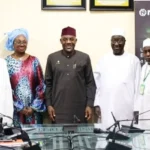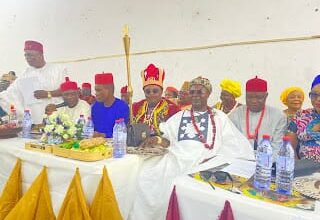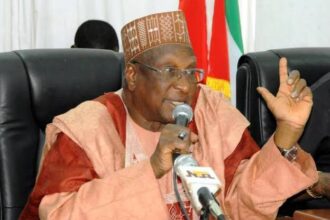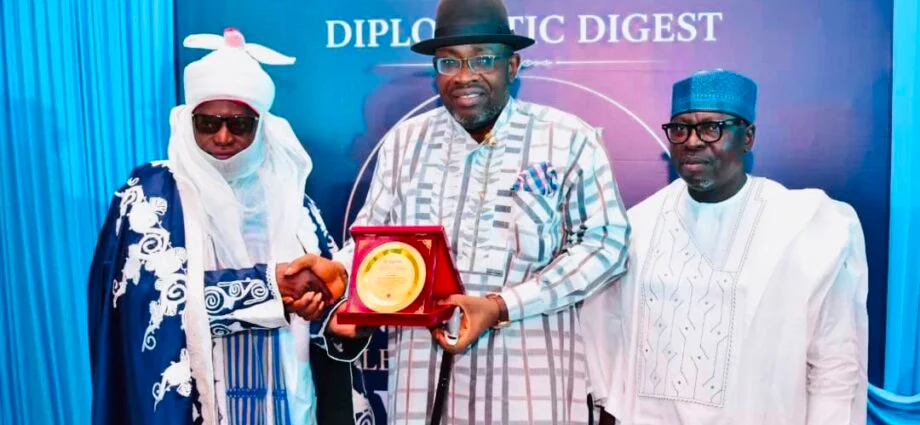
Senator Seriake Dickson, National Leader of the Nigeria Democratic Congress (NDC) and former Governor of Bayelsa State, has been honoured with the Pillar of Nigeria Democracy Award at the sixth anniversary lecture organised by Diplomatic Digest in collaboration with the Diplomatic Correspondents’ Chapel.
The event, held on Friday in Abuja, attracted diplomats, senior government officials, political leaders, media practitioners, civil society actors and other distinguished guests from across the country.
The News Agency of Nigeria (NAN) reports that representatives of the Ghanaian High Commission, the Burkina Faso High Commission and the Federal Ministry of Foreign Affairs were among the dignitaries present at the ceremony.
Receiving the award, Dickson expressed appreciation to the organisers for what he described as a significant recognition of his contributions to democratic governance and constitutional rule in Nigeria.
He also thanked his family, political associates, supporters and well-wishers, saying the honour would further inspire him to deepen his commitment to the defence of democracy, the rule of law and accountable governance.
According to him, the award was not merely a personal achievement but a recognition of the collective struggle of Nigerians who have continued to defend democratic ideals since the end of military rule.
Dickson dedicated the honour to leaders and members of the Nigeria Democratic Congress, as well as to all Nigerians who have remained steadfast in supporting constitutional democracy despite the country’s political and economic challenges.
“This award belongs to all Nigerians who have remained resilient in the defence of democracy and constitutional governance,” he said.
Reflecting on Nigeria’s democratic journey since 1999, Dickson commended citizens who have sustained democratic governance through elections, political participation and civic engagement.
He described democracy as a long and demanding process that requires patience, sacrifice, vigilance and institutional commitment rather than a destination that can be achieved overnight.
“Democracy is a marathon, not a sprint,” he said. “There are twists and turns, ups and downs, but perseverance is essential if we are to build a stable and prosperous nation.”
The senator maintained that despite its imperfections, democracy remains the most reliable path to national development and social progress.
According to him, no country can achieve sustainable development through unconstitutional governance, authoritarian rule or the suppression of institutions.
He stressed that democratic governance must be anchored on respect for the rule of law, credible elections, independent institutions and responsible leadership.
Dickson identified a free press, an impartial judiciary and an independent electoral commission as indispensable pillars of democracy, warning that democracy becomes hollow when these institutions are weakened.
“Without these essential elements, there is little difference between a civilian dictator and a military dictator,” he said.
He cautioned that civilian leaders who govern under the constitution must never undermine democratic institutions while claiming commitment to constitutional rule.
The former governor expressed concern over what he described as the shrinking democratic space in several African countries, particularly within the ECOWAS sub-region.
He warned that democratic backsliding, unconstitutional changes of government and growing distrust in political institutions pose serious threats to regional peace, stability and economic cooperation.
Dickson specifically referred to the emergence of new regional alignments such as the Alliance of Sahel States, saying such developments should provoke serious reflection among leaders in West Africa.
“The emergence of breakaway blocs within the sub-region does not speak well of regional leadership,” he said.
He urged President Bola Ahmed Tinubu, who currently chairs ECOWAS, to use his leadership position to strengthen democratic institutions across the region and discourage any attempt to use state institutions for partisan political purposes.
The senator reiterated his earlier position in the Senate that African leaders must uphold constitutional rule, respect term limits and conduct free, fair and credible elections in order to consolidate democracy on the continent.
According to him, one of the greatest threats to democracy in Africa is the tendency of governments to place themselves above constitutional institutions.
“When leaders treat institutions as instruments of personal or partisan power, public trust in democracy begins to erode,” he said.
Dickson also called on ministers, governors, legislators and other public office holders to demonstrate greater respect for the law and for the institutions of state.
He argued that democratic culture can only grow when leaders submit themselves to constitutional restraints and act in ways that strengthen public confidence in governance.
Looking ahead to the 2027 general elections, the NDC leader emphasised the need to protect the Independent National Electoral Commission (INEC), the judiciary and security agencies from political interference.
He said Nigerians must be assured that electoral outcomes genuinely reflect the will of the people.
“Credible elections are the foundation of democratic legitimacy,” he stated. “Citizens must have confidence that their votes count and that institutions are not manipulated for partisan advantage.”
Dickson further thanked leaders, members and officials of the Nigeria Democratic Congress for their support and commitment to the party’s democratic ideals.
He dedicated the award to all Nigerians and NDC members working to preserve multi-party democracy, constitutional governance and national unity.
The former governor concluded by appreciating Diplomatic Digest and the Diplomatic Correspondents’ Chapel for recognising what he described as his democratic contributions, sacrifices and public service, while pledging to continue advocating for stronger institutions, credible elections and a more accountable democratic order in Nigeria and across Africa.