A heated disagreement broke out between members of the ruling All Progressives Congress (APC) and the opposition African Democratic Congress (ADC) over President Bola Ahmed Tinubu’s educational credentials and the constitutional requirements for contesting elective office in Nigeria.
The exchange occurred during an appearance on Channels Television’s Politics Today on Monday, where representatives of both parties sharply disagreed on what the law requires of candidates seeking political office.
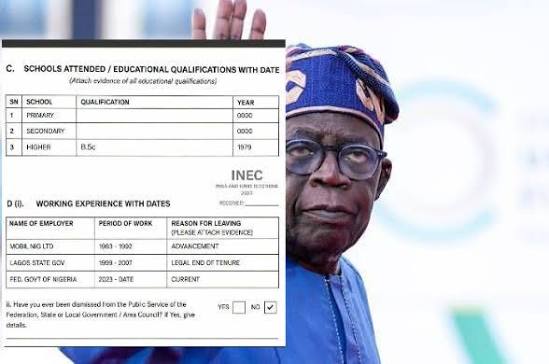
During the programme, ADC chieftain Kalu Kalu challenged President Tinubu to publicly disclose the primary and secondary schools he attended, arguing that Nigerians are entitled to full information about the educational background of their leaders.
Kalu maintained that public office holders, particularly those seeking the nation’s highest office, should provide clear and verifiable details of their educational history.
According to him, transparency on such matters is essential in a democracy and helps strengthen public confidence in political leadership.
He argued that questions surrounding educational credentials would continue to arise as long as the President does not provide what he described as complete information about his academic background.
In response, APC member Alwan Hassan defended President Tinubu and rejected the suggestion that the Constitution requires a candidate to present detailed records of primary and secondary school attendance.
Hassan contended that the relevant constitutional provision speaks of possession of a “school certificate” or its equivalent, and not necessarily the disclosure of every school attended.
He further argued that the Constitution recognises alternative forms of qualification equivalent to a school certificate.
According to Hassan, the ability to read and write is one of the recognised equivalents contemplated by the law, and therefore the argument being advanced by the ADC was misplaced.
“The Constitution is clear on what is required,” Hassan said during the programme. “What is required is a school certificate or its equivalent, and the equivalent includes the ability to read and write.”
The APC chieftain insisted that the President had met the constitutional threshold for contesting office and that attempts to reopen debates about his educational background were politically motivated.
The disagreement quickly became one of the major talking points of the television programme, with both men repeatedly interrupting each other while defending their respective positions.
The exchange reflects the continuing political controversy surrounding educational qualifications and documentation ahead of the 2027 general election.
Questions about candidates’ academic records have remained a recurring issue in Nigerian politics, particularly during presidential election cycles, where nomination forms and supporting documents submitted to the Independent National Electoral Commission (INEC) often receive intense public scrutiny.
Political analysts say the latest debate is likely to intensify following the publication of candidates’ personal particulars and credentials by INEC as part of the preparations for the 2027 elections.
The issue has also generated wider public discussion on social media and among legal commentators regarding the interpretation of constitutional provisions dealing with educational qualification for elective office.
Supporters of the ADC argue that Nigerians deserve complete transparency from those seeking public office, while APC supporters maintain that constitutional qualification should be determined strictly by the provisions of the law rather than by political expectations.
The disagreement comes at a time when political parties are increasingly positioning themselves for the next election cycle, with opposition parties seeking to challenge the ruling party on issues of governance, accountability and leadership.
Observers note that debates over educational credentials often become politically significant because they touch on questions of integrity, transparency and eligibility.
However, legal experts have repeatedly pointed out that disputes over qualifications are ultimately matters for the courts where evidence can be examined in accordance with constitutional and electoral laws.
Although Monday’s exchange did not resolve the controversy, it underscored the likelihood that educational qualification will remain one of the issues in the broader political contest leading up to the 2027 elections.
As preparations for the election continue, both the APC and ADC appear poised to maintain their opposing positions, with the ruling party insisting that the constitutional requirement has been met and the opposition continuing to demand fuller disclosure of the President’s educational background.
The debate is expected to remain a prominent feature of political discourse in the months ahead as parties intensify campaigns and scrutiny of candidates seeking elective office across the country.