
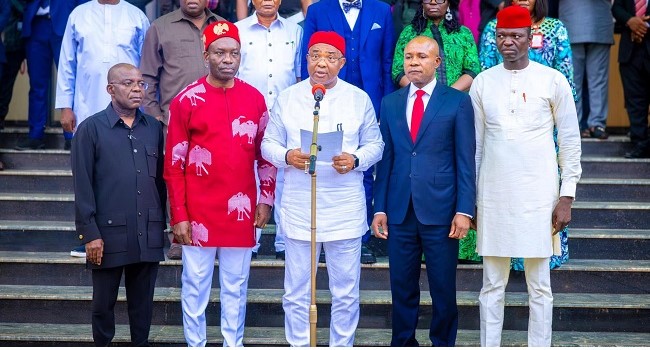
Imo State Governor and Chairman of the South-East Governors’ Forum, Senator Hope Uzodimma, has announced that the five governors of the South-East geopolitical zone have resolved to support President Bola Ahmed Tinubu’s bid for re-election in the 2027 general elections, citing what they described as the administration’s unprecedented commitment to the development of the region through strategic infrastructure and economic initiatives.
Uzodimma disclosed the decision while addressing members of the Imo State Elders Council and traditional rulers during a meeting in Owerri. According to him, the governors undertook a comprehensive assessment of the Federal Government’s performance in the South-East and unanimously concluded that President Tinubu had demonstrated genuine commitment to addressing decades of developmental neglect in the region.
He explained that the governors’ decision was informed by tangible projects and policy interventions rather than political sentiments, stressing that the South-East would continue to align itself with the Federal Government because of the visible impact of the Renewed Hope Agenda.
According to the governor, the region can no longer ignore concrete evidence of federal investment across the five South-East states.
“We, the five governors of the South-East, have reviewed all options and decided that we will work with President Bola Tinubu because we want to be part of the Project Nigeria,” Uzodimma declared.
He further revealed that the governors were already planning a joint courtesy visit to President Tinubu to consolidate their working relationship with the Federal Government and deepen collaboration on projects aimed at accelerating development across the South-East.
Uzodimma said one of the administration’s most significant achievements for the region was the establishment of the South East Development Commission (SEDC), describing it as a historic milestone that fulfilled a long-standing aspiration of the people of the South-East.
According to him, successive administrations had failed to establish the commission despite repeated demands dating back to the end of the Nigerian Civil War.
He noted that President Tinubu signed the South East Development Commission Bill into law on July 24, 2024, before inaugurating the governing board of the commission in February 2025 and providing the necessary funding to enable it commence operations.
The governor described the commission as a strategic intervention that would facilitate reconstruction, economic revitalisation, infrastructure renewal and sustainable development across the region.
Uzodimma also commended the Federal Government for reviving rail transportation in the South-East through the rehabilitation and commencement of commercial operations on the Port Harcourt–Aba railway corridor.
He described the project as the first practical step toward reconnecting the South-East to Nigeria’s national railway system after years of neglect.
According to him, the operational railway has already begun facilitating the movement of passengers and goods, thereby boosting commercial activities and reducing transportation costs within the region.
The governor further praised President Tinubu for approving the reconstruction of the Eastern Rail Corridor, a major infrastructure project estimated at approximately $3 billion.
The rail project stretches from Port Harcourt through several South-East states to Maiduguri in the North-East.
Uzodimma expressed confidence that once completed, the railway corridor would significantly improve trade, strengthen regional integration, stimulate industrial growth and enhance economic opportunities across multiple states.
On road infrastructure, the governor highlighted several ongoing federal road projects that he said have transformed transportation within the South-East.
Among them are the Phase 2A and Phase 2B access roads leading to the Second Niger Bridge, including the dual carriageway connecting Umunya, Ogbunike, Ogidi, Nkpor and Asaba.
He noted that the road project, which includes the construction of seven bridges, is expected to ease traffic congestion, improve logistics and facilitate interstate commerce.
The governor also referenced the approval of the 108-kilometre Otuocha–Anam–Abaji Road and the 150-kilometre Oba–Nnewi–Uga–Ihube/Okigwe Junction Road.
According to him, these strategic highways will strengthen economic connectivity among Anambra, Imo, Abia and neighbouring states while opening up new opportunities for agriculture, commerce and industrial development.
Beyond physical infrastructure, Uzodimma said the South-East has also benefited from several nationwide economic reforms introduced by the Tinubu administration.
These include increased statutory allocations to state governments, the introduction of the Nigerian Education Loan Fund (NELFUND) to support students in tertiary institutions, enhanced security operations and fiscal reforms designed to improve the ease of doing business across the country.
He argued that these initiatives have contributed significantly to strengthening state finances and creating an enabling environment for economic growth.
According to the governor, the people of the South-East are increasingly evaluating governments based on measurable performance rather than political rhetoric.
“The South-East has decided. Our people judge governments by performance and not by political sentiments. The evidence is on the ground,” he stated.
Turning to developments within Imo State, Uzodimma urged members of the Imo State Elders Council and the traditional institution to continue supporting the implementation of the state’s Charter of Equity.
He described the Charter as a landmark legal framework designed to institutionalise fairness, equity and inclusiveness in the rotation of political leadership within the state.
The governor recalled that when he assumed office in 2020, Imo State was deeply divided along political and sectional lines.
According to him, his administration initiated a series of reforms aimed at restoring unity, rebuilding public confidence and promoting inclusive governance.
He explained that the enactment of the Charter of Equity by the Imo State House of Assembly was intended to ensure that every geopolitical zone within the state has a fair opportunity to produce the governor, thereby fostering political stability and reducing unnecessary tension.
“The Charter of Equity is real, and I need your mandate to implement it because that is what will bring lasting peace to Imo State,” Uzodimma said.
He insisted that the next governor of Imo State must emerge strictly in accordance with the provisions of the Charter of Equity and possess the leadership qualities necessary to consolidate the gains recorded by his administration.
According to him, whoever succeeds him must demonstrate integrity, fairness, competence and a genuine commitment to good governance rather than reversing ongoing developmental programmes.
Uzodimma warned politicians against attempting to undermine or manipulate the Charter of Equity for personal political ambitions.
He declared that he would personally defend the law to ensure that the principles of fairness and justice remain the foundation of political succession in Imo State.
“I will take the fight personally to protect the Charter of Equity. I will stop at nothing,” the governor declared.
He also called for increased investment in skills acquisition programmes, vocational education and youth empowerment initiatives as part of broader efforts to tackle unemployment and reduce crime.
According to him, equipping young people with practical and entrepreneurial skills remains one of the most effective strategies for promoting sustainable economic development and improving livelihoods across Imo State.
Uzodimma concluded by urging traditional rulers to continue partnering with the government in promoting peace, supporting developmental initiatives and fostering unity among communities.
He expressed confidence that sustained collaboration between government, traditional institutions and community leaders would accelerate development and ensure that Imo State remains on the path of stability, inclusive governance and long-term prosperity.


One Comment
All this that Uzodinma is say is out of point. Can one give what he doesn’t have? Can a man who is busy borrowing and sharing do something reasonable to his people? Can a foundation that was built on lies and propagation turn to realistic? Can a man who is tribalistic carry another tribe along? Can a man who his 3 years borrowed passed his successor of 8 years? Can a man who reject good governance and chasing 2nd tenure and politics do good to his people? Please for their political promises, let shine our eyes and elect CAPABLE, RELIABLE, TRUSTED & COMPETENT LEADER WHO CAN TAKE NIGERIAN FROM CONSUMPTION TO PRODUCTION STATE.