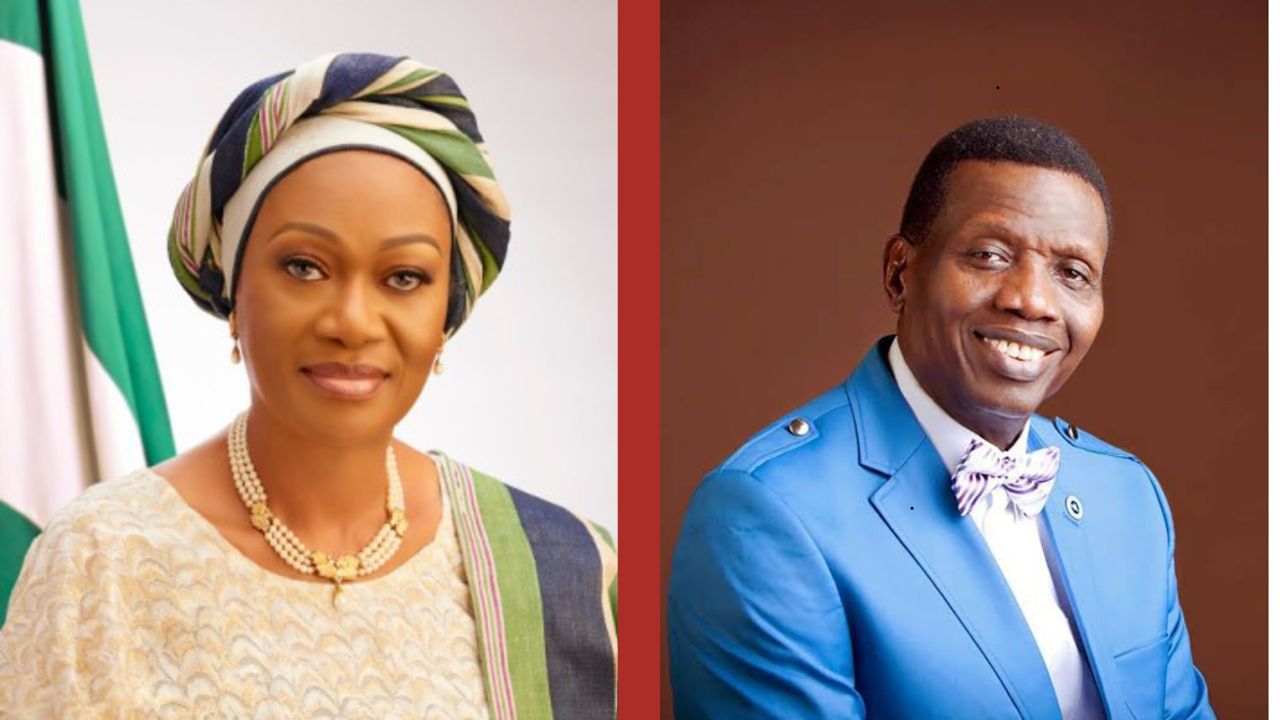
The General Overseer of the Redeemed Christian Church of God, Enoch Adejare Adeboye, has firmly stated that Nigeria’s First Lady, Oluremi Tinubu, will not be removed from her position as an ordained pastor in the church, despite growing public debate over the matter.
Adeboye made the clarification during the church’s monthly Holy Ghost Service, where he addressed concerns raised in some quarters regarding the dual role of the First Lady as both a political figure and a religious leader. His remarks were direct and unambiguous, signalling the church’s resolve to stand by its internal processes and decisions.
According to the revered cleric, Oluremi Tinubu’s ordination was neither recent nor politically motivated. He explained that she was ordained as an Assistant Pastor over a decade ago, at a time when her husband, Bola Ahmed Tinubu, had not indicated any intention to run for the presidency. This timeline, he noted, is critical in understanding the legitimacy of her position within the church.
Adeboye stressed that the First Lady underwent the full spiritual and administrative requirements necessary for ordination within the RCCG. He described the process as thorough and structured, involving years of service, commitment, and adherence to the doctrines and expectations of the church. By these standards, he maintained, she remains fully qualified to hold her pastoral role.
Addressing calls from critics who have suggested that her position should be reconsidered due to her current political status, Adeboye rejected such demands outright. He made it clear that the church would not yield to external pressure or public opinion in matters relating to its internal governance and spiritual leadership.
“The church operates based on its established principles and guidelines,” Adeboye implied in his remarks, underscoring that decisions regarding ordination and leadership are not subject to political considerations or societal pressure. He added that there has been no violation of church rules or ethical standards by Oluremi Tinubu that would warrant any disciplinary action.
The issue has sparked wider conversations about the intersection of religion and politics in Nigeria, particularly when individuals occupy influential roles in both spheres. However, Adeboye’s position reflects a clear boundary: that ecclesiastical decisions remain within the purview of the church, regardless of the political visibility of its members.
Observers note that the RCCG, one of Nigeria’s largest and most influential Pentecostal denominations, has a well-established system for ordaining ministers, often requiring years of active service and demonstrated spiritual growth. Adeboye’s defence of the First Lady suggests that her ordination is rooted in this long-standing institutional framework rather than any recent development tied to political power.
For supporters of the First Lady, the statement serves as a reaffirmation of her personal journey within the church, independent of her husband’s political career. They argue that her role as a pastor reflects a long-standing commitment to faith and service, which predates her current position in government.
On the other hand, critics have raised concerns about potential conflicts of interest or the optics of holding significant religious and political influence simultaneously. While such concerns persist in public discourse, the RCCG leadership appears resolute in its stance that these issues do not invalidate her standing within the church.
Adeboye’s comments also highlight a broader principle often upheld by religious institutions: the autonomy to govern their internal affairs without interference. By insisting that the church will not “bow to pressure,” he reinforced the idea that spiritual appointments and recognitions are determined by doctrinal and institutional criteria, not by external expectations.
The development comes at a time when public scrutiny of public office holders and their affiliations is increasingly intense. In Nigeria, where religion plays a significant role in societal life, the overlap between faith and governance frequently attracts attention and debate.
Nevertheless, Adeboye’s statement leaves little room for ambiguity. The RCCG, under his leadership, recognizes Oluremi Tinubu as a duly ordained pastor who has met all necessary requirements and continues to serve without breaching any established guidelines.
As discussions continue, the church’s position signals a commitment to maintaining its internal integrity and decision-making processes. For now, the message from the RCCG leadership is clear: Oluremi Tinubu’s pastoral role stands, and there are no plans to review or revoke it based on external criticism.