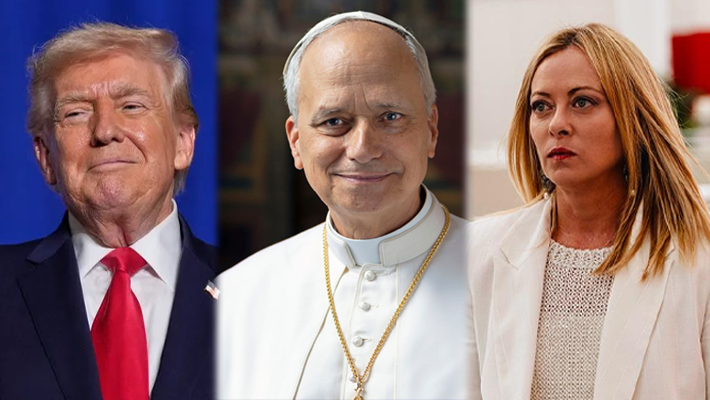
Italian Prime Minister Giorgia Meloni has openly criticised United States President Donald Trump over his recent comments directed at Pope Leo XIV, describing the remarks as “unacceptable” and urging respect for the spiritual leader of the Catholic Church.
Meloni, who leads the right-wing political party Brothers of Italy, issued the rebuke in a formal statement on Monday, marking one of the most direct criticisms of Trump by a European leader in recent weeks. Her comments come amid growing international concern over escalating rhetoric between political and religious authorities.
“I find President Trump’s words toward the Holy Father unacceptable,” Meloni said, emphasising the importance of maintaining decorum and mutual respect in global discourse. She further underscored the Pope’s moral and spiritual authority, noting that his calls for peace and opposition to war are consistent with the long-standing teachings of the Catholic Church.
“The Pope is the head of the Catholic Church, and it is right and normal that he calls for peace and condemns every form of war,” she added, reinforcing the legitimacy of the pontiff’s stance on global conflicts.
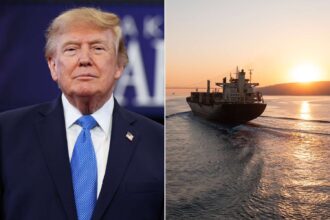
The controversy erupted following a series of social media posts by Trump on Sunday night, in which he launched a sharp attack on Pope Leo XIV. The US President criticised the pontiff’s views on international affairs and domestic policies, particularly those relating to migration and ongoing geopolitical tensions in the Middle East.
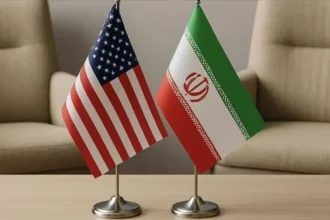
In his post, Trump described the Pope as “weak on crime” and “terrible for foreign policy,” comments that have since drawn widespread backlash from political leaders, religious groups, and international observers. The remarks were reportedly triggered by the Pope’s recent expressions of concern over the Trump administration’s immigration policies and the broader implications of the ongoing conflict involving the United States, Israel, and Iran.
Trump also accused the Pope of holding positions that, according to him, could undermine global security. “I don’t want a Pope who thinks it’s OK for Iran to have a nuclear weapon,” he wrote, despite there being no public record of the Pope advocating such a stance. The claim has been widely criticised as a misrepresentation of the pontiff’s views.
In a follow-up post, Trump defended his administration’s record, asserting that his policies have led to significant achievements in areas such as crime reduction and economic performance. He insisted that his actions reflect the mandate given to him by American voters, referencing what he described as a landslide electoral victory.
“I don’t want a Pope who criticises the President of the United States because I’m doing exactly what I was elected to do,” Trump added, doubling down on his earlier remarks.
The situation escalated further when Trump shared an artificial intelligence-generated image depicting himself in a religious context, portraying him as Jesus Christ healing the sick. The image, which was later deleted, sparked additional controversy and criticism, with many questioning the appropriateness of such imagery given its religious implications.
Speaking to reporters on Monday, Trump attempted to downplay the incident, suggesting that he had interpreted the image differently. According to him, he believed the depiction presented him as a doctor rather than a religious figure. Nonetheless, the post had already circulated widely before its removal, contributing to the intensifying debate.
In response to the criticism and the broader controversy, Pope Leo XIV addressed the issue while speaking to journalists aboard the papal plane. The pontiff reaffirmed his commitment to the core teachings of the Church and signalled that he would not be deterred from expressing his views on moral and humanitarian issues.
“I’m not afraid of the Trump administration or of speaking out loudly about the message of the Gospel, which is what the Church works for,” the Pope said, according to reports. His remarks were seen as a measured but firm response, emphasising the Church’s role in advocating for peace, justice, and compassion.
The exchange has highlighted the growing tension between political authority and religious leadership in the context of global crises. Analysts note that while disagreements between governments and religious institutions are not uncommon, the tone and public nature of this dispute have amplified its significance.
Meloni’s intervention is particularly notable given her political alignment, as she is often seen as ideologically closer to conservative leaders like Trump. Her decision to publicly criticise the US President underscores the sensitivity of the issue and the importance placed on respecting religious institutions, especially within predominantly Catholic countries like Italy.
The incident also raises broader questions about the role of religious leaders in political discourse and the extent to which they can or should comment on government policies. For many observers, the Pope’s statements reflect a moral obligation to address issues such as war, migration, and human rights, even when such positions may conflict with political agendas.
As reactions continue to pour in from around the world, the episode serves as a reminder of the delicate balance between political power and moral authority. With both sides maintaining firm positions, it remains to be seen whether the situation will de-escalate or further strain relations between the United States and influential religious figures on the global stage.