Leading figures within the African Democratic Congress (ADC) and a faction of the Peoples Democratic Party (PDP) convened a high-level closed-door meeting in Abuja on Wednesday, intensifying speculation about a possible opposition coalition ahead of Nigeria’s 2027 general elections.
The gathering, which brought together influential political actors from both camps, is widely interpreted as a strategic response to the mounting internal crises affecting the two parties, as well as the broader challenge of confronting the ruling All Progressives Congress (APC). Observers believe the meeting signals an emerging effort to consolidate opposition forces in a bid to strengthen their electoral prospects.
Among the prominent attendees was former Vice President Atiku Abubakar, now a leading figure within the ADC following his departure from the PDP. Also present was the Governor of Oyo State, Seyi Makinde, whose participation has drawn particular attention given his continued influence within PDP structures.
The meeting also included David Mark, who currently leads a contested faction within the ADC, and Kabiru Turaki, who headed the PDP delegation. The convergence of these figures, many of whom have long histories within Nigeria’s political establishment, underscores the seriousness of the discussions and their potential implications.
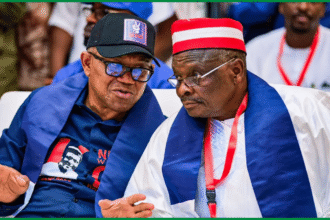
Although the exact details of the deliberations were not made public, images shared via the PDP’s official social media channels depicted a unified gathering of opposition stakeholders. The optics of the meeting—featuring leaders from different political alignments seated together—have been interpreted as a signal of growing cooperation, if not an outright merger in the making.
Political analysts suggest that the secrecy surrounding the meeting’s agenda reflects both the sensitivity and strategic importance of the discussions. At a time when both the ADC and PDP are grappling with internal divisions, any move toward collaboration would require careful negotiation and consensus-building among competing interests.
The meeting comes against the backdrop of significant turmoil within both parties. The ADC is currently embroiled in a legal dispute over its leadership, with competing factions contesting control of the party in court. This legitimacy battle, currently before the Federal High Court, has created uncertainty about the party’s organisational structure and its readiness for upcoming political contests.
Similarly, the PDP continues to struggle with deep internal divisions, characterised by competing power blocs and unresolved leadership tensions. These challenges have weakened the party’s cohesion and raised concerns about its ability to function effectively as a unified opposition platform.
It is within this context that the Abuja meeting is being viewed as a potential turning point. For many within the opposition, the need for unity has become increasingly urgent, particularly in light of the perceived dominance of the APC at both federal and state levels.
A source familiar with the discussions described the meeting as a matter of political survival. According to the source, both parties recognise that continued fragmentation could leave them vulnerable to further marginalisation ahead of the 2027 elections.
“The meeting is about survival,” the source said. “There is a growing realisation that if opposition forces remain divided, they risk being systematically weakened before the next election cycle.”
Adding another layer of complexity to the situation, the meeting coincided with a formal petition submitted by the David Mark-led faction of the ADC to the Independent National Electoral Commission (INEC). In the petition, the faction called for the immediate resignation of INEC Chairman, Joash Amupitan.
The petition accuses the electoral body’s leadership of partisan conduct, alleging that its recent actions have unfairly targeted the ADC. Specifically, the party claims that administrative obstacles—such as the refusal to acknowledge or process official correspondence—are being used to frustrate its operations and limit its ability to participate effectively in the political process.
According to the ADC faction, these actions constitute serious breaches of constitutional and institutional responsibilities, raising concerns about the neutrality of the electoral commission. The allegations, if substantiated, could have significant implications for the credibility of the electoral process.
The timing of the petition, alongside the high-level meeting in Abuja, suggests a coordinated effort by opposition actors to both challenge perceived institutional bias and strengthen their political positioning.
The presence of Governor Makinde at the meeting is particularly noteworthy. As a sitting PDP governor with considerable influence, his engagement with ADC figures, including Atiku Abubakar, points to a possible realignment of political alliances. Such a shift could reshape the opposition landscape, especially if it leads to broader cooperation between factions within and across parties.
Atiku’s role is equally significant. Having transitioned from the PDP to the ADC after internal disagreements in previous election cycles, he represents a bridge between the two political formations. His involvement in the meeting reinforces speculation that he may play a central role in any future coalition arrangement.
Beyond leadership dynamics, the opposition is also grappling with procedural challenges that could affect its participation in the 2027 elections. The ADC has previously raised concerns about what it described as “landmines” set by INEC, including a deadline of May 10 for the submission of candidates.
The party has argued that it is being deliberately obstructed from meeting this deadline due to ongoing administrative and legal challenges. If unresolved, such issues could limit the party’s ability to field candidates, thereby weakening its electoral prospects.
This concern further underscores the urgency of the Abuja meeting, as opposition leaders seek to navigate both internal and external pressures. For many, the path forward may lie in collaboration, even if it requires setting aside longstanding rivalries and differences.
While it remains unclear whether the meeting will lead to a formal merger or coalition, it has undoubtedly reignited conversations about the future of opposition politics in Nigeria. The coming months are likely to be critical, as parties assess their options and determine whether unity is achievable in practice.
For now, the Abuja meeting stands as a significant moment in the evolving political landscape, reflecting both the challenges facing opposition parties and their determination to remain relevant in the face of mounting adversity.