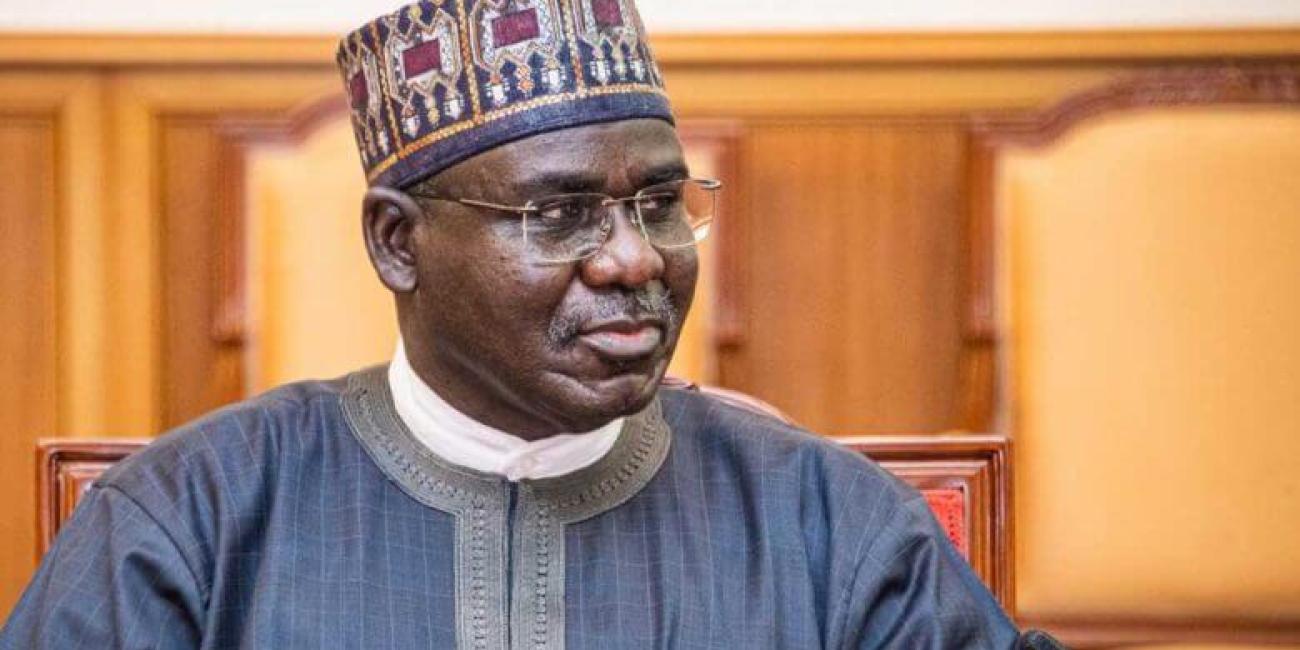
Former Chief of Army Staff, Lt. Gen. Tukur Buratai (retd.), has stated that he cannot be held accountable for the failure to publicly disclose the identities of individuals allegedly financing terrorism in Nigeria, insisting that such decisions fall outside the sole purview of the Nigerian Army.
Buratai made the remarks on Friday during an appearance on Channels Television’s Politics Today, where he addressed longstanding public concerns about the non-disclosure of names of suspected terror sponsors. The issue has remained a source of debate amid persistent insecurity across parts of the country.
Responding to questions about why the names of alleged financiers have not been made public, Buratai rejected suggestions that he bears responsibility for withholding such information.
“You cannot say I should be responsible for naming the financiers of terror,” he said during the interview.
He explained that multiple government and security agencies are involved in intelligence gathering and counterterrorism operations, adding that those institutions are aware of the identities in question and understand why the names have not been released publicly.
“It’s not just about mentioning names; those agencies know why the names are not released. Action should be taken; these individuals are still within society today, and they are known. I take responsibility for certain things that are strictly the Nigerian Army’s responsibility,” Buratai added.
His comments come amid renewed scrutiny over the handling of terrorism-related investigations, particularly concerning allegations that suspects linked to terror financing were released without prosecution.
Buratai also addressed the controversial policy of rehabilitating repentant Boko Haram members, clarifying that the initiative was not conceived or executed independently by the Nigerian Army but was a broader government decision.
According to him, the military’s initial strategy in 2016 included offering insurgents a window to surrender under defined conditions.
“The initial concept that we had was that we gave them a timeline to surrender in 2016, and if they surrendered, we gave them a free passage and handed them over to appropriate agencies to rehabilitate them,” he explained.
The rehabilitation programme, which has drawn mixed reactions from Nigerians, was designed to encourage defections from insurgent ranks and reintegrate repentant fighters into society. Critics, however, have questioned its effectiveness and transparency, particularly in light of recurring attacks in parts of the North-East and other regions.
Beyond defending past policies, Buratai expressed concern about the current state of national security, lamenting what he described as a worsening security environment. He stressed that improved intelligence gathering is critical to tackling insurgency, banditry, and other forms of violent crime.
He also called for increased recruitment into the security services, arguing that expanding manpower would strengthen operational capacity and enhance territorial coverage.
“We need more personnel and better intelligence coordination if we are to effectively secure the country,” he said, underscoring the scale and complexity of Nigeria’s security challenges.
Meanwhile, fresh controversy has emerged following reports by SaharaReporters that military authorities have detained a serving Brigadier General, Gabriel E. Archibong, since the first week of January 2026 over alleged links to a retired Major General, Danjuma Hamisu Ali-Keffi.
According to the report, Archibong is being held at the Army’s Special Investigation Bureau. Three other individuals—two military personnel and one civilian—are also reportedly in custody in connection with the case.
Sources cited in the report claimed that Archibong’s domestic staff, including his cook or gardener, personal assistant, and driver, were arrested and detained as part of the investigation.
Archibong currently serves as Chief of Staff at the Training and Doctrine Command (TRADOC) of the Nigerian Army in Minna, Niger State. In that role, he is said to play a key part in shaping military training standards, doctrine development, and operational readiness.
The circumstances surrounding his detention have generated speculation within military and security circles. SaharaReporters alleged that Archibong’s arrest may be linked to his communication with Ali-Keffi, who has been embroiled in a protracted dispute with Buratai and the military hierarchy.
Ali-Keffi, appointed in October 2020 by then-President Muhammadu Buhari to head the covert Presidential Task Force known as Operation Service Wide (OSW), has repeatedly alleged that individuals arrested for terror financing were released while under military custody.
Operation Service Wide was established as a multi-agency task force comprising personnel from the military, security and intelligence services, as well as legal officers from the Office of the Attorney General of the Federation. Its mandate included identifying, arresting, investigating, and prosecuting financiers and collaborators of terrorist organisations, alongside targeting key insurgent leaders.
In January, SaharaReporters reported that Archibong’s arrest followed Ali-Keffi’s legal and public confrontation with Buratai. The report also cited a military source who claimed that Archibong was taken to his residence in Lugbe, Abuja, a day after his arrest, where soldiers conducted a search lasting over three hours.
“Nothing incriminating was found, but his phones and laptop were seized,” the source reportedly stated.
Further allegations suggest that Archibong’s detention may be connected to claims that he was “not cooperating” with military authorities. However, official statements clarifying the basis of his arrest have not been publicly issued.
Ali-Keffi, for his part, filed a multi-billion-naira lawsuit in December 2025 at the National Industrial Court in Abuja against the Nigerian Army and the top leadership of the military and defence establishment. In his suit, he challenges his arrest, detention, and compulsory retirement.
He alleges that he was unlawfully detained for 64 days without charge, subjected to torture, denied fair hearing, and forced into compulsory retirement in violation of constitutional provisions, the Armed Forces Act, and established military regulations.
Ali-Keffi also claims that suspects arrested under Operation Service Wide for alleged terrorism financing were released while he remained in detention. According to him, his detention and retirement triggered threats against him and his family, forcing repeated foreign trips for safety and causing significant financial and psychological hardship.
In his lawsuit, he is seeking ₦100 billion in compensatory damages, ₦100 billion in punitive damages, and ₦120 million in special damages for lost allowances. He is also asking the court to nullify his compulsory retirement, recognise him as having retired voluntarily at the age of 60, and order the full payment of his pensions, gratuities, and other entitlements with accrued interest.
The unfolding legal battle and reported detentions have intensified debate over transparency, accountability, and internal dynamics within Nigeria’s security architecture. As insecurity continues to challenge the country, calls for greater institutional clarity and effective prosecution of terror financiers remain central to public discourse.
Buratai’s recent comments, distancing himself from the decision not to disclose alleged financiers, have added another layer to an already complex and politically sensitive issue.