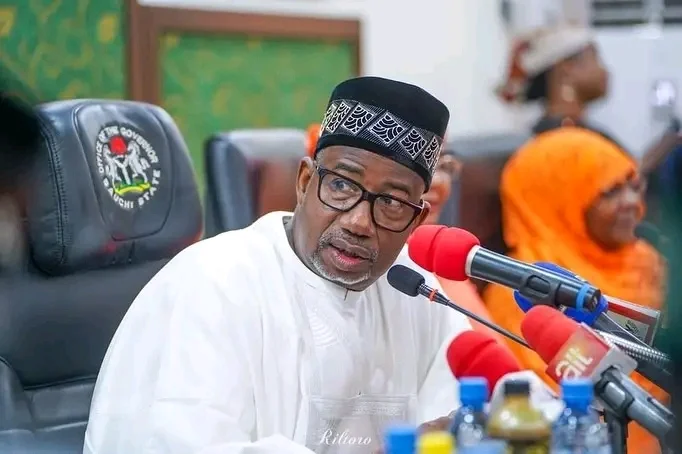
Fresh political developments suggest that the opposition Peoples Democratic Party (PDP) may be facing another major setback as the Chairman of the PDP Governors’ Forum and Governor of Bauchi State, Bala Mohammed, is reportedly finalising plans to defect to the ruling All Progressives Congress (APC).
Sources familiar with the ongoing negotiations revealed that the governor could formally announce his move to the APC within the week, barring any last-minute changes. The development, if confirmed, would represent a significant political shift within Nigeria’s opposition landscape and further consolidate the influence of the ruling party.
Investigations indicate that discussions regarding the terms of Mohammed’s defection are still ongoing. Multiple insiders with knowledge of the talks said the Bauchi governor has already held meetings with Bola Ahmed Tinubu and key leaders of the APC to signal his readiness to join the ruling party.
According to sources close to the negotiations, Mohammed has been offered the APC senatorial ticket for his political future. In addition, he may be entitled to similar political privileges and allowances previously extended to other governors who have defected from opposition parties to the ruling APC.
However, the terms reportedly presented to Mohammed are said to be more restrictive than those granted to earlier defectors.
One source familiar with the discussions disclosed that during his meeting with President Tinubu and the APC leadership, the Bauchi governor openly declared his intention to align himself with the ruling political structure.
The source explained that the governor’s move may also be linked to the ongoing legal challenges facing his Commissioner for Finance, Yakubu Adamu.
Adamu is reportedly facing terrorism-related allegations alongside a money laundering case involving approximately ₦4.6 billion. According to insiders, the commissioner is currently under investigation and has allegedly threatened to implicate the governor if he is not released from custody.
Although the details surrounding the case remain unclear, some political observers believe the development may have increased pressure on the governor and influenced his current political calculations.
Further reports indicate that the APC leadership has imposed certain conditions on Mohammed as part of the defection arrangement. These conditions are believed to be significantly stricter than those offered to other governors who previously joined the ruling party.
Sources within the political camp of Seyi Makinde, one of the prominent figures within the PDP, have expressed surprise and disappointment over the reported defection plans.
Members of Makinde’s camp reportedly view Mohammed’s move as a betrayal, particularly given his leadership role as chairman of the PDP Governors’ Forum and his previous involvement in efforts to reposition the party.
According to party insiders, several PDP stakeholders are questioning how a governor who had long positioned himself as a leading voice within the opposition could now consider abandoning the party at a critical moment.
Sources familiar with the negotiations further revealed that during discussions with President Tinubu, Mohammed was informed that the APC structure in Bauchi State would not be handed over to him.
Unlike earlier defectors who were reportedly allowed to assume control of party structures in their respective states, Mohammed was told that the existing APC leadership in Bauchi would remain intact.
A source who spoke on the condition of anonymity said the president made it clear that the governor would not be permitted to nominate his successor in the state once his tenure ends.
“The message was very direct,” the source explained. “He was told that he could return to the Senate through the APC ticket if he wished, but the party structure in Bauchi would not be surrendered to him, and he would not have the authority to decide who succeeds him as governor.”
The restriction is believed to have caused some discomfort for the governor, particularly because of his desire to maintain political influence in the state after leaving office.
Another sensitive condition reportedly presented to Mohammed involves an apology to Seyi Tinubu.
According to sources, APC leaders have not forgotten an incident that occurred in 2025 involving Mohammed’s son, Shamsudeen Bala Mohammed.
During the Ramadan period that year, Seyi Tinubu had visited Bauchi State and distributed food items and other palliatives to residents as part of a charitable outreach initiative.
However, Shamsudeen Bala Mohammed publicly criticised the gesture, arguing that such distributions amounted to temporary relief rather than sustainable empowerment.
He reportedly advised Seyi Tinubu to invest instead in programmes that would create long-term economic opportunities for the people, such as vocational training and support for small businesses.
The remarks generated controversy at the time and were widely interpreted in political circles as an embarrassment to the presidency.
Sources now say the APC leadership has insisted that Governor Mohammed must apologise to Seyi Tinubu as part of the reconciliation process before his defection can be finalised.
According to insiders, the governor has already taken steps to offer the apology in order to demonstrate his commitment to joining the ruling party.
Despite this gesture, Mohammed is reportedly still uneasy about some of the political conditions attached to the move.
In particular, he is said to be pushing for greater influence within the APC structure in Bauchi State, especially regarding succession arrangements after the end of his governorship.
To pursue this objective, sources say the governor has reached out to the National Chairman of the APC, Nentawe Yilwatda, seeking assistance in negotiating a compromise with the president.
Specifically, Mohammed is believed to be proposing a 60–40 power-sharing arrangement within the APC structure in Bauchi State that would allow him to retain some level of influence.
As of the time of filing this report, it remains unclear whether the APC national leadership has accepted this proposal.
Nevertheless, indications suggest that the governor has already begun preparing the political ground for his possible defection.
Sources revealed that Mohammed has scheduled a meeting with key political stakeholders in Bauchi State this week, a move widely interpreted as part of the consultation process ahead of the anticipated announcement.
Within the PDP, the development has reportedly generated anger and disappointment among several party members.
Some leaders within the opposition party argue that Mohammed’s planned exit could further weaken the PDP at a time when it is already grappling with internal divisions and declining political strength.
Party insiders noted that as chairman of the PDP Governors’ Forum, Mohammed had been expected to remain committed to rebuilding and defending the party.
“If the chairman of the PDP Governors’ Forum cannot remain in the party to fight for its survival, then it raises serious questions about the future of the opposition,” one PDP member reportedly remarked.
Political analysts believe the governor’s potential defection could significantly alter the balance of political power across Nigeria.
If Mohammed formally joins the APC, the ruling party would control 32 state governors, further strengthening its dominance in national politics.
Currently, the PDP has only a handful of governors remaining in its fold, including Seyi Makinde.
Other parties with state governors include the Labour Party, which controls Abia State through Governor Alex Otti.
Similarly, the All Progressives Grand Alliance governs Anambra State under Chukwuma Soludo.
In Osun State, Governor Ademola Adeleke is associated with the Accord Party.
Observers say the coming days will be crucial in determining whether the Bauchi governor will proceed with the move or reconsider his position amid the political controversy surrounding the development.