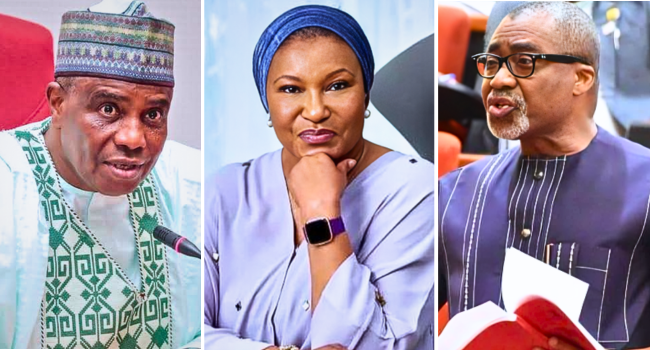
In a significant political development within Nigeria’s legislative arena, nine senators on Thursday formally defected from their respective political parties to the African Democratic Congress (ADC), marking one of the most notable shifts in the composition of the Senate in recent months.
The defections were officially announced during plenary at the National Assembly by the President of the Senate, Godswill Akpabio, who read the letters submitted by the lawmakers informing the chamber of their decision to leave their former political platforms.
The move reflects growing political realignments across Nigeria as parties and political figures reposition themselves ahead of the 2027 general elections.
The nine lawmakers who joined the ADC cut across several opposition parties in the Senate.
Among them are five senators who previously belonged to the Peoples Democratic Party (PDP). They include:
- Aminu Waziri Tambuwal
- Mohammed Ogoshi Onawo
- Binos Dauda Yaroe
- Austin Akobundu
- Lawal Adamu Usman
Three other senators defected from the Labour Party (LP). They include:
- Ireti Kingibe
- Victor Umeh
- Tony Nwoye
Also joining the ADC is Enyinnaya Abaribe, who previously belonged to the All Progressives Grand Alliance (APGA).
The defections reflect a growing interest among opposition politicians in consolidating around alternative political platforms ahead of the next election cycle.
While reading the letters submitted by the senators, Senate President Akpabio quoted former Sokoto State governor Aminu Waziri Tambuwal as explaining that his decision was largely driven by persistent internal conflicts within the PDP.
According to the letter, divisions and leadership disagreements within the party had made it increasingly difficult for him to continue participating actively in its affairs.
Tambuwal wrote that ongoing disputes, legal battles, and factional divisions had weakened the party’s cohesion and direction.
“The persistent internal crisis, leadership disagreements, litigations and divisions within the party at various levels have made it increasingly difficult for me to continue my active participation and commitment as a member of the Peoples Democratic Party,” the letter stated.
He added that the prolonged internal tensions had eroded the unity that once characterised the PDP, prompting him to seek a new political platform.
Tambuwal therefore formally notified the Senate of his decision to move to the ADC.
During the plenary session, the Senate leadership also addressed issues surrounding the defection of Enyinnaya Abaribe.
Some lawmakers raised questions about whether the circumstances surrounding his exit from APGA meet the constitutional requirements that allow legislators to defect without risking the loss of their seats.
Under Nigeria’s Constitution, lawmakers may lose their seats if they defect from the party on whose platform they were elected, except in cases where there is a division within the party or where they can prove they were forced out.
Abaribe had claimed that he was removed from the leadership structure of APGA in September 2025, which he said justified his decision to leave the party.
However, the Senate leadership said it would review the circumstances surrounding his case.
Akpabio announced that Abaribe would be given one week to reconsider his decision while the Senate examines the legal implications of his defection.
The defections have altered the political composition of the Senate, boosting the presence of the ADC in the upper legislative chamber.
Following the latest development, the distribution of seats in the Senate now stands as follows:
- All Progressives Congress – 85 senators
- African Democratic Congress – 9 senators
- Peoples Democratic Party – 8 senators
- New Nigeria Peoples Party – 1 senator
- National Democratic Coalition – 1 senator
- All Progressives Grand Alliance – 1 senator
- Social Democratic Party – 1 senator
Three senatorial seats are currently vacant following the deaths of several lawmakers.
The late senators include Barinada Mpigi, Godiya Akwashiki, and Okey Ezea.
By-elections are expected to be conducted to fill the vacant seats.
Political observers have described the latest defections as unusual because most recent political realignments in Nigeria have involved opposition politicians moving into the ruling party.
Since the emergence of Bola Ahmed Tinubu in 2023 under the platform of the APC, several governors, lawmakers, and political leaders have defected from opposition parties to the ruling party.
The movement of senators to the ADC therefore represents a rare shift away from the dominant political trend.
Analysts say the development could signal growing efforts by opposition leaders to reorganise and build a stronger coalition ahead of the 2027 elections.
The defections also come amid increasing concerns among opposition figures that Nigeria may be drifting toward a one-party dominant political system.
Some political commentators have argued that the wave of defections to the APC since Tinubu assumed office has weakened the opposition and reduced political competition.
However, President Tinubu has repeatedly dismissed such claims.
He has insisted that Nigeria remains a multi-party democracy where political actors are free to associate with parties of their choice.
The president has also argued that political realignments are normal in democratic systems and should not be interpreted as evidence of authoritarian tendencies.
The growing prominence of the ADC in national politics is closely linked to the emergence of a coalition of opposition leaders seeking to challenge the APC in the 2027 general elections.
In July 2025, several influential political figures reportedly adopted the ADC as a political vehicle through which opposition forces could unite.
Among the prominent figures associated with the coalition are Atiku Abubakar, Peter Obi, Rotimi Amaechi, Nasir El-Rufai, and David Mark.
The coalition aims to consolidate opposition forces and create a stronger platform capable of challenging the ruling party in future elections.
Meanwhile, Nigeria’s electoral umpire, the Independent National Electoral Commission (INEC), has revised the timetable for the 2027 general elections following the enactment of the Electoral Act 2026.
Under the new schedule, presidential and National Assembly elections will be conducted on January 16, 2027, while governorship and State House of Assembly elections will hold on February 6, 2027.
The adjustment was made partly to ensure that the elections do not clash with the Ramadan fasting period.
INEC also announced that political party primaries will take place between April 23 and May 30, 2026.
Parties are expected to submit the names of their candidates between June 27 and July 11, 2026, while campaigns for national elections will commence on August 19, 2026.
The voter register is scheduled to be published by December 15, 2026.
The defection of nine senators to the ADC highlights the fluid nature of Nigeria’s political landscape as parties and politicians reposition themselves ahead of the next electoral cycle.
With the 2027 elections still some distance away, analysts believe that further alliances, defections, and political negotiations are likely to reshape the country’s party system.
For now, the emergence of the ADC as a growing opposition platform suggests that Nigeria’s political contest in 2027 could be far more competitive than many observers initially anticipated.