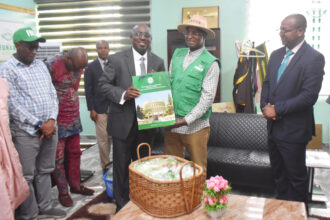
The United Nations Educational, Scientific and Cultural Organisation (UNESCO) has commended the Governor of Abia State, Alex Otti, for placing education and human capital development at the centre of his administration’s policy priorities. The organisation described the ongoing reforms in the state’s education sector as a significant step toward improving learning outcomes and building a stronger foundation for sustainable development.
The commendation was delivered by Jean‑Paul Ngome‑Abiaga during a courtesy visit by a UNESCO delegation to the governor at his country home in Nvosi, located in Isiala Ngwa South Local Government Area, on Tuesday.
Ngome-Abiaga said the organisation had been closely monitoring the progress made by the Abia State Government since Otti assumed office in 2023, noting that the administration’s policies in education, infrastructure, and fiscal management had already begun to produce measurable results.
According to him, the transformation taking place in Abia State demonstrates how deliberate investments in human capital and institutional reforms can reshape the future of a society.
He stated that UNESCO was particularly impressed by the scale of attention being devoted to the education sector, adding that such commitment reflects a clear understanding of the role education plays in national development.
One of the major highlights of the governor’s education policy that drew commendation from the UNESCO delegation was the decision by the Abia State Government to allocate 20 per cent of its annual budget to education.
Ngome-Abiaga described the allocation as a bold and forward-looking decision that places the state among the few sub-national governments in Africa making deliberate investments in knowledge development and human capacity building.
He explained that UNESCO had already established collaborative programmes with the Abia State Government and its institutions, particularly in the area of health education and public awareness.
According to him, the partnership has already produced tangible results.
He disclosed that through the collaboration:
- More than 1,000 teachers in the state have been trained in health education.
- Over 700 community and religious leaders have been engaged in campaigns on HIV awareness and public health education.
- More than 300 schools have been integrated into the state’s flagship education reform programme known as the Abia First Education Programme.
Ngome-Abiaga noted that these achievements became possible following the launch of the Abia First Education Programme by the governor, which UNESCO sees as a major catalyst for improving the quality of education in the state.
He praised the governor for initiating a policy framework that combines educational access with community participation and health awareness.
“Our collaboration has resulted in the training of more than 1,000 teachers on health education, the engagement of more than 700 community and religious leaders on HIV and health awareness, and the involvement of over 300 schools under the Abia First Education Programme,” he said.
He added that UNESCO values the progress made so far and looks forward to expanding the scope of its partnership with the state government.
The UNESCO representative also encouraged the Abia State Government to deepen its collaboration with the organisation and other international development partners.
He emphasised the need to strengthen budgetary provisions for health education and expand joint programmes that align with UNESCO’s mandate in education, science, culture, communication, and information.
According to him, UNESCO remains fully committed to supporting Abia State through technical expertise and institutional collaboration in the design and implementation of programmes that promote sustainable development.
“We are here in this country because our mandate focuses on education, science, culture, communication, and information,” Ngome-Abiaga said.
“We are here for you. We are here to assist you and to support your work. We would like you to know that UNESCO remains available whenever you need such support.”
He assured the governor that the organisation would continue to place its global experience and technical resources at the disposal of the Abia State Government to strengthen educational outcomes and improve public health education.
Also speaking during the visit, the Chief Executive Officer of Sterling One Foundation, Olapeju Ibekwe, highlighted the significance of the Africa Social Impact Summit in advancing the United Nations Sustainable Development Goals across Africa.
Ibekwe explained that the summit was launched in 2022 in partnership with the United Nations system in Nigeria following the COVID-19 pandemic, with the aim of accelerating development partnerships among governments, the private sector, and international development organisations.
According to her, the summit has already played a major role in mobilising financial resources for development initiatives across the continent.
She disclosed that the platform has helped unlock over $100 million in development financing, which has been directed toward projects addressing education, healthcare, and economic empowerment.
Ibekwe also spoke about the Business Coalition for Education, a partnership initiative launched in collaboration with the Office of the Vice President to tackle the persistent challenge of out-of-school children in Nigeria.
She explained that the initiative encourages private sector participation in expanding access to quality education and supporting government programmes aimed at reducing the number of children who are not enrolled in school.
As part of efforts to strengthen collaboration, she invited Governor Otti to participate in the upcoming Africa Social Impact Summit scheduled to hold on July 22 and 23 at the Eko Convention Centre.
She also urged Abia State to join the Business Coalition for Education as a pioneer public sector partner, noting that the state’s ongoing reforms make it a strong candidate for leadership within the initiative.
Responding to the delegation, Governor Otti expressed appreciation for UNESCO’s recognition of the state government’s efforts and reaffirmed his administration’s commitment to strengthening partnerships with international organisations and development partners.
The governor described the requests presented by the delegation as consistent with the vision of his administration to prioritise education and health as pillars of development.
“What you came with is a request that no one can say no to,” Otti said.
“You spoke about partnership, support to reduce the number of out-of-school children, and greater investment in health education. These are very important for any government that is serious.”
He explained that the Abia State Government currently allocates 20 per cent of its budget to education and 15 per cent to healthcare, reflecting its commitment to improving the quality of life for citizens.
The governor also recalled that shortly after assuming office, his administration discovered that school fees were a major barrier preventing many children from attending school.
To address the challenge, the government introduced a free and compulsory basic education policy, which has significantly increased school enrolment across the state.
Governor Otti noted that the surge in enrolment following the introduction of free education created new demands on the state’s educational infrastructure.
To meet the challenge, the government embarked on a series of reforms, including:
- Recruitment of thousands of new teachers
- Massive reconstruction and renovation of public schools
- Establishment of smart schools equipped with digital learning tools
- Standardisation of school curricula across the state
- Strengthening of security around educational facilities
According to him, these initiatives are designed to ensure that increased access to education is matched with improvements in the quality of learning.
He emphasised that education remains one of the most powerful tools for combating poverty and building a prosperous society.
The governor assured the UNESCO delegation that the Abia State Government would continue to work closely with international organisations, development partners, and the private sector to strengthen the education system.
He added that reducing the number of out-of-school children remains a major priority for his administration.
Otti expressed optimism that sustained collaboration with UNESCO and other partners would help accelerate the transformation already taking place in the state’s education sector.
“We are committed to working with UNESCO and other partners to improve our education system and ensure that every child in Abia State has access to quality learning opportunities,” he said.
The visit concluded with both parties reaffirming their commitment to deepening cooperation in education, health awareness, and human capital development as Abia State continues its efforts to position itself as a model for education reform in Nigeria.