Venezuela was plunged into a new political and constitutional crisis on Saturday after the country’s Supreme Court ordered Vice President Delcy Rodríguez to assume the role of acting president following the capture of President Nicolás Maduro in an early-morning military operation carried out by the United States.
In a ruling delivered by the Constitutional Chamber of the Supreme Tribunal of Justice, the court directed Rodríguez to take over the functions of the presidency with immediate effect, citing the need to preserve continuity of governance and national defence in the wake of what it described as the “forced absence” of the sitting president.
According to the court, Rodríguez is to assume “the office of President of the Bolivarian Republic of Venezuela, in order to guarantee administrative continuity and the comprehensive defence of the Nation.” The ruling marks an extraordinary intervention by the judiciary in response to what authorities described as an unprecedented security and sovereignty crisis.
Related posts:
- Trump Announces Transitional Control After Venezuela’s President Nicolás Maduro Capture During Air Strikes
- Trump Says Venezuela’s President Maduro Captured After U.S. Strikes
- Supreme Court Affirms Tinubu’s Powers to Suspend Governors, Declare State of Emergency
- President Tinubu appoints Prof Joash Ojo Amupitan as new INEC Chairman
The court further stated that it would continue deliberations to determine the appropriate legal and constitutional framework for managing the situation. It said the objective of its ongoing review would be to ensure “the continuity of the State, the administration of government, and the defence of sovereignty in the face of the forced absence of the President of the Republic.”
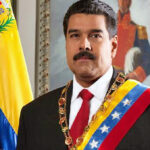
Maduro’s capture, confirmed earlier on Saturday by U.S. authorities, has sent shockwaves through Venezuela and the international community. The operation reportedly took place in the early hours of the morning and resulted in Maduro being taken out of the country and transported to the United States. Details surrounding the circumstances of the operation remain limited, but the development represents a dramatic escalation in the long-running standoff between Washington and Caracas.
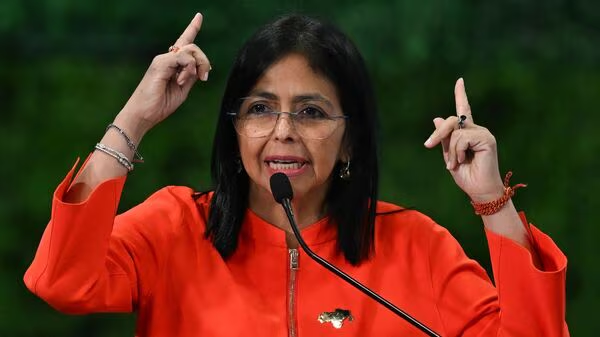
Shortly after the court’s announcement, Rodríguez addressed the nation in a televised broadcast during an emergency meeting of Venezuela’s National Defence Council. In her remarks, she partially blamed Israel for what she characterised as foreign involvement in the operation that led to Maduro’s capture, framing the event as an attack on Venezuelan sovereignty.
“The governments of the world are shocked that the Bolivarian Republic of Venezuela is the victim and target of an attack of this nature, which undoubtedly has Zionist undertones,” Rodríguez said. “It is truly shameful.” She did not provide evidence to support the allegation but insisted that the incident was part of a broader international conspiracy against Venezuela.
Rodríguez’s remarks reflect the Venezuelan government’s longstanding narrative of foreign aggression and external interference, particularly involving the United States and its allies. Her convening of the National Defence Council signalled heightened security concerns and an effort to project institutional control amid uncertainty and potential unrest.
Meanwhile, in the United States, the White House appeared to underscore the significance of the development through an unusual public display. Official White House social media accounts shared footage showing Maduro being escorted through a Drug Enforcement Administration building in New York City. The video, which quickly circulated online, was accompanied by the caption, “Perp walked,” suggesting a deliberate attempt to signal U.S. authority and the seriousness of the action taken against the Venezuelan leader.
The release of the footage further inflamed reactions in Caracas, where government officials and supporters described it as humiliating and provocative. Critics of the Maduro government, however, viewed the images as symbolic of accountability after years of allegations involving corruption, drug trafficking, and human rights abuses against senior Venezuelan officials.
As the situation unfolded, the U.S. State Department reiterated its highest-level travel advisory for Venezuela, warning American citizens to avoid travel to the country under all circumstances. In a Level 4: Do Not Travel advisory, the department cited what it described as “severe risks to Americans,” noting that the security environment remains volatile and unpredictable.
In a security alert dated January 3, the U.S. Embassy warned that the situation in Venezuela “remains fluid” following Maduro’s capture. The embassy, which currently operates out of Bogotá, Colombia, emphasised that there are no commercial flights operating in or out of Venezuela and urged U.S. citizens still in the country to exercise extreme caution.
“Venezuela has the highest Travel Advisory level, Level 4: Do Not Travel, due to severe risks to Americans, including wrongful detention, torture in detention, terrorism, kidnapping, arbitrary enforcement of local laws, crime, civil unrest, and poor health infrastructure,” the advisory stated.
The State Department also reminded the public that the United States withdrew all diplomatic personnel from its embassy in Caracas in March 2019 and suspended operations there. Since then, all consular services, both routine and emergency, have remained unavailable.
“All consular services, routine and emergency, remain suspended,” the advisory said, adding that the U.S. government remains unable to provide emergency assistance to American citizens in Venezuela.
In light of these constraints, U.S. authorities strongly advised Americans not to travel to Venezuela. Those already in the country were urged to establish multiple communication channels with contacts outside Venezuela and to enrol in the Smart Traveler Enrollment Program in order to receive security updates and alerts.
Within Venezuela, the Supreme Court’s decision to install Rodríguez as acting president is expected to shape the immediate political landscape. As a long-time ally of Maduro and a central figure in his administration, Rodríguez is seen by supporters as a symbol of continuity and resistance. Critics, however, argue that the move raises constitutional questions and further concentrates power within a small circle of political elites.
The coming days are likely to be critical as the court continues its deliberations and the government seeks to maintain stability amid heightened tensions. With Maduro now in U.S. custody and international reactions still unfolding, Venezuela faces one of the most consequential moments in its modern political history, with implications for governance, sovereignty, and regional security across Latin America.