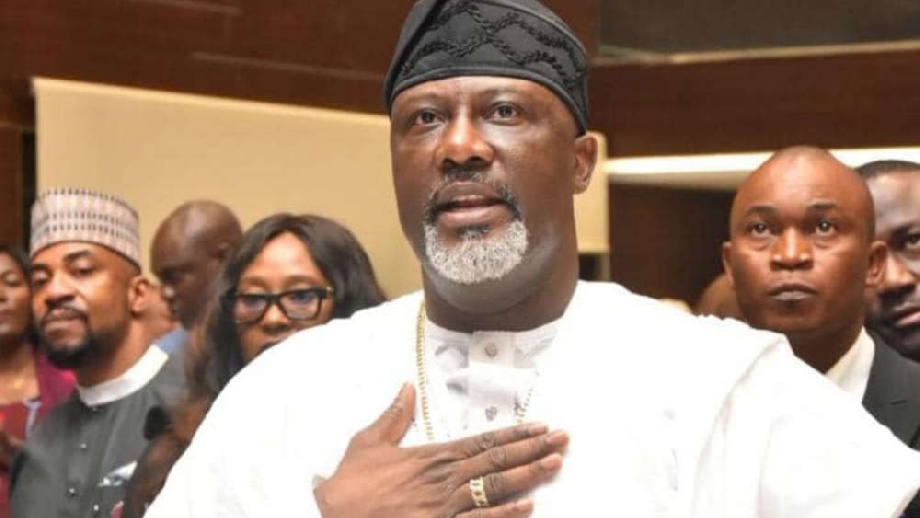
A chieftain of the African Democratic Congress and former senator representing Kogi West, Dino Melaye, has described Peter Obi as an admirable Nigerian with impressive personal qualities, but argued that he is not presently suited to occupy the office of the President of Nigeria.
Melaye made the remarks during an interview on Channels Television on Thursday, where he spoke about the evolving political landscape ahead of the 2027 general elections and the possible contenders for the nation’s highest political office.
His comments have since generated discussion within political circles, particularly among supporters of Obi and observers closely monitoring early political alignments ahead of the next presidential race.
During the television interview, Melaye acknowledged that Obi is widely respected for his personal character and contributions to public discourse in Nigeria.
He said the former governor possesses admirable qualities and has built a reputation as a disciplined and principled political figure.
“But let me even tell you, Peter Obi is a fantastic Nigerian,” Melaye said. “I have tremendous respect for him, and I have said it before—he is a fantastic person.”
Melaye stressed that his comments should not be interpreted as a personal attack on Obi but rather as an assessment of the political realities surrounding Nigeria’s leadership needs at the present moment.
According to him, admiration for an individual’s personality or political style does not necessarily translate into suitability for the presidency.
While acknowledging Obi’s strengths, Melaye argued that the former presidential candidate currently lacks the broad national appeal required to unite Nigeria’s diverse population.
Nigeria, Africa’s most populous country, is home to hundreds of ethnic groups and multiple religious communities, making national cohesion a major challenge for any leader.
Melaye suggested that the next president must possess the political reach and experience necessary to build bridges across the country’s many regional and cultural divides.
According to him, leadership at the federal level requires more than administrative competence; it demands a unique ability to manage complex political dynamics and bring together people with differing interests and backgrounds.
In his view, Obi has not yet demonstrated the level of national consensus-building required to effectively govern the country.
Despite his reservations about Obi’s readiness, Melaye reiterated that he holds the former governor in high regard.
He emphasised that his position was not intended to diminish Obi’s contributions to Nigeria’s political space but to highlight what he sees as the timing factor in leadership.
“This is not his time to be president,” Melaye said.
The former senator suggested that political leadership often depends on timing and circumstance, and that even capable individuals may have to wait for the right moment to assume higher responsibilities.
He did not rule out the possibility that Obi could become president in the future but maintained that the current political environment requires a different type of leadership.
Peter Obi has emerged as one of Nigeria’s most influential political figures in recent years.
The former governor of Anambra State gained national prominence during the 2023 presidential election, when he ran under the platform of the Labour Party.
His candidacy attracted strong support, particularly among young voters and urban professionals who were drawn to his campaign’s emphasis on accountability, fiscal prudence, and economic reform.
Obi’s supporters, often referred to as the “Obidient” movement, mobilised extensively both online and offline, making his campaign one of the most vibrant grassroots political movements in Nigeria’s recent history.
Although he did not win the election, his performance significantly reshaped the political landscape by demonstrating that a candidate outside the traditional two-party structure could command nationwide attention.
Since the conclusion of the 2023 elections, Obi has repeatedly signalled his intention to remain active in national politics.
He has consistently indicated that he plans to contest the presidency again in the 2027 general elections.
Supporters believe that his growing popularity and expanding political network could position him as a formidable contender in the next electoral cycle.
Political analysts have also noted that Obi’s ability to sustain a loyal base of supporters may influence future alliances and coalition-building efforts among opposition parties.
However, critics—including Melaye—have raised questions about whether his support base can be effectively translated into a nationwide political structure capable of winning a presidential election.
Dino Melaye remains a prominent and outspoken figure in Nigeria’s political arena.
A former member of the Peoples Democratic Party, Melaye represented Kogi West in the Senate from 2015 to 2023 and became widely known for his vocal participation in national political debates.
In recent years, he has aligned himself with the African Democratic Congress, where he is considered one of the party’s visible figures.
Melaye’s comments on Obi are part of a broader conversation among Nigerian politicians about the direction of the country’s leadership and the qualities required in the next president.
Although the next presidential election is still some time away, discussions about potential candidates and political alignments have already begun to intensify.
Political parties and influential figures are gradually positioning themselves in anticipation of what many analysts expect to be a highly competitive race.
Observers say that debates such as the one sparked by Melaye’s remarks reflect the early stages of strategic political messaging.
For many politicians, public commentary on potential contenders is a way of shaping the narrative and influencing public perception long before formal campaigns begin.
Melaye’s remarks have generated mixed reactions among Nigerians.
Supporters of Obi argue that his record as governor and his strong showing in the 2023 election demonstrate his readiness to lead the country.
They also point to his reputation for prudent financial management and transparency as evidence that he possesses the qualities needed to steer Nigeria through its economic challenges.
Critics, however, maintain that the presidency requires a broader coalition of political forces and deeper national reach than Obi has so far demonstrated.
Some analysts say the debate ultimately highlights a central question facing Nigeria’s opposition politics: whether emerging political movements can translate popular enthusiasm into durable national power.
As Nigeria gradually moves toward another electoral cycle, discussions about leadership, governance, and political direction are expected to intensify.
The 2027 presidential race could feature a diverse field of candidates representing different ideological and regional interests.
For now, Melaye’s comments serve as an early signal of the debates likely to shape the political discourse in the years ahead.
While acknowledging Obi’s stature as a respected political figure, Melaye’s position underscores the continuing contest over who is best positioned to lead Africa’s largest democracy in the next phase of its development.