United States mining companies are preparing to invest heavily in Venezuela’s mineral sector as Washington intensifies efforts to secure access to critical resources in the South American nation.
The development was disclosed by U.S. Interior Secretary Doug Burgum during a visit to Caracas on Wednesday, where he held talks with Venezuela’s interim president, Delcy Rodríguez, and representatives of several American mining corporations.
Burgum said more than two dozen mining and mineral companies accompanied him on the trip and were eager to begin operations in Venezuela, bringing with them billions of dollars in potential investment and thousands of high-paying jobs.
According to him, the companies are prepared to move quickly once regulatory barriers are reduced and the legal framework for foreign participation in the mining industry is clarified.
“They represent billions of dollars in investments and billions of dollars in well-paid jobs,” Burgum said after the meeting in Caracas, noting that American investors were eager to cut bureaucratic obstacles that could slow the flow of capital into Venezuela’s resource sector.
Burgum’s visit highlights the growing economic and political realignment between Washington and Caracas following dramatic changes in Venezuela’s leadership earlier this year.
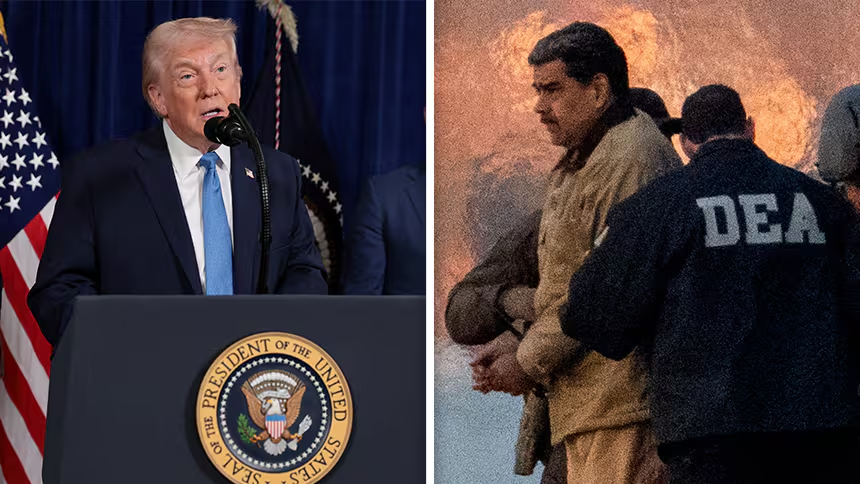
The administration of U.S. President Donald Trump has argued that its intervention in Venezuela opened the door to a new phase of cooperation between the two countries, particularly in energy and mineral development.
The visit also comes barely weeks after a U.S. military operation in January that resulted in the capture of former Venezuelan leader Nicolás Maduro, who was subsequently flown to New York to face trial on drug trafficking charges.
Following Maduro’s removal, Rodríguez—who previously served as vice president—was elevated to interim president under arrangements supported by Washington.
American officials say the new leadership has shown willingness to cooperate with U.S. policy goals, particularly by opening Venezuela’s resource industries to foreign investment.
Burgum, who also heads the Trump administration’s National Energy Dominance Council, described the possibilities for collaboration between the United States and Venezuela as virtually limitless.
“The opportunities for collaboration and synergy between our two countries have no limits,” he said while addressing business executives during the visit.
His trip follows a similar visit by U.S. Energy Secretary Chris Wright, who earlier travelled to Caracas to promote increased oil production and deeper energy cooperation between the two countries.
During that visit, Wright urged Venezuela to dramatically expand its oil output, arguing that the country’s vast petroleum reserves could play a major role in global energy markets.
Venezuela possesses the world’s largest proven oil reserves, and Washington has already begun encouraging American companies to return to the country’s energy sector after years of sanctions and diplomatic tensions.
However, Burgum’s visit signals that U.S. interest extends beyond oil to include the country’s extensive mineral deposits.
Apart from petroleum, Venezuela is believed to possess large reserves of gold, diamonds, bauxite and coltan—minerals considered critical for modern technologies such as smartphones, electric vehicles and advanced military systems.
Coltan, in particular, contains metals used in electronic devices including laptops, mobile phones and aerospace equipment, making it strategically valuable in global supply chains.
Much of Venezuela’s mining activity is concentrated in the Orinoco Mining Arc, a vast southeastern region rich in mineral resources.
Despite its potential wealth, the area has long been associated with illegal mining operations, environmental degradation and widespread deforestation.
Environmental groups have warned that uncontrolled mining in the region has polluted rivers and threatened indigenous communities living nearby.
In response to growing international interest in the sector, Rodríguez has indicated that her administration plans to introduce sweeping reforms to Venezuela’s mining laws.
The proposed changes are expected to modernize the legal framework governing mineral exploration and extraction while allowing greater participation by foreign investors.
Rodríguez’s brother, Jorge Rodríguez, confirmed earlier this week that lawmakers were preparing legislation that would allow large international companies to exploit mineral and rare earth deposits.
Although details of the reforms have yet to be released, officials say the goal is to attract foreign capital and advanced technology needed to develop the country’s vast natural resources.
The reforms would mirror similar steps already taken in Venezuela’s oil sector, where regulatory changes have opened the door to greater private investment.
Washington has strongly encouraged these economic reforms as part of its broader strategy to stabilize Venezuela and reduce global reliance on mineral supplies from rival powers such as China.
Analysts say the United States is increasingly focused on securing reliable sources of critical minerals used in advanced manufacturing, defence systems and renewable energy technologies.
Venezuela’s deposits of coltan, bauxite and other strategic minerals could therefore become an important component of U.S. supply chains in the coming years.
Meanwhile, diplomatic relations between the two countries appear to be improving rapidly after years of hostility.
In another sign of the warming ties, the U.S. Department of Transportation has authorised an American Airlines subsidiary, Envoy Air, to resume direct flights between Miami and the Venezuelan cities of Caracas and Maracaibo.
The flights will mark the first direct air connection between the two countries since 2019, when relations deteriorated sharply during Trump’s earlier presidency.
President Trump has also publicly praised Rodríguez for cooperating with U.S. officials and implementing reforms aimed at opening Venezuela’s economy.
In a post on his Truth Social platform, the American president said the interim leader was “doing a great job and working with U.S. representatives very well.”
While supporters of the new partnership say it could revive Venezuela’s struggling economy, critics warn that the rapid expansion of mining activity could intensify environmental damage and social tensions if not carefully managed.
For now, however, Washington appears determined to deepen its economic presence in Venezuela, with mining, oil and other resource sectors expected to form the backbone of a new era of cooperation between the two countries.