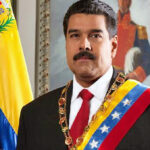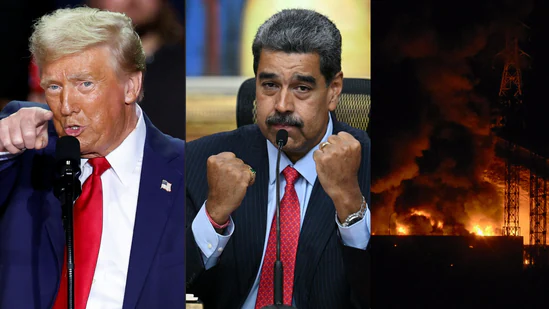
Washington — United States President Donald Trump has announced that U.S. forces carried out overnight strikes in Venezuela and captured the country’s long-serving President, Nicolás Maduro, in what would represent the most dramatic U.S. military intervention in Latin America in decades.
In a statement posted early Saturday on his Truth Social platform, Trump said the operation resulted in the arrest of Maduro and his removal from Venezuela. According to the U.S. president, the action followed months of escalating pressure on the Venezuelan leader over allegations of drug trafficking, election fraud, and the illegitimacy of his continued hold on power.
“The United States of America has successfully carried out a large-scale strike against Venezuela and its leader, President Nicolás Maduro, who has been, along with his wife, captured and flown out of the country,” Trump wrote.
Related posts:
- “Christianity faces an existential threat in Nigeria” – President Trump vows to protect Christians globally
- President Trump orders Pentagon to prepare for possible military action in Nigeria over Christian genocide
- President Donald Trump declares Nigeria a “Country of Particular Concern,” cites mass killings of Christians
- Confront Trump or Cut Diplomatic Ties with the US – Sheikh Gumi Tells President Tinubu
If confirmed, the operation would mark Washington’s most direct military action in Latin America since the 1989 invasion of Panama, when U.S. forces deposed military ruler Manuel Noriega on drug trafficking charges. That intervention remains a deeply contentious chapter in regional history and continues to shape attitudes toward U.S. involvement in the internal affairs of Latin American states.
Trump said the operation was conducted “in conjunction with U.S. law enforcement” agencies and promised to provide further details at a press conference scheduled for later on Saturday at his Mar-a-Lago resort in Florida. A U.S. official, speaking on condition of anonymity, told Reuters that Maduro was apprehended by elite U.S. special forces during the operation.
The U.S. government has long accused Maduro of transforming Venezuela into a “narco-state,” alleging that senior officials are involved in international drug trafficking networks. Washington has also rejected the legitimacy of Venezuela’s 2024 presidential election, which the opposition claims it won by a wide margin but which Maduro declared himself the victor.
Maduro, who succeeded the late President Hugo Chávez in 2013, has consistently dismissed U.S. accusations, arguing that Washington’s actions are motivated by a desire to gain control of Venezuela’s vast oil reserves, the largest proven reserves in the world. He has portrayed U.S. sanctions and diplomatic pressure as part of a broader campaign of economic and political warfare against his government.
As of early Saturday, there was no immediate confirmation from Venezuelan authorities that Maduro had been captured or removed from the country. However, senior officials in Caracas responded with defiant rhetoric and calls for resistance.
Venezuela’s Defence Minister, Vladimir Padrino, condemned the reported U.S. action in a video broadcast on state television shortly after Trump’s announcement. Without directly addressing Maduro’s status, Padrino denounced the presence of foreign troops on Venezuelan soil.
“Free, independent and sovereign Venezuela rejects with all the strength of its libertarian history the presence of these foreign troops, which have only left behind death, pain and destruction,” Padrino said. “Today we clench our fist in defense of what is ours. Let us unite, for in the unity of the people we will find the strength to resist and to triumph.”
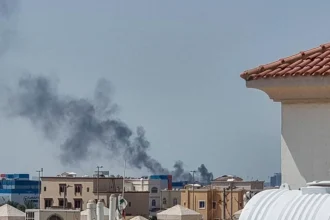
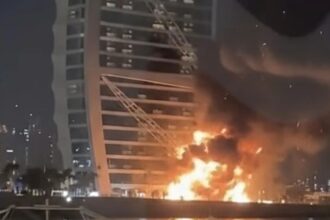
In the early hours of Saturday morning, explosions were reported in several parts of Venezuela, including the capital, Caracas. Witnesses told Reuters that loud blasts, military aircraft, and plumes of black smoke were visible across the city from around 2 a.m. local time for approximately 90 minutes. Images and videos circulating on social media appeared to show fires and damaged infrastructure in multiple locations.
Venezuela’s government said attacks occurred not only in Caracas but also in the states of Miranda, Aragua, and La Guaira. Authorities declared a national emergency and announced the mobilization of military units across the country. The extent of the damage and the number of casualties, if any, were not immediately clear.
The developments have sent shockwaves across Latin America and beyond, raising concerns about regional stability and the potential for escalation. While many governments in the region have been openly critical of Maduro and have questioned the legitimacy of his continued rule, direct U.S. military intervention is widely viewed with suspicion and opposition due to the region’s long history of foreign interference.
Analysts note that memories of past U.S. interventions — from Guatemala and Chile during the Cold War to Panama in 1989 — remain deeply ingrained in the political consciousness of Latin America. Even governments that oppose Maduro have traditionally favored diplomatic and multilateral approaches rather than unilateral military action.
The Venezuelan opposition, led by prominent figure María Corina Machado, who was recently awarded the Nobel Peace Prize, adopted a cautious stance in its initial response. In a brief statement posted on X, the opposition said it had no official comment on the reported events, reflecting the sensitivity and uncertainty surrounding the situation.
International reaction was still unfolding, with governments and multilateral organizations expected to issue statements as more details become available. The United Nations, the Organization of American States, and regional blocs such as CELAC and Mercosur are likely to face renewed pressure to respond to what could represent a major turning point in Venezuelan and hemispheric politics.
Within the United States, the reported operation is expected to provoke intense debate. Supporters of Trump’s hardline approach to Venezuela argue that years of sanctions and diplomacy failed to dislodge Maduro, while critics warn that military intervention risks civilian casualties, regional destabilization, and long-term blowback.
Legal experts have also raised questions about the international law implications of such an action, including issues of sovereignty and the use of force without explicit authorization from international bodies.
As of Saturday morning, key details remain unclear, including Maduro’s precise location, his legal status, and whether he faces immediate prosecution in the United States. Trump’s promised press conference is expected to shed further light on the scope of the operation, the justification for it, and Washington’s next steps.
For now, Venezuela remains on edge as the country grapples with uncertainty over its leadership and the prospect of further unrest. The coming days are likely to be critical in determining whether the reported capture of Maduro marks the end of his rule or the beginning of a new and volatile chapter in Venezuela’s long-running political crisis.