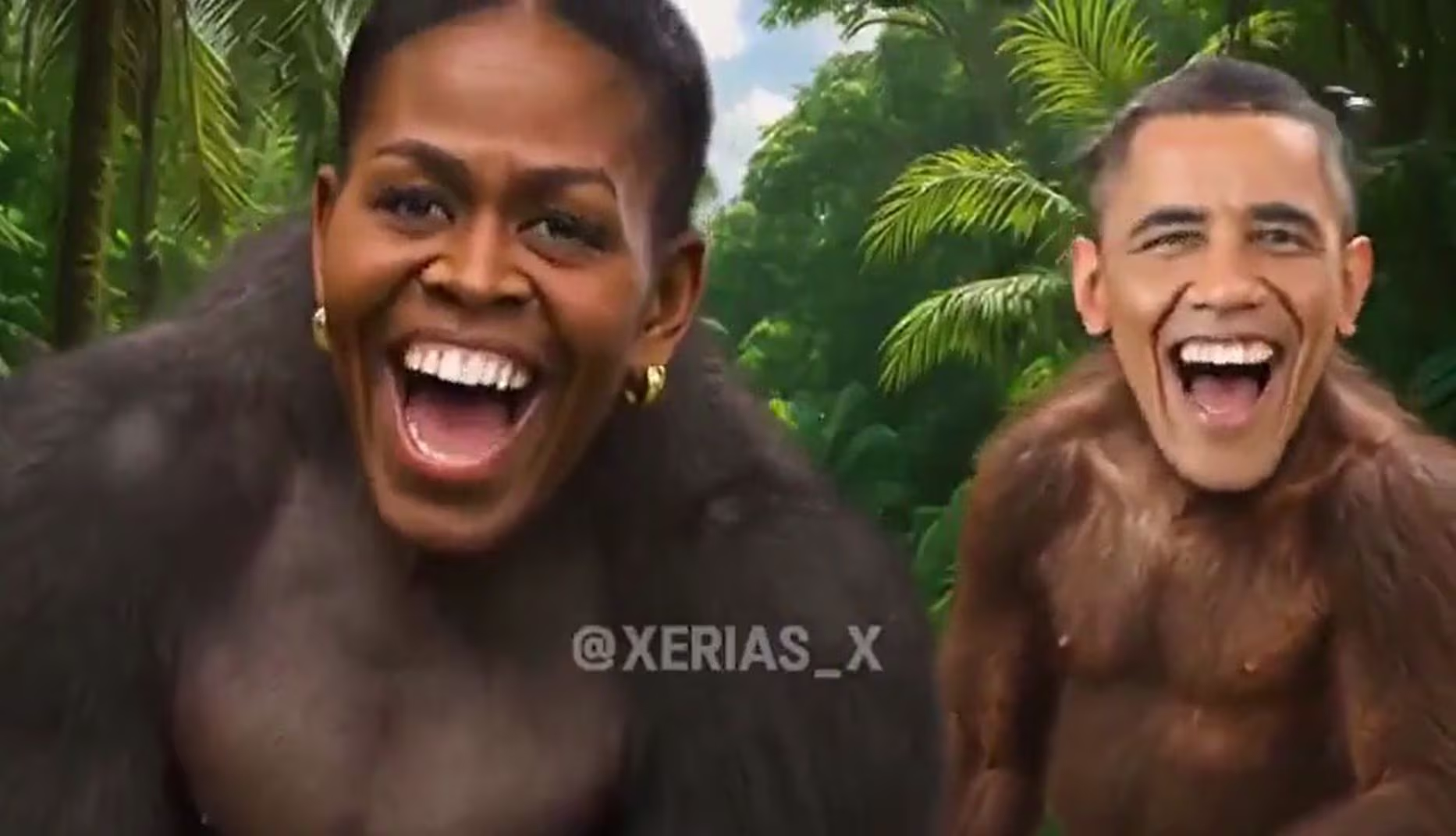
President Donald Trump on Friday removed a highly offensive and racist video from his Truth Social account after facing swift and intense backlash from across the U.S. political spectrum. The video, which depicted former President Barack Obama and former First Lady Michelle Obama as apes in a jungle setting, triggered outrage from Democrats and Republicans alike and forced the White House into rapid damage control.
The video was posted late Thursday night and remained online for nearly 12 hours before it was taken down. During that period, condemnation mounted steadily, with critics describing the content as dehumanising, racist, and unbecoming of a sitting president. The uproar quickly spilled onto mainstream media and social platforms, placing renewed scrutiny on Trump’s online behaviour and the tone of his political messaging.
By midday Friday, a White House official confirmed to CNN that the post had been removed and attributed the incident to an internal error. According to the official, a staff member had “erroneously made the post” without the president’s knowledge or approval.
“The president was not aware of that video, and was very let down by the staffer who put it out,” a White House adviser said, as senior aides worked to distance Trump from direct responsibility for the offensive content.
The explanation marked a sharp shift from the administration’s initial response. Earlier in the day, the White House had attempted to downplay the controversy, dismissing public anger as “fake outrage.” That stance quickly became untenable as condemnation continued to grow, particularly from within Trump’s own party.
One of the most prominent Republican voices to publicly criticise the post was Senator Tim Scott of South Carolina, the only Black Republican in the U.S. Senate and a close ally of Trump. Scott described the video as blatantly racist and urged its immediate removal.
“Praying it was fake because it’s the most racist thing I’ve seen out of this White House,” Scott wrote on X. “The President should remove it.”
According to Republican Senate officials, Scott’s remarks were part of a broader wave of private and public pressure from GOP lawmakers who contacted Trump directly to express concern. Those interventions reportedly played a key role in prompting the eventual deletion of the video.
The racist clip appeared as part of a wider late-night posting spree by Trump on Truth Social. During that period, the president shared multiple posts repeating his long-standing and unsubstantiated claims that the 2020 presidential election was rigged. One of the videos he circulated was a compilation that included an AI-altered segment showing the Obamas’ faces superimposed onto monkeys’ bodies, set to the song “The Lion Sleeps Tonight.”
Reports indicate that Trump shared the video twice before it was ultimately removed.
In addition to the racist clip, Trump also posted other unrelated and cryptic content during the same burst of activity. In one post, he shared a screenshot containing the message, “This can be a great option if things don’t work out,” accompanied by a video clip of martial arts icon Bruce Lee engaged in a fight scene. The meaning of the post was unclear, further fuelling speculation about the intent and oversight behind the late-night uploads.
The incident has reignited concerns about Trump’s use of social media, particularly his tendency to amplify inflammatory or misleading content. Critics argue that such behaviour contributes to political polarisation and undermines public trust in democratic institutions, while supporters often dismiss the controversies as media overreaction.
Beyond the immediate outrage over the racist video, the episode unfolded against the backdrop of renewed scrutiny over Trump’s recent remarks about the U.S. electoral system. Earlier in the week, the president suggested that Republicans should “take over” election administration in various locations, comments that alarmed election experts and civil rights advocates.
“The Republicans should say, ‘We want to take over,’” Trump said during a conservative podcast released on Monday.
In the same conversation with former deputy FBI director Dan Bongino, Trump went further, floating the idea that elections should be “nationalised,” a proposal that would represent a dramatic shift in how voting is administered in the United States. Under the U.S. Constitution, elections are largely managed by states, not the federal government.
Trump’s comments sparked widespread concern about his commitment to established democratic norms. Voting rights groups warned that federal “takeover” rhetoric could be interpreted as an attempt to centralise power and weaken local electoral safeguards.
Facing mounting criticism, Trump sought to walk back his remarks during an interview with NBC News correspondent Tom Llamas on Wednesday. In that interview, he denied advocating for nationalisation of elections.
“I didn’t say nationalise,” Trump claimed, despite recordings of his comments being widely circulated.
The White House also attempted to soften the impact of the president’s statements. On Tuesday, press secretary Karoline Leavitt said Trump remains committed to the U.S. Constitution, even as he continues to question the integrity of past elections.
She reiterated Trump’s belief that previous elections were marred by “fraud and irregularities,” claims that have been repeatedly rejected by courts, state officials, and independent audits.
The controversy surrounding the racist video has added to a growing list of incidents that have kept Trump’s rhetoric and online conduct under intense scrutiny. Critics argue that such episodes reveal a pattern of inflammatory messaging, while the administration maintains that errors by staff or misinterpretations by critics are often to blame.
For many observers, the bipartisan backlash to the video was notable, signalling limits to how far controversial content can be tolerated even within Trump’s own party. Senator Scott’s intervention, in particular, underscored the sensitivity of racial issues and the political costs of appearing to endorse or tolerate racist imagery.
As Trump continues to campaign and comment aggressively on elections, governance, and political opponents, analysts say similar controversies are likely to recur unless tighter controls are placed on his social media activity.
Whether the White House’s explanation of a staff error will satisfy critics remains uncertain. What is clear, however, is that the episode has once again thrust Trump’s digital footprint, racial rhetoric, and approach to democratic institutions into the centre of national debate.