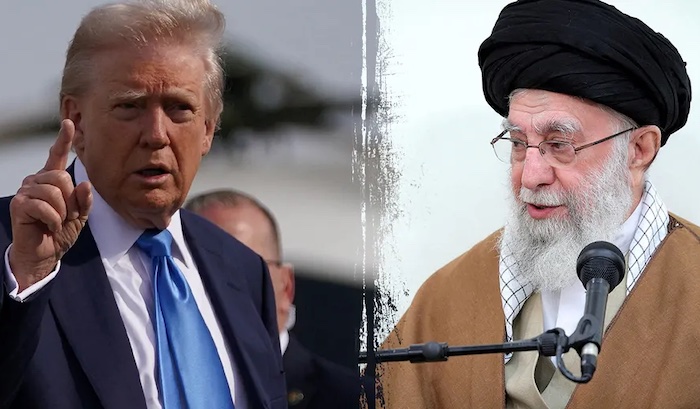
United States President Donald Trump confirmed on Saturday that Iran’s Supreme Leader, Ali Khamenei, along with approximately 40 senior military and civilian officials, was killed during coordinated airstrikes carried out by the United States and Israel.
The announcement marked a dramatic escalation in an already volatile regional confrontation and signaled a potential turning point in Iran’s political trajectory. According to Trump, the operation targeted key leadership figures across Iran’s military, intelligence, and strategic command structures, delivering what he described as a decisive blow to the Islamic Republic’s governing apparatus.
In a statement posted on his Truth Social platform, Trump declared that Khamenei had been killed in precision strikes enabled by advanced intelligence and surveillance systems operating in coordination with Israel. He characterized the Iranian leader as responsible for decades of regional instability and violence, framing the operation as both retribution and strategic necessity.
The President further claimed that members of Iran’s Islamic Revolutionary Guard Corps (IRGC) were now seeking immunity from the United States amid the collapse of senior command structures. According to Trump, segments of Iran’s security apparatus were signaling reluctance to continue hostilities and exploring pathways to defection or negotiated guarantees.
He urged the Iranian public to “seize control of your destiny,” framing the moment as an opportunity for regime change and political transformation after more than four decades of clerical rule following the 1979 revolution.
Israeli Prime Minister Benjamin Netanyahu also announced that Israel’s opening wave of strikes had effectively decimated Iran’s upper-tier defense and intelligence leadership. Israeli officials stated that seven senior defense and intelligence commanders were killed, with approximately 30 top military and civilian leaders targeted overall.
Netanyahu described the strike on Khamenei’s compound in Tehran as a powerful surprise attack and asserted there were strong indications that the Iranian leader had not survived. He publicly called on Iranian citizens to mobilize against the ruling regime, urging mass demonstrations to accelerate internal political change.
Among those reported killed were Khamenei’s top security adviser Ali Shamkhani, IRGC Commander Mohammad Pakpour, Defence Minister Aziz Nasirzadeh, Chief Military Secretary Mohammad Shirazi, and Head of Military Intelligence Saleh Asadi.
In addition, Israeli sources stated that Hossein Jabal Amelian, chairman of Iran’s nuclear weapons research organization SPND, and former SPND head Reza Mozaffari-Nia were eliminated in the strikes.
One senior figure reportedly surviving the assault is Ali Larijani, Secretary of Iran’s Supreme National Security Council and a longtime confidant of Khamenei.
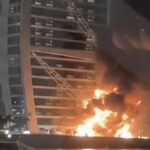
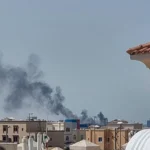
In response, Iran launched retaliatory attacks targeting US military bases and allied states across the Middle East. Missile and drone strikes were reported in Saudi Arabia, Jordan, Qatar, the United Arab Emirates, Kuwait, Bahrain, and Syria, among others.
The United States maintains approximately 13 military bases across the region, typically hosting between 30,000 and 40,000 troops. These installations became immediate focal points of Iranian retaliation.
Iranian officials described the strikes as a legitimate response to what they termed aggression against sovereign territory. The IRGC framed US military assets and affiliated infrastructure as lawful targets.
The rapid escalation forced widespread airspace closures across the Middle East. According to Reuters, at least eight countries — including Iran, Israel, Iraq, Jordan, Qatar, Bahrain, Kuwait, and the UAE — suspended civilian flights. Syria closed part of its southern airspace along its border with Israel for 12 hours.
The disruptions reverberated across global aviation networks, grounding flights and forcing rerouting across Europe and Asia. Markets braced for volatility, particularly in energy trading.
Oil prices were expected to surge when trading resumed, as Tehran has repeatedly threatened to blockade the Strait of Hormuz, a strategic maritime corridor through which a substantial portion of global oil shipments transit. Any disruption to traffic through the strait could have immediate and severe consequences for global energy supply chains.
Energy analysts warned that even the perception of potential closure could drive speculative price spikes, compounding economic uncertainty already heightened by geopolitical instability.
Reports indicated that more than 250 people were killed across Iran during the strikes, though independent verification remained limited. An Iranian official alleged that 85 fatalities occurred after a strike hit a girls’ school, though details surrounding that claim were still emerging.
Tehran called for an emergency meeting of the United Nations nuclear watchdog, while European Union foreign ministers scheduled extraordinary consultations to assess diplomatic and security implications.
Trump and Netanyahu both framed the operation as an opportunity for systemic change within Iran. Trump stated that segments of Iran’s military and security establishment were already signaling openness to immunity arrangements. He suggested that elements of the IRGC and police forces might merge with what he described as Iranian patriots to stabilize the country.
The President added that bombing operations would continue throughout the week “or as long as necessary” to secure regional peace objectives.
However, analysts caution that leadership decapitation does not automatically guarantee regime collapse. Iran’s constitutional mechanisms provide for succession procedures, and entrenched institutions such as the IRGC maintain significant operational autonomy.
The assassination of a sitting Supreme Leader represents an extraordinary geopolitical event with far-reaching consequences. The immediate effects include heightened military exchanges, disrupted commerce, volatile energy markets, and deep uncertainty over Iran’s internal stability.
Whether the strikes precipitate regime change, prolonged conflict, or rapid escalation remains unclear. What is certain is that the balance of power across the Middle East has shifted dramatically within the span of a single day, and the international community now faces one of the most consequential crises in recent regional history.