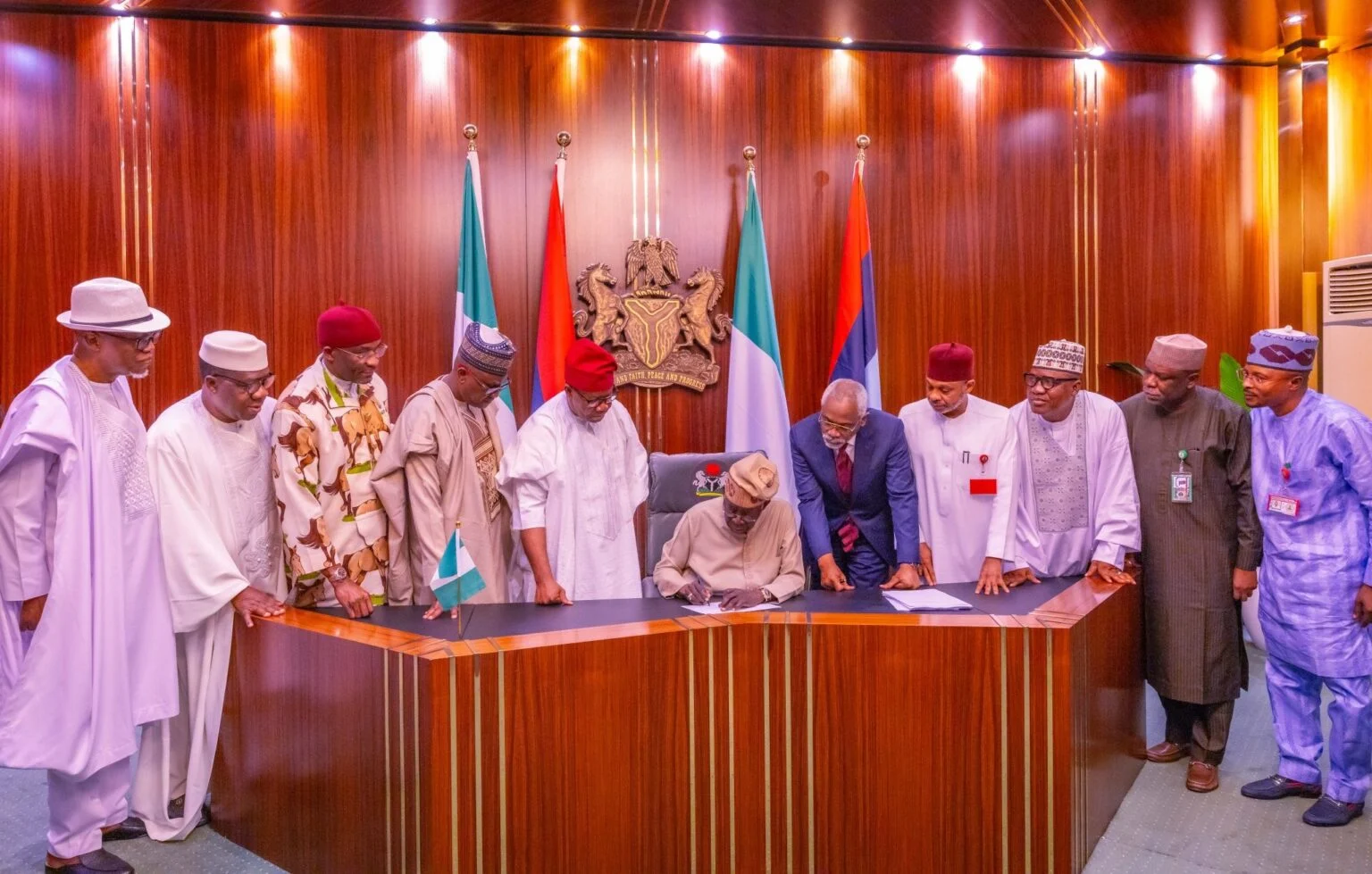
President Bola Ahmed Tinubu on Wednesday signed into law the highly debated Electoral Act, 2022 (Repeal and Re-Enactment) Bill 2026, marking the culmination of months of intense legislative scrutiny, political disagreements, and public protests. The signing came just a day after the National Assembly passed the bill following dramatic sessions in both chambers that exposed deep divisions over the future of Nigeria’s electoral process—particularly the issue of electronic transmission of election results.
The bill’s passage has generated widespread controversy across the country, with critics arguing that certain provisions could weaken electoral transparency. Protests were staged in Abuja prior to the president’s assent, as civil society groups and opposition figures voiced concerns over amendments they believe may create loopholes in the conduct of elections.
At the heart of the controversy lies Clause 60 of the bill, which addresses the transmission of election results. The provision became a flashpoint during Senate deliberations on Tuesday, triggering heated exchanges and procedural disputes that nearly derailed proceedings.
Tensions escalated when Senator Enyinnaya Abaribe demanded a formal division on Clause 60, a move that required senators to physically indicate their support or opposition. His demand followed hours of debate and exposed sharp disagreements within the chamber over whether election results should be transmitted exclusively through electronic means or whether manual alternatives should remain permissible in cases of technological failure.
Senate President Godswill Akpabio initially suggested that the request for a division had been withdrawn earlier in the session. However, opposition senators vehemently disagreed, insisting that the matter remained unresolved and required a formal vote. The disagreement intensified, contributing to a chaotic atmosphere on the Senate floor.
Deputy Senate President Barau Jibrin attempted to restore order by citing procedural rules, arguing that revisiting a clause already ruled upon would violate the Senate’s standing orders. Instead of calming tensions, his intervention further inflamed the chamber. At one point, Senator Sunday Karimi was reportedly seen confronting Abaribe during the uproar, highlighting the emotional intensity surrounding the debate.
Amid the disorder, Senate Leader Opeyemi Bamidele clarified that he had earlier sponsored a motion to rescind the bill’s passage, effectively nullifying prior decisions taken on the legislation. According to him, this meant that Abaribe’s demand for a division was procedurally valid, since the Senate had reopened deliberations on the bill.
Akpabio later suggested that Abaribe’s insistence on a recorded vote was intended to publicly demonstrate his stance on electronic transmission of results. Nonetheless, he allowed the process to proceed. Rising under the appropriate procedural order, Abaribe specifically called for a division on Clause 60(3), objecting to the provision permitting reliance on Form EC8A—the manually completed polling unit result sheet—if electronic transmission fails.
Abaribe argued that allowing manual transmission in the event of network disruption could create opportunities for manipulation, thereby undermining electoral transparency. He proposed that the clause be removed entirely to ensure that electronic transmission remains mandatory and exclusive.
When the vote was eventually conducted, 15 opposition senators stood against retaining the provision, while 55 senators voted in favor of keeping it. The outcome ensured that the controversial clause remained part of the re-enacted law.
Earlier in the day, Senate proceedings had been temporarily stalled as lawmakers undertook clause-by-clause reconsideration of the bill following the motion to rescind its earlier amendment. The Senate dissolved into the Committee of the Whole to carefully re-examine the legislation.
Before rescinding its previous passage of the bill, senators raised concerns regarding the timing of the 2027 general elections and certain technical inconsistencies within the proposed law. Bamidele explained that the motion to revisit the bill was partly informed by the Independent National Electoral Commission’s announcement that the next general elections would be held in February 2027.
He noted that this proposed date might conflict with Clause 28 of the bill, which mandates that elections be conducted at least 360 days before the expiration of the current tenure. Additionally, he warned that holding elections during the Ramadan period could negatively impact voter turnout, logistics, and overall inclusiveness.
The Senate also identified discrepancies between the bill’s Long Title and numerous clauses, including Clauses 6, 9, 10, 22, 23, 28, 29, 32, 42, 47, 51, 60, 62, 64, 65, 73, 77, 86, 87, 89, 93, and 143. These inconsistencies contributed to the decision to reconsider and re-enact the legislation before final passage.
Meanwhile, drama unfolded in the House of Representatives, where opposition lawmakers staged a dramatic walkout over similar concerns about Clause 60(3). The turmoil began after Francis Waive, Chairman of the House Committee on Rules and Business, moved a motion to reverse the chamber’s earlier approval of the bill, which had initially been passed in December 2025.
Waive’s motion was widely perceived as an attempt to weaken the provision mandating compulsory electronic transmission of results from polling units to collation centers. When Speaker Tajudeen Abbas put the motion to a voice vote, chaos erupted.
Although loud objections were raised, the Speaker ruled that the “ayes” had prevailed. Opposition members disputed this conclusion, claiming that the “nays” were louder and accusing the leadership of bias and procedural impropriety. The disagreement quickly escalated, prompting protests and heated exchanges on the floor.
In an effort to defuse tensions, Abbas called for an executive session behind closed doors. However, the private meeting failed to restore calm. Upon returning to plenary, lawmakers resumed their protests, and the session descended into disorder.
Several members physically blocked Deputy Speaker Benjamin Kalu from continuing the proceedings, reflecting the depth of frustration among aggrieved legislators. As tensions mounted, opposition lawmakers staged a mass walkout, leaving the chamber nearly empty.
The controversy surrounding the bill underscores broader anxieties about Nigeria’s electoral system and the credibility of future elections. Advocates of mandatory electronic transmission argue that it reduces the risk of result manipulation, enhances transparency, and strengthens public trust in democratic institutions. Critics of rigid electronic requirements, however, contend that network limitations in certain areas necessitate fallback options to ensure that elections are not disrupted by technological failures.
President Tinubu’s decision to sign the bill into law now shifts attention to its implementation. While supporters view the re-enacted legislation as a necessary update to address emerging electoral challenges, opponents remain skeptical about its potential implications.
As Nigeria prepares for the 2027 general elections, the events surrounding the passage of the Electoral Act 2026 highlight the fragile balance between procedural order, political rivalry, and democratic accountability. The heated debates in both chambers reveal not only disagreements over specific clauses but also deeper questions about trust, transparency, and the future direction of the nation’s electoral framework.
With the law now in effect, stakeholders across the political spectrum will be closely watching how its provisions shape the conduct of upcoming elections—and whether it ultimately strengthens or undermines Nigeria’s democratic process.