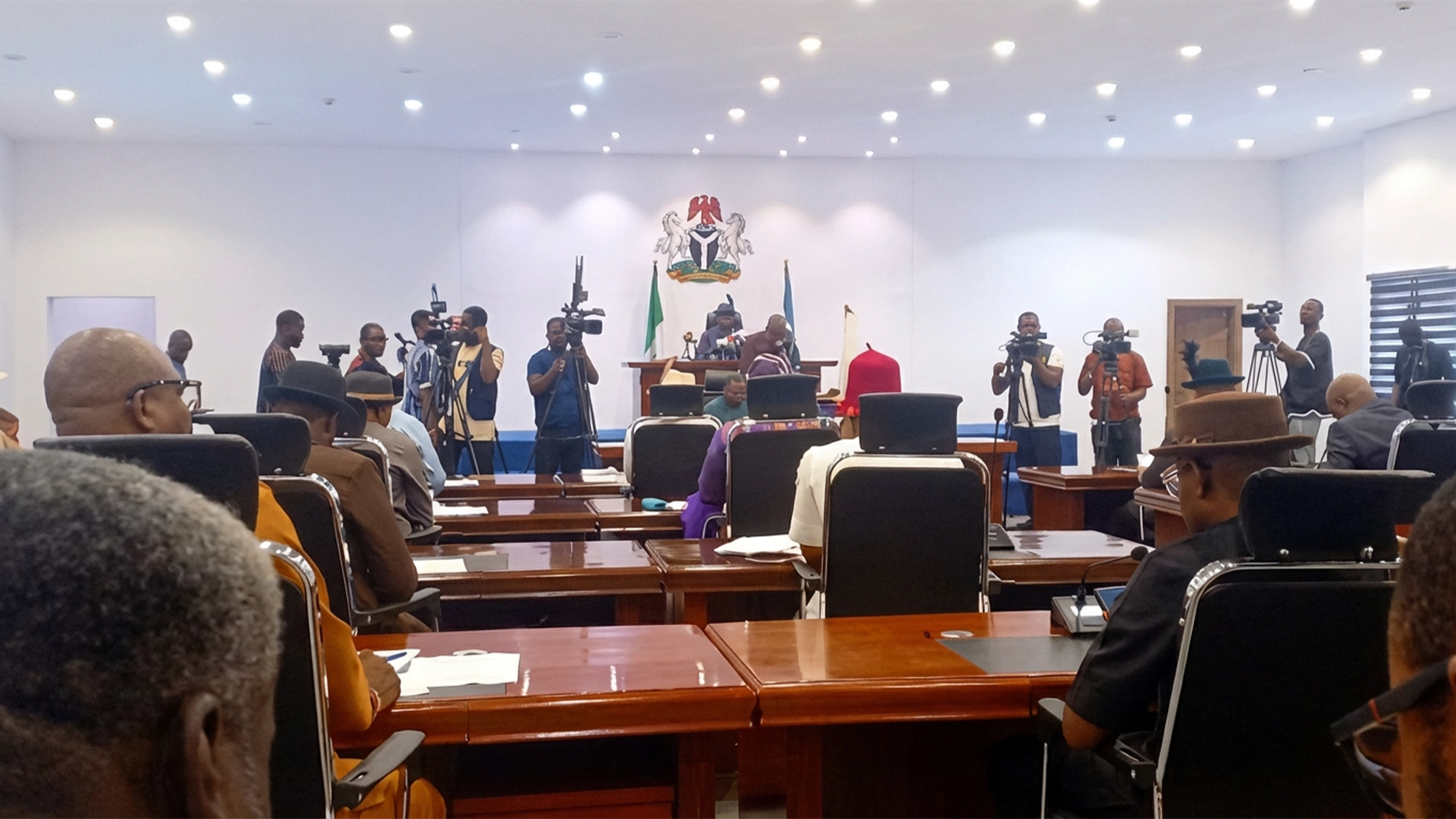
The Rivers State House of Assembly has formally suspended impeachment proceedings against Governor Siminalayi Fubara and his deputy, Ngozi Odu, marking a significant pause in a political confrontation that has gripped the oil-rich state since the beginning of 2026.
The decision was announced on Thursday during plenary at the Assembly’s resumed sitting in Port Harcourt. Lawmakers confirmed that the move followed intervention by President Bola Tinubu earlier this month, a development widely seen as instrumental in de-escalating tensions between the executive and legislative arms of the state government.
Origins of the Impeachment Process
The impeachment initiative was first triggered at the Assembly’s inaugural sitting of 2026. During that session, presided over by the Speaker, the Majority Leader, Major Jack, formally presented a notice of allegations outlining claims of gross misconduct against the governor and his deputy.
Among the allegations cited were the demolition of the State House of Assembly complex, alleged extra-budgetary expenditure, withholding of funds designated for the Assembly Service Commission, and purported refusal to comply with a Supreme Court ruling regarding the financial autonomy of the legislature. Lawmakers framed the action within the ambit of Section 188 of the 1999 Constitution (as amended), which provides the procedural framework for impeachment of a state governor or deputy governor.
Section 188 outlines a multi-stage process requiring the issuance of a notice signed by at least one-third of members, followed by the constitution of an investigative panel by the Chief Judge of the state. If the panel finds the allegations substantiated, the House may proceed to adopt its findings and potentially remove the officeholder with a two-thirds majority vote.
In line with this constitutional provision, the Assembly transmitted a letter dated January 16, 2026, to the Chief Judge of Rivers State, Justice Simeon Amadi, requesting the constitution of a seven-member investigative panel to examine the allegations.
Judicial Roadblock
However, the impeachment process encountered immediate judicial resistance. Governor Fubara and Deputy Governor Odu each approached the High Court in Port Harcourt, challenging the legality and procedural validity of the impeachment proceedings.
The High Court subsequently issued restraining orders preventing the Chief Judge from acting on the Assembly’s request or constituting an investigative panel pending the determination of the substantive suit. This legal development effectively stalled the impeachment machinery.
Justice Amadi, responding formally to the Assembly, declined to set up the panel. He cited the subsisting High Court order and emphasized that the matter had become sub judice. In his communication, he noted that the Speaker and the Assembly had already filed an appeal against the restraining order, but until the appellate court resolved the matter, no further action could be taken to constitute the investigative panel.
The doctrine of sub judice, which bars parallel actions on matters actively under judicial consideration, thereby introduced a constitutional and procedural impasse between the legislative and judicial arms of government in Rivers State.
Political Context and Escalation
The impeachment initiative did not arise in isolation. It followed a highly publicized political dispute that intensified after the Minister of the Federal Capital Territory, Nyesom Wike, accused Governor Fubara of failing to adhere to a peace accord brokered by President Bola Tinubu in 2025.
The underlying rift has been widely interpreted as a power struggle within the state’s political establishment. Observers have pointed to tensions over governance control, fiscal administration, and institutional authority as key drivers of the conflict.
The demolition of the Assembly complex—one of the central allegations—became symbolic of the broader confrontation between the executive and legislative branches. The governor’s camp has maintained that administrative decisions were taken within the bounds of executive authority, while lawmakers have framed the actions as deliberate attempts to undermine legislative independence.
Presidential Intervention
Amid rising tensions and mounting legal complexities, President Bola Tinubu intervened earlier this month. Though details of the discussions have not been fully disclosed, Assembly sources confirmed that the President’s involvement was decisive in persuading parties to suspend further escalation.
The federal intervention appears aimed at preserving institutional stability and preventing a protracted constitutional crisis in one of Nigeria’s most economically strategic states. Rivers State plays a central role in national oil production and revenue generation, making political stability in the state a matter of broader national interest.
The Assembly’s decision to suspend impeachment proceedings reflects what insiders describe as a pragmatic recalibration rather than a withdrawal of allegations. By pausing the process, lawmakers have allowed ongoing judicial proceedings to unfold without the added volatility of parallel legislative action.
Constitutional and Governance Implications
The episode underscores the intricate interplay between constitutional law, political negotiation, and institutional power in Nigeria’s federal system. While Section 188 provides a legal mechanism for impeachment, its application is frequently shaped by judicial interpretation and political context.
The High Court injunction highlights the judiciary’s critical role as arbiter in impeachment disputes. Courts have historically intervened where procedural irregularities or constitutional ambiguities arise, reinforcing checks and balances within the system.
At the same time, the President’s mediation illustrates the informal yet influential role of federal leadership in managing intra-party and inter-branch conflicts at the state level.
Path Forward
With impeachment proceedings now suspended, attention shifts to the appellate process and broader reconciliation efforts. The appeal filed by the Assembly against the High Court’s restraining order remains pending, and its outcome could shape the legal trajectory of the dispute.
Political analysts suggest that sustained dialogue between the executive and legislature will be essential to restore functional governance. Institutional cooperation is particularly critical in the areas of budget implementation, fiscal transparency, and compliance with judicial directives—issues that featured prominently in the original notice of allegations.
For now, the suspension offers breathing space in a confrontation that had threatened to deepen divisions within the state’s political landscape. Whether the pause evolves into durable reconciliation or merely postpones further confrontation will depend on legal outcomes, political negotiations, and the willingness of key actors to prioritise governance stability.
The Rivers State House of Assembly’s decision thus marks a pivotal moment in an unfolding political drama—one shaped by constitutional provisions, judicial oversight, and presidential diplomacy.